What's inside
As an Amazon Associate I earn from qualifying purchases. This post may contain affiliate links at no extra cost to you.
For a painted interior window frame, choose wood that stays reasonably straight, has a smooth face, and is easy to fill and sand. Poplar is a practical choice for most dry rooms. Finger-jointed pine can cost less and works well when the frame will be fully painted. Clear pine is easy to find but may have knots and resin pockets that need extra preparation. If the window is in a bathroom or another damp area, moisture control matters more than choosing a supposedly moisture-proof species.
As an Amazon Associate we earn from qualifying purchases at no extra cost to you.

Our Top Picks
 Zinsser Bulls Eye Water-Base Primer & Sealer32 Fl Oz (Pack of 1)4.25 x 4.25 x 4.85 inches0 PoundsCheck on Amazon

What matters in a painted frame
Paint hides color and grain, but it does not hide every defect. Raised grain, dents, open joints, and poorly filled nail holes can still show through a satin or semi-gloss finish. Look for straight stock with flat, smooth faces and minimal knots. Check the full length: a board that bows or twists is harder to fit tightly against the wall and window jamb.
Also consider the trim profile and how much material you need to machine or cut. A stable, predictable board is useful for narrow casing and mitred corners, where small movement can open a visible gap. No wood species prevents seasonal movement entirely; keeping indoor humidity reasonably steady and sealing all faces helps reduce surprises.
Wood options compared
| Material | Best for | Advantages | Trade-offs |
|---|---|---|---|
| Poplar | Smooth, painted trim in dry rooms | Usually consistent, machines cleanly, takes primer and paint well | Costs more than basic pine; dents more easily than some harder woods |
| Finger-jointed pine | Budget-conscious painted casing | Often sold in long, straight lengths; knots are removed or joined out | Finger joints can show through if not primed and filled carefully |
| Clear pine | Small projects or trim where a natural look may matter later | Widely available and easy to cut | Knots and resin can bleed through paint; quality varies |
| MDF | Simple profiles in dry interiors | Very smooth face, no wood grain or knots, often economical | Edges absorb paint, swells if wet, and creates fine dust when cut |
When to choose poplar or pine
Poplar is a good default if you want a clean painted finish and can find straight stock at a sensible price. It is not necessary to buy it for every window, though. Finger-jointed pine is a reasonable lower-cost choice for ordinary casing, especially when the pieces are long and straight and the joints are sound. Inspect the joints for gaps, loose sections, or uneven surfaces before buying.
Clear pine is fine when the trim is inexpensive, the profile is simple, or you are prepared to prime knots with a stain-blocking primer. A regular wall primer may not stop resin or tannin stains from appearing later. If the board has conspicuous knots or resin pockets, it can take more work to get a uniform finish than the initial price savings justify.
MDF can be a good paint-grade option for dry rooms, but treat cut edges differently from the smooth face. They soak up primer and can remain fuzzy or rough unless sealed and sanded. Keep MDF away from persistent condensation or leaks: swelling at an exposed edge may not return to its original shape after drying.
Buying and checking the stock
Match the wood to the casing dimensions and profile rather than buying the widest board available and assuming it will behave. For a typical interior casing, many projects use stock around 1/2 to 3/4 inch thick, but check the existing jamb depth and the desired reveal before ordering. Bring a short offcut or measure the opening carefully so you do not end up with a casing edge proud of the jamb.
Lay each board on a flat surface and sight along both edges. Reject pieces with a pronounced bow, twist, split end, or loose finger joint. A small crown may be manageable if it can be oriented toward the wall and held flat, but a twisted board will fight the fasteners and can leave gaps at the corners. Buy a little extra for test cuts and for replacing a piece with a bad mitre.
Preparation and paint steps
Let the trim acclimate indoors for a few days before cutting, particularly if it was stored outside or in an unheated shed. Cut and dry-fit the pieces first. Fasten the casing without crushing the wood; countersink finish nails slightly, then fill the holes with a paintable filler suitable for the wood and finish.
Sand the faces with 120- or 150-grit paper to remove mill marks, then finish with 180 grit. Sanding much finer can make some surfaces less receptive to primer. Ease sharp edges with a light pass of sandpaper so paint does not leave a thin, fragile film at the corners. Vacuum the dust and wipe the surface with a clean, dry cloth.
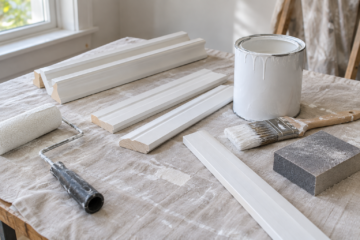
Use a primer intended for interior wood or trim. On knotty pine, resinous spots, or areas with stains, use a stain-blocking primer as directed; one coat may not be enough on stubborn knots. Prime end grain and MDF edges thoroughly, since they absorb more than the faces. After the primer dries, sand lightly with 180- or 220-grit paper, remove the dust, and apply two thin coats of trim paint rather than one heavy coat. Follow the product label for recoat times. Rushing between coats can leave soft paint that dents or sticks.
Useful materials to have on hand
For a typical project, look for poplar trim boards or finger-jointed pine casing, depending on budget and availability. A stain-blocking wood primer is useful for knots and discoloration; for clean poplar, a suitable general wood primer may be enough. Use a paintable filler for nail holes and a flexible paintable caulk for small gaps where casing meets the wall. Caulk is not a substitute for a tight mitre or a properly fitted joint.
Windows in damp rooms
In a bathroom, kitchen, or laundry room, first address condensation and ventilation. Paint and wood selection cannot compensate for repeated wetting. Seal cut ends and exposed edges, prime all sides where practical, and maintain the paint film. Poplar and pine can both work in a well-ventilated room, but neither should be left unsealed near a recurring leak. If water routinely reaches the trim, fix the source before installing new casing.
0 Comments