What's inside
As an Amazon Associate I earn from qualifying purchases. This post may contain affiliate links at no extra cost to you.
For a painted decorative ceiling beam, the best wood is usually straight, dry, and easy to machine—not the most expensive species. Paint hides color and grain, so paying extra for clear oak or walnut rarely improves the finished beam. In most rooms, finger-jointed pine, clear pine, poplar, or a well-sealed MDF beam will produce a better result than rough structural lumber.
As an Amazon Associate we earn from qualifying purchases at no extra cost to you.


Our Top Picks
 Ekena Millwork 3 1/2"W x 5 1/2"H x3.5-in. W x 5.5-in. H x 8-ft. L96 x 3.5 x 5.5 inchesCheck on Amazon
 Heritage Timber Salvaged Timber Faux Wood Beam5.5-in. W x 5.5-in. H x 6-ft. L72 x 5.5 x 5.5 inchesCheck on Amazon
 Ekena Millwork 5 1/2"W x 5 1/2"H x5.5-in. W x 5.5-in. H x 10-ft. L120 x 5.5 x 5.5 InchesCheck on Amazon
Best wood choices for a painted beam
Poplar is the safest all-around choice for a high-quality painted finish. It is relatively stable, machines cleanly, has few knots, and accepts primer well. Poplar can have green or purple streaks, but those disappear under an effective stain-blocking primer. It costs more than construction pine, but saves time on knot sealing and defect repair.
Clear pine is the better value when the beam is large or the budget is tight. Choose kiln-dried boards marked clear, select, or paint grade rather than ordinary framing lumber. Pine is easy to find and easy to sand, but resinous knots can bleed through paint. Every knot needs two coats of shellac-based or dedicated stain-blocking primer.
Finger-jointed pine is often an excellent compromise. The short sections are glued together into long, straight trim boards with few large knots. It paints well after filling the joint lines, although cheap products may show raised joints or open seams after installation. Inspect the board under bright light before buying.
Medium-density fiberboard (MDF) gives the smoothest painted surface for a hollow box beam or a beam made from flat panels. It has no knots or grain to telegraph through the paint. However, MDF is heavy, swells badly when exposed to water, and produces fine dust during cutting. Use moisture-resistant MDF where available, seal every cut edge, and do not use it in a damp room unless the design keeps it dry.
| Material | Painted finish | Stability | Best use | Main drawback |
|---|---|---|---|---|
| Poplar | Very good | Good | Premium painted trim and visible beams | Higher cost; occasional green or purple color |
| Clear pine | Good with preparation | Fair to good | Budget-friendly solid wood beams | Knots and resin can bleed |
| Finger-jointed pine | Good | Good | Long, straight painted boards | Joints may telegraph or open |
| MDF | Excellent when sealed | Very stable indoors | Hollow box beams and smooth panels | Heavy, dust-producing, moisture-sensitive |
| Construction lumber | Fair at best | Unpredictable | Hidden framing only | Warp, knots, checks, and rough surfaces |
Solid wood or hollow box beam?
A decorative beam does not normally need to be a solid timber. A three-sided box made from boards or MDF is lighter, straighter, and easier to attach over a ceiling. For example, three 1-by-8 boards can form a beam roughly 7 1/4 inches wide, depending on the joint and trim details. A hollow beam also lets you hide wiring or fit around minor ceiling irregularities.
Use solid wood when the beam is narrow, you want visible end grain, or the piece will take abuse. Use a box beam for long spans, wide profiles, and ceiling installations where weight matters. Do not treat a decorative box as structural without an engineer’s design; it is trim, not a replacement for a load-bearing member.
For a basic painted box beam, buy straight, kiln-dried boards from a trim or cabinet supplier. A low-cost paint-grade poplar boards option is often worth considering for a visible face. If using MDF, a moisture-resistant MDF board reduces, but does not eliminate, swelling risk.
What to avoid
Do not build the visible skin from wet, green, or freshly treated lumber. As it dries, it can shrink, twist, and open painted joints. Avoid boards with large loose knots, deep end checks, severe cup, or a moisture content noticeably different from the surrounding stock. Indoor trim should generally be near the home’s equilibrium moisture content; in many heated homes, 6% to 10% is a reasonable target.
Reclaimed barn wood can work, but it is a poor shortcut for a smooth painted beam. It may contain hidden nails, dirt, insect damage, oil, or salts that interfere with adhesion. Clean it, inspect it with a metal detector, let it acclimate indoors, and use a stain-blocking primer. Its irregular surface is worthwhile only if you want a distressed appearance.
Surface preparation before painting
Let new wood acclimate in the room for at least three to seven days, stacked with spacers so air can circulate. Sand solid wood with 120-grit paper, then finish with 150 or 180 grit. MDF faces usually need only light sanding with 180 grit; aggressive sanding can expose fuzzy fibers and create a visible patch.
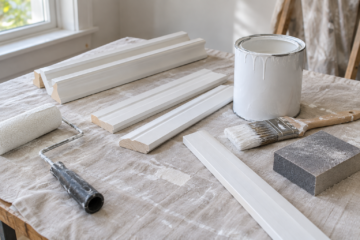
Fill nail holes, brad holes, and joints with a paintable wood filler. For seams that may move, use a high-quality paintable acrylic-latex caulk rather than rigid filler. Keep caulk lines narrow: a thick bead can shrink, crack, or remain visibly soft. Break sharp outside edges with a light sanding pass. A tiny roundover, about 1/16 inch, holds paint better than a razor edge.
Remove dust with a vacuum and a slightly damp lint-free cloth. Do not soak MDF edges. Seal exposed MDF edges with thinned water-based primer, sanding sealer, or a dedicated MDF primer, then sand lightly after it dries. The edge may need two or three coats because it absorbs much more than the face.
Primer and paint selection
Use a bonding or high-build acrylic primer for clean poplar and pine. For knots, sap, smoke stains, or questionable reclaimed wood, use a shellac-based stain-blocking primer on the affected areas or the entire beam. Water-based primer alone is the common failure point: resin can migrate through it and appear as yellow-brown spots weeks later.
After primer dries, sand raised grain with 220-grit paper and remove the dust. Two finish coats are normally better than one heavy coat. A durable satin or low-sheen trim paint hides minor surface defects while remaining washable. High-gloss paint highlights every dent and uneven joint, so use it only when the surface is exceptionally smooth.
A shellac-based stain-blocking primer is money well spent on knotty pine. For sanding and dust control, a fine-finish sanding sponge is useful around edges and assembled joints, where a power sander can remove too much material.
The practical buying decision
Choose poplar for a prominent beam where labor and a clean finish matter more than the lowest material price. Choose clear or finger-jointed pine when you want genuine wood at a lower cost and are willing to seal knots. Choose MDF for a smooth, stable box beam in a dry interior, especially when the beam will be painted white or another solid color. Ordinary construction lumber is acceptable for hidden cleats and blocking, but it is usually a false economy for the visible surface.
0 Comments