What's inside
As an Amazon Associate I earn from qualifying purchases. This post may contain affiliate links at no extra cost to you.
For a natural-finish coffee table, the best wood is not simply the hardest or most expensive species. It should look good under a clear finish, resist dents and spills, remain reasonably stable indoors, and be available in boards wide enough for the top. For most projects, white oak is the safest all-around choice. Walnut is the upgrade for a darker, more furniture-like appearance, while maple is a strong choice when you want a pale, clean surface.
As an Amazon Associate we earn from qualifying purchases at no extra cost to you.

Our Top Picks
 Varathane Water-Based Ultimate Satin PolyurethaneHalf Pint (Pack of 1)3 x 3 x 3 inches0.64 poundsCheck on Amazon



Best overall: white oak
White oak combines attractive grain, good dent resistance, and reliable availability. Its open grain remains visible under oil, hardwax oil, or clear varnish, and its tan-to-light-brown color works with both modern and traditional designs. Quartersawn white oak shows prominent medullary rays; plain-sawn boards have a more familiar cathedral grain.
White oak is also a practical choice for a first table. Small sanding marks are less obvious than they are on maple, and a few color variations look intentional after finishing. It is heavier than pine and somewhat harder on cutting tools, but ordinary carbide blades and sharp router bits handle it without trouble.
Use a penetrating oil or hardwax oil if you want a low-sheen, touchable surface. For better protection against coffee rings and wet glasses, apply three or more coats of a water-based polyurethane. Water-based finishes preserve the pale color better than oil-based polyurethane, which adds a noticeable amber tone.
How the main choices compare
| Wood | Appearance under clear finish | Durability | Best reason to choose it | Main drawback |
|---|---|---|---|---|
| White oak | Tan, visible open grain | High | Best balance of looks and toughness | Can be heavy and relatively expensive |
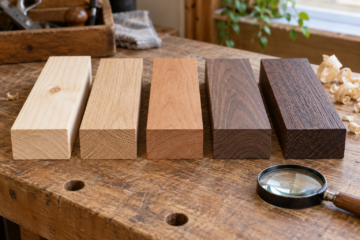
| Walnut | Chocolate brown, generally closed grain | Medium-high | Rich color with minimal finishing | Costs more; can show dents and scratches |
| Hard maple | Very pale, smooth, subtle grain | High | Clean contemporary appearance | Uneven stain absorption and visible sanding defects |
| Cherry | Pink-brown, darkens with light | Medium-high | Warm color that improves with age | Uneven color and blotching can occur |
| Pine | Light, knotty, strongly varied | Low-medium | Lowest material cost | Dents easily and may blotch |
When walnut or cherry makes more sense
Walnut is the easiest premium species to make look finished. Its naturally dark brown color hides minor color variation, and a clear satin finish usually provides all the color it needs. Choose walnut for a sleek table where the wood itself is the visual feature. It is softer than oak and maple, however, so sharp-edged objects and grit under decorative items can leave marks.
Cherry starts lighter and pinker than many buyers expect. It darkens substantially with sunlight, especially during the first year, eventually reaching a warm reddish brown. That change is part of its appeal, but a new table may not match a cherry cabinet or floor immediately. Cherry also benefits from careful sanding because swirl marks can become obvious under clear finish.
If you are buying rough lumber, select boards with similar color and grain before cutting. A wood moisture meter is useful insurance: aim for roughly 6% to 8% moisture content for typical heated or air-conditioned interiors. Lumber that is much wetter can shrink after assembly, opening joints or causing a glued-up top to cup.
Maple and pine: good value with conditions
Hard maple makes a very durable tabletop and suits a light Scandinavian or minimalist design. Its tight grain gives a smooth surface, but that also exposes mistakes. Sanding through finer grits in one area, leaving cross-grain scratches, or rounding one edge more than another will show under a clear finish. Sand consistently through 120, 150, and 180 grit, using a random-orbit sander with light pressure.
Pine is perfectly reasonable when price matters or when you want a casual farmhouse look. It is much cheaper than hardwood and easy to cut and sand. The trade-off is practical: a coffee table made from pine will dent, compress at fasteners, and show wear quickly. Select the clearest, driest boards you can find, and avoid large loose knots near the edges. A satin film finish is usually a better choice than a delicate oil alone because it gives the soft wood more spill resistance.
Prepare the top before finishing
Wood species cannot rescue poor preparation. After glue-up, flatten the top with a planer, router sled, or careful sanding. Remove glue squeeze-out completely; even a thin dried film can prevent finish from penetrating and leave a pale patch. A PVA wood glue is sufficient for normal interior joinery, provided the edges fit tightly and the boards are clamped without forcing them out of alignment.
Sand the whole surface evenly. Stop at 180 grit for most film finishes and 180 or 220 grit for hardwax oils, following the finish maker’s instructions. Vacuum the dust, then wipe with a clean, lightly dampened cloth or use a tack cloth for woodworking. Do not flood the surface with water, which can raise the grain unevenly and create more work.
Test the complete finishing schedule on an offcut from the actual table. Compare one coat, two coats, and the final sheen. This catches surprises such as oak turning too yellow, maple developing blotches, or walnut becoming darker than expected. Finish all faces, including the underside and edges, to reduce uneven moisture exchange. Let the table cure fully—often several days for water-based products and longer for oils—before putting heavy objects on it.
What to buy
Choose white oak if you want the safest combination of durability, availability, and visible grain. Choose walnut when appearance matters more than price and you prefer a dark top without stain. Choose hard maple for a pale, modern table and pine when a low-cost, intentionally rustic project is the priority. In every case, spend time selecting straight, dry boards and preparing the surface; those decisions affect the finished table more than a small difference in species hardness.

0 Comments