What's inside
As an Amazon Associate I earn from qualifying purchases. This post may contain affiliate links at no extra cost to you.
For a clear-finished built-in bookcase, the plywood’s face veneer is the part you see, but its core affects shelf stiffness, edge treatment, screw holding, and how well the cabinet stays square. For most projects, cabinet-grade birch plywood is a practical choice if you plan to apply a clear finish. If you want a more pronounced wood pattern, choose a veneer that matches the look you want, such as maple, oak, or walnut. Buy for the finished appearance and the actual panel quality—not just the species printed on the label.
Choose the face veneer for the room
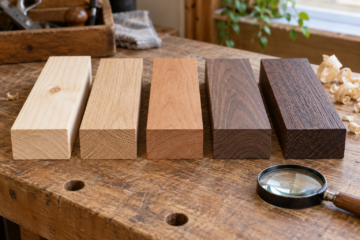
Birch and maple have relatively subtle grain and take clear finish to a light, even-looking result, though both can show blotching or color variation. Oak has stronger grain and open pores; it looks more textured and may need pore filling for a glass-smooth finish. Walnut is darker and usually costs more. A clear finish will deepen and warm the color of any veneer, so inspect a sample with the finish you intend to use before committing to a full sheet.
Look at the actual sheet whenever possible. Veneer color, grain, patching, and matching vary between panels, even in the same grade. For a matched built-in, buy all the plywood at once and keep sheets in the same orientation when cutting. If the grain matters, plan the cut list so adjacent doors, side panels, or visible shelves come from neighboring areas of the veneer.
Compare common plywood choices
| Plywood type | Appearance under clear finish | Trade-off | Best use |
|---|---|---|---|
| Birch-faced cabinet plywood | Light color, generally restrained grain | Quality and core construction vary; face veneer can be thin | Paint-free shelves, sides, and casework on a sensible budget |
| Maple-faced plywood | Light, fine grain | Can show blotchy color under some stains | Clean, understated cabinetry; often best left natural or lightly toned |
| Oak-faced plywood | Strong, open grain | Visible pores may need filling for a very smooth finish | A traditional, prominent grain pattern |
| Veneer-core hardwood plywood | Depends on the face veneer | Can be lighter and easier to machine, but voids and edge layers need inspection | General cabinet work when the core is sound and shelves are supported |
| MDF-core veneer plywood | Often flat and uniform | Heavy; edges absorb finish and hold screws less reliably than solid wood | Flat panels and short spans where added weight is acceptable |
Check grade, thickness, and core
“Cabinet grade” is not a universal guarantee. Check the face for patches, splits, sanding-through, and mismatched color, then inspect the edges for gaps or large core voids. A void near a shelf edge can break through during routing or leave a weak spot for a screw. Ask the supplier what the grade means and whether the panel is intended for interior use. If the bookcase will be in a damp area, choose a panel rated for that environment rather than assuming a hardwood face makes it moisture-proof.
Nominal 3/4-inch plywood is often about 23/32 inch thick, but actual thickness varies. Measure the sheets before cutting dados or ordering edge banding. For ordinary bookcase shelves, 3/4-inch material is a common starting point; long, heavily loaded shelves can still sag. A 36-inch span holding books is more demanding than a 24-inch span. Reduce the unsupported span with a center divider, add a front hardwood nosing, or use thicker material rather than expecting finish or edge banding to stiffen a shelf.
If cost matters more than a premium face, a good birch-faced panel is often adequate, especially when the bookcase has shorter shelves and simple, natural finish. Cheaper construction plywood is less predictable: face defects, rough grain, and core gaps can take longer to hide than the savings justify. Avoid buying solely by sheet price; include waste from defects and the labor needed to prepare the surface.
Plan edges and assembly before finishing
Plywood edges expose the core, which rarely looks like the face veneer. Cover visible edges with solid-wood lipping, iron-on veneer edge banding, or a deliberate contrasting detail. Solid lipping around 1/8 to 3/4 inch thick can protect a shelf edge and add stiffness when glued well. Keep the lipping flush, then sand carefully; it is easy to sand through the thin face veneer while leveling a proud edge. Test your approach on an offcut.
Use a sharp, fine-tooth blade and support the panel to limit tear-out. A scoring cut or a sacrificial backing board can improve the show face. Dry-fit parts before applying glue, and wipe glue squeeze-out promptly with a damp cloth without flooding the veneer. Dried glue blocks stain and finish, leaving pale patches that are difficult to correct later. For cabinet joinery, use a glue intended for interior woodworking and suitable mechanical fasteners; do not rely on screws driven into a plywood edge for a heavily loaded connection.
Sand and finish without damaging the veneer
Start with the panel’s existing surface condition. If it is already smooth, a light pass with 180-grit paper may be enough; use 150 grit only to remove machining marks or small defects. Finish around 180 to 220 grit, following the grain and keeping the sander moving. Many plywood face veneers are thin, and aggressive sanding can expose the darker layer beneath. Hand-sand edges and corners lightly. Remove dust with a vacuum and a clean, lint-free cloth.
For a clear, natural look, test a water-based clear coat and an oil-based clear coat on scraps. Water-based finishes tend to keep pale woods lighter; oil-based finishes usually add amber warmth. The same product can look different on birch, oak, and maple, so test the actual plywood, including any edge lipping. Apply the number of coats on the product label, sanding between coats only as directed. If staining, test first: maple and birch can take stain unevenly, and stain will not conceal glue spots or veneer patches.
For a buying starting point, compare birch cabinet plywood with iron-on veneer edge banding if you want to cover exposed shelf edges. For a durable clear coat, look at water-based polyurethane and test it on an offcut before finishing the assembled bookcase.

0 Comments