As an Amazon Associate I earn from qualifying purchases. This post may contain affiliate links at no extra cost to you.
Sweep a one-car garage after a day of milling and the floor tells you almost nothing useful. The chips you can see are heavy and they fall fast. The dust that matters is the part you cannot see: particles under 10 microns that hang in the air for hours, drift into the house through the door gap, and settle on every flat surface by Tuesday. That is the real reason people start hunting for the best dust collector for small shop use, usually a week or two after deciding a shop vac and a broom were not cutting it.
No recommendation makes sense until you know what a dust collector does differently from that vac, because the two machines are not competing in the same event. Get the mechanism straight and most of the buying decision falls out of it on its own.
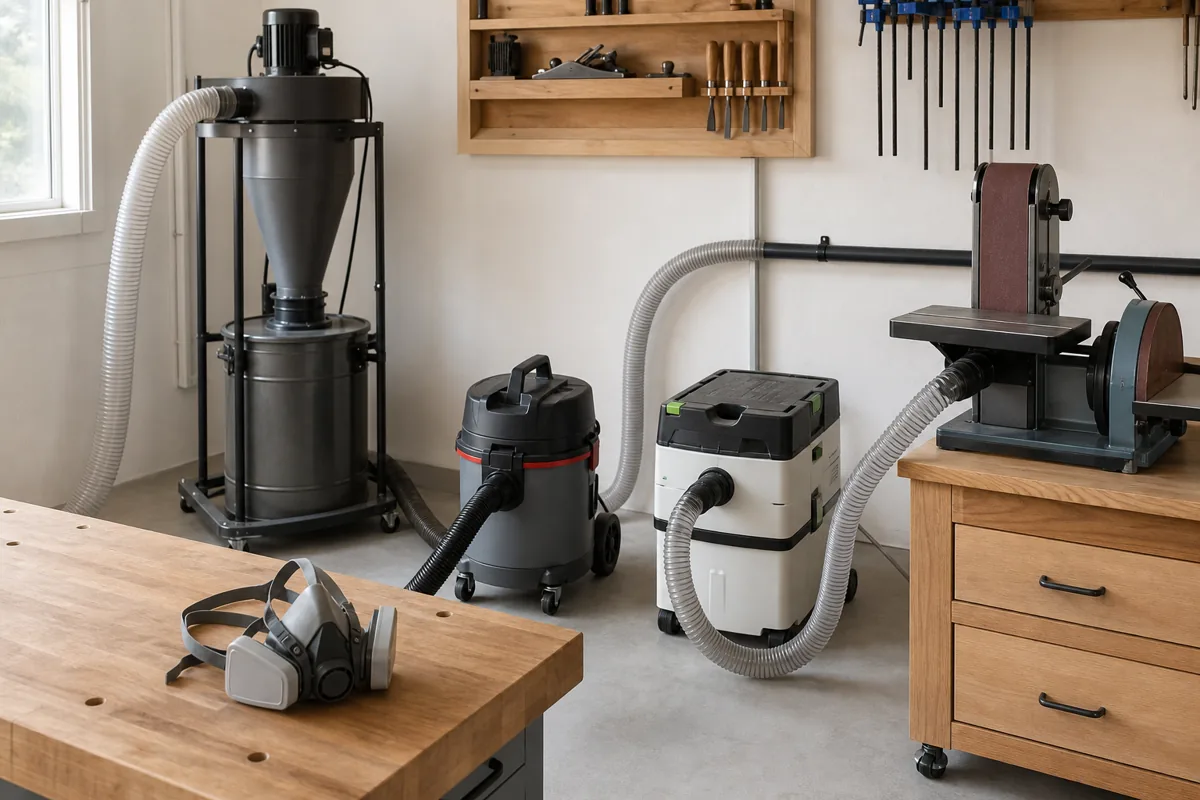
The Misconception: A Strong Shop Vac Is Just a Small Dust Collector
It is not, and horsepower has nothing to do with why. Every air mover trades between two numbers: volume, measured in CFM, and static pressure, measured in inches of water lift. Picture a garden hose with a nozzle sitting next to a fire department supply line. The nozzle punches hard through a tiny opening. The supply line moves a river at low pressure. Both are useful. Neither substitutes for the other.
A shop vac is the nozzle. It is built for high water lift through a narrow hose, which is why it can yank a screw out of a crack, and it moves air in the low hundreds of CFM at best. A dust collector is the supply line: static pressure in the single digits to low teens, but several hundred CFM through a 4 inch or larger inlet. Fine airborne dust does not respond to suction pressure. It responds to captured airflow, because you have to swallow the whole cloud a spinning cutter throws before room air carries it off.
So the machine decides the tool. Sanders, routers, track saws and miter saws release dust in a small contained stream, and a vac handles them well. Table saws, jointers, planers and bandsaws throw a wide, fast plume. The long-standing shop rule of thumb is roughly 350 CFM at the port of a small machine and something in the 600 to 800 range at a table saw or planer if fine dust, not just chips, is the goal.
| Setup | What it genuinely does well | The catch |
|---|---|---|
| Shop vac plus mini separator | Sanders, routers, track saw, miter saw, cleanup | Not enough air volume for a table saw or planer hood |
| 1 to 1.5 HP single stage | One machine at a time on short 4 inch runs | Stock felt bags pass fine dust until you upgrade them |
| Wall mount or rolling 1 HP unit | Tight shops, small footprint, moves to the machine | Short runs only, small collection bag, limited reach |
| 1.5 to 2 HP cyclone | Real ducting, 5 or 6 inch mains, steady airflow | Tall, pricier, larger models often want 240V |
| Ambient air cleaner | Catching the fines that already escaped | Cleans the room, collects nothing at the source |
Filters Matter More Than Motors
Here is the second misconception, and it is the expensive one: the bag hanging on your collector is not doing what you think. On a single-stage machine the lower bag is a bin and the upper bag is the filter, and every cubic foot of air the impeller moves passes through that upper bag and returns to the room you are standing in. Plenty of budget units ship with 30-micron felt. That is a window screen guarding a bathroom vent. It catches shavings beautifully and blows the sub-10-micron fraction, the part that travels deepest into your lungs, right back at your face.
A pleated canister in the 1 micron class fixes that, and it does something else worth money: far more surface area means less resistance, so the fan delivers closer to its rating. A bad filter costs you air twice, once in what it leaks and once in what it chokes.
Pleated Canister Filter Upgrade, 1 Micron Class
If you already own a 1 to 1.5 HP collector with a felt bag, this buys more clean air per dollar than a new machine does. Measure your flange diameter and available height first, and favor listings that state an actual micron rating instead of vague “fine dust” wording.
How to Size the Best Dust Collector for Small Shop Layouts
Size to your single hungriest machine, not to the sum of the shop. One person cannot run a planer and a table saw at once, so whole-shop math is wasted money. Then look at the pipe, because ducting sets the ceiling, not the sticker on the motor. A 4 inch line practically caps out around 350 to 400 CFM regardless of what fan is on the end, while stepping up to 6 inch roughly doubles what the same duct can carry. Twenty feet of 4 inch flex turns a 2 HP collector into a louder 1 HP collector.
Flex hose carries something like three times the friction of smooth-wall pipe foot for foot, and every tight 90 degree elbow costs you the equivalent of several feet of straight run. Keep flex to the last two or three feet at the machine. Close every blast gate except the one in use, because an open gate anywhere bleeds off velocity everywhere. Before buying, check ceiling height against the machine, since cyclones are tall, and check amp draw against your circuit.
Cyclone, Single Stage, or Separator
The real difference is where the heavy material leaves the airstream. A cyclone spins incoming air down a cone so chips and grit drop out before they ever touch the filter, so the filter stays clean and airflow holds steady all afternoon. A single-stage unit throws everything at the filter, which loads up as you work, so you finish the day with less airflow than you started with. A mini separator on a shop vac lid is the same physics at one-tenth the scale, and it works.
- ✔ Filter stays clean, so airflow stays consistent through long sessions
- ✔ Chips drop into a bin you dump instead of a bag you wrestle
- ✔ Pairs well with 5 or 6 inch mains, where usable CFM actually lives
- ✘ Tall footprint that fights low garage ceilings
- ✘ Costs noticeably more than a comparable single stage
- ✘ Overkill if your shop is a sander, a router and a miter saw
1.5 to 2 HP Cyclone Collector
The right call if you plan to run fixed duct to two or three stationary machines. Confirm total height with the filter installed and check whether the model you like wants 120V or 240V before you commit to a spot on the wall.
The Cheap Wins People Skip
Hoods beat horsepower. A table saw cabinet port with an open throat plate and no over-blade collection leaks the finest dust straight up at your face, so blade guard pickup and a sealed cabinet do more than a bigger motor. Start the collector before the cut and leave it running a half minute after. Run an air cleaner after you leave the shop, not while you work, and wear a mask for hand sanding no matter what you own.
Cyclone Separator for a Shop Vac
The cheapest real improvement for a vac-based shop. It keeps the vac filter from clogging, which is what kills suction mid-project. Match the inlet size to your hose and expect it to help with sanding and routing, not with a planer.
FAQ
Is a 1 HP dust collector enough for a small shop? For one machine at a time on a short 4 inch run, yes, as long as you replace the felt bag with a 1 micron class filter. It runs out of headroom the moment you want a 6 inch main, a long overhead duct, or a planer hood.
Can I skip the filter and vent the collector outside? The best filter is no filter, and venting out works, but you are pumping several hundred CFM out of the building and that air gets replaced from somewhere. In a garage attached to a house with a gas water heater or furnace, that can pull combustion gases back down the flue. Provide makeup air and keep fuel-burning appliances out of the loop.
Do I still need a respirator if the collector is good? For hand sanding and cleanup, yes. Even well-ducted machines miss dust at the source, and sweeping puts settled fines right back into the air. An N95 for light work, a P100 for long sanding sessions.
Buy the filter before the motor if you already own a collector, choose your duct size before you choose horsepower, and be honest about which machines in your shop actually need several hundred CFM. That order of operations gets a small shop breathing clean far cheaper than chasing the biggest unit that fits.
Check prices on Amazon →
0 Comments