Key takeaways
- A plain-language guide to workshop ventilation ideas, explaining how air actually moves through a shop before recommending fans, filters, and exhaust setups.
What's inside
As an Amazon Associate I earn from qualifying purchases. This post may contain affiliate links at no extra cost to you.
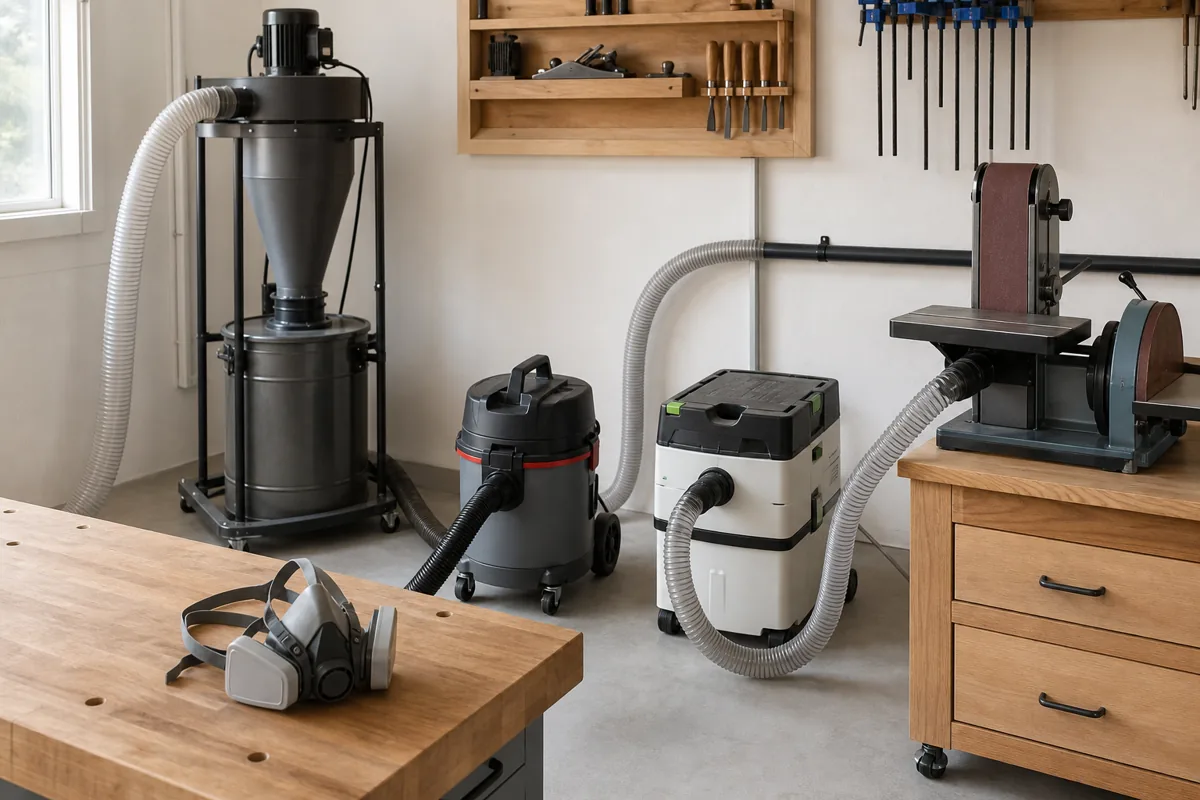
Most shops have a dust collector, a shop vac, and a box fan sitting in the corner, and the owner still gets a headache after spraying finish. That is because dust collection and ventilation are two different jobs, and the box fan is usually pointed the wrong way. The workshop ventilation ideas below start with the mechanism, because once you understand how air actually moves through a room, the equipment choices get obvious and cheap.
Here is the problem stated honestly. A dust collector captures chips and coarse dust at the tool. It does almost nothing for the invisible fraction under 10 microns that stays airborne for hours, and nothing at all for solvent vapor from lacquer, contact cement, or polyurethane. Ventilation is a separate system whose only job is swapping the air in the room for air from outside, or filtering the same air over and over. Those two strategies solve different problems and you probably need both.
As an Amazon Associate we earn from qualifying purchases at no extra cost to you.


| Approach | What it actually does | Best for | Rough cost tier |
|---|---|---|---|
| Exhaust fan to outside | Removes contaminated air from the building | Finish fumes, welding smoke, heat | Low to medium |
| Ambient air cleaner | Recirculates and filters fine dust | Fine sanding dust after the cut | Medium |
| Cross ventilation (two openings) | Pushes a slow air river across the room | General freshening, mild odors | Very low |
| Source capture hood | Grabs contaminants before they spread | Soldering, glue-up, spray station | Low, often DIY |
| Makeup air inlet | Lets exhaust actually leave | Any sealed or tight shop | Very low |
The Misconception: A Fan In The Window Is Ventilation
The single most common mistake is putting a fan in the window and calling it done. Air is not compressible at the pressures a box fan generates, which means for every cubic foot the fan pushes out, one cubic foot has to come in from somewhere. If your shop is a reasonably tight garage with the door closed and no other opening, the fan spins, makes noise, and moves very little air. It is stirring, not exhausting.
The analogy I use is a drinking straw with your thumb over the top. You can suck as hard as you want and nothing comes up. Take your thumb off and the liquid flows. A shop needs its thumb off, which means a deliberate inlet on the opposite side of the room from the exhaust. Crack a window, leave the man door open, or cut a screened inlet vent low on the far wall.
Second misconception: bigger CFM is always better. What matters more is the path the air takes. A modest fan with a good inlet on the far wall beats a monster fan with no inlet, every time. You want the fresh air to enter, travel through your breathing zone and work area, and then leave. If the inlet is two feet from the exhaust, the air short circuits and the rest of the room never turns over.
Sizing It Without Doing Engineering Math
The industry shorthand is air changes per hour, or ACH. Multiply your shop length by width by height to get cubic feet. Divide that by 60 and you have the CFM needed for one air change per minute, which is far more than you need. For practical purposes, aim for roughly 6 to 10 air changes per hour for general woodworking, and push toward 15 to 20 or more while actively spraying finish.
Worked example. A 20 by 24 foot garage with 9 foot ceilings is about 4,320 cubic feet. Ten air changes per hour means moving 43,200 cubic feet in an hour, or about 720 CFM. That is well within reach of a single decent exhaust fan, and a lot of cheap box fans claim numbers in that range on paper. Treat printed CFM figures as optimistic marketing, since they are usually measured with zero static pressure and no ductwork. Assume you will get meaningfully less in a real installation and buy accordingly.
Shutter-Style Exhaust Fan for Garage Shops
A wall-mounted shutter fan is the honest answer for a shop where you finish, weld, or run engines. It mounts through the wall or a plywood window insert, the gravity shutter keeps weather and bugs out when it is off, and it will outlast several box fans. Look for models in the 10 to 16 inch blade range for a one or two car garage, and check whether the listed CFM is a free-air number. Wire it to a switch by the door so you actually use it.
Workshop Ventilation Ideas By Problem, Not By Product
For finish fumes and solvent vapor. This is a health and fire issue, not a comfort issue. Solvent vapors are usually heavier than air, so they pool low and travel along the floor toward ignition sources like water heater pilots, furnace burners, and non-sealed motors. Exhaust low, bring makeup air in high or across, and never spray flammable finishes in a room with an open-flame appliance. If you spray regularly, treat the fan motor itself as a consideration and look for explosion-proof or externally-mounted motor designs.
For fine airborne dust. Here an ambient air cleaner earns its keep. It hangs from the ceiling, pulls room air through a pleated filter plus a bag or HEPA stage, and returns it. It does not replace collection at the tool, it cleans up the fraction that escaped. Run it during work and leave it running 30 to 60 minutes after you shut the lights off, since that is when the fine stuff is still suspended. A common shop-built version is a box fan sandwiched with furnace filters, which works but strains a fan not designed for the load.
For heat and humidity. Moving air is the cheapest cooling in a shop. A high-volume low-speed ceiling fan or a drum fan aimed at the bench does not lower the temperature but it does move the boundary layer off your skin. In humid climates, ventilating a cool shop with warm humid outside air can condense moisture on your cast iron. In summer, ventilate during the dry part of the day and wax your tables.
For soldering, glue-up, and small-scale fumes. Source capture beats room ventilation by a wide margin. A small inline duct fan, a length of flex duct, and a shop-built hood over the bench pull contaminants before they reach your face. This is the highest value per dollar in the whole guide.
Air Filtration Unit for Fine Dust
Ceiling-hung ambient cleaners are worth it if you sand indoors and cannot open the doors half the year. Prioritize a unit with a washable outer prefilter and a replaceable inner filter with a stated MERV rating, plus a remote timer so it keeps running after you leave. Check filter replacement cost before you buy, since a cheap unit with proprietary filters gets expensive fast.
Building A Layered Setup That Fits Your Shop
Think of it in three layers. Layer one is capture at the tool, which is your dust collector or vac with a good hood. Layer two is source capture for fumes, meaning a small hood and duct fan over the spot where you glue, solder, or spray. Layer three is whole-room turnover, which is your exhaust fan plus a real inlet, backed up by an ambient filter for the fine dust that gets past everything else.
Order of purchase, if the budget is tight: fix your inlet first because it is free, then add source capture at the bench, then a proper exhaust fan, then the ceiling filter last. Most people buy that list backwards and wonder why the expensive box did not fix the smell.
- ✔ Exhaust plus a dedicated inlet removes contaminants from the building instead of recirculating them
- ✔ Source capture hoods are cheap to build and dramatically reduce what reaches your breathing zone
- ✔ Ambient filters keep working after you stop for the day, when fine dust is still suspended
- ✔ Most upgrades are reversible and renter friendly with a plywood window insert
- ✘ Ventilating conditioned air costs money in heating and cooling season
- ✘ Outside air can bring humidity that rusts cast iron surfaces
- ✘ Printed CFM ratings are usually free-air numbers and overstate real-world performance
- ✘ None of it replaces a respirator for spraying or heavy sanding
One more point that gets skipped: respiratory protection is not optional just because you improved the airflow. Ventilation reduces exposure, it does not eliminate it. A fitted half-mask with the right cartridge for organic vapors, or P100 filters for dust, is the last line of defense and belongs on your face when you spray or sand.
Frequently Asked Questions
Can I just use my dust collector as ventilation? No, and this is worth being clear about. A single-stage collector that vents back into the room can actually make fine dust exposure worse if its filter is a coarse bag, because it grinds fine particles into suspension and blows them out. Collection and ventilation are separate jobs. If you vent your collector outside, remember you are exhausting a lot of air and need makeup air, or you will pull combustion gases down a flue.
Should the fan blow in or blow out? Blow out for anything contaminated, meaning fumes, smoke, and dust. Exhausting puts the room under slight negative pressure so contaminated air leaves rather than pushing into the house. Blowing in is fine for cooling a clean shop, but it pressurizes the space and can drive dust and odors under the door into living areas.
How do I ventilate a basement shop with no windows? Look for an existing path first, such as a dryer vent, an unused stove vent, or a rim joist you can drill through. A small inline duct fan connected through the rim joist with a backdraft damper handles a bench-scale exhaust. For anything involving solvents in a basement with a furnace or water heater, do the work outside or in the garage instead. Negative pressure near open-flame appliances risks backdrafting carbon monoxide, and that is not a tradeoff worth making.
Sort out the air path first, add capture where the contaminants are born, and the equipment list gets short and affordable. If you are ready to price the pieces, start with the fan and filter categories and compare real specs rather than headline numbers.
Check prices on Amazon →
0 Comments