What's inside
As an Amazon Associate I earn from qualifying purchases. This post may contain affiliate links at no extra cost to you.
Best Dust Masks for Woodworking: Fit, Filters, and Comfort
For most woodworking, choose a well-fitting N95 disposable respirator for occasional sanding or a reusable half-mask with P100 filters for frequent, dusty work; whichever you choose, a reliable face seal matters more than a higher filter rating that leaks around your nose or cheeks.
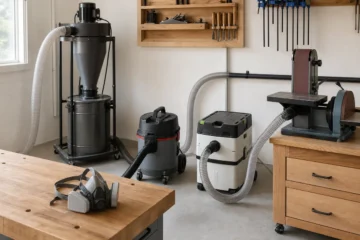
Wood dust is airborne particulate, and sanding can keep it suspended long after the tool stops. A dust mask or respirator helps reduce exposure, but it does not replace local exhaust ventilation, a dust extractor, or cleanup that avoids blowing dust back into the air. This guide compares the practical trade-offs—not just the filter labels—so you can choose for your work, face, and safety glasses.
As an Amazon Associate we earn from qualifying purchases at no extra cost to you.


Disposable vs. reusable: which suits your shop?
| Option | Typical filter rating | Approximate mask weight | Best fit for | Ownership trade-off |
|---|---|---|---|---|
| Disposable filtering facepiece, such as N95 | N95: filters at least 95% of test particles under its certification test conditions | About 10–25 g | Occasional sanding, short jobs, low-cost backup | Replace the whole mask; fit and strap condition can vary by model |
| Disposable filtering facepiece, such as P100 | P100: filters at least 99.97% of test particles under its certification test conditions | About 15–35 g | People who prefer a lightweight disposable but need a higher-rated filter | Often pricier per mask; can feel warm or restrictive during extended work |
| Reusable half-mask with replaceable filters | Commonly N95-equivalent or P100, depending on compatible filter | About 100–200 g before filters | Regular sanding, repeated shop sessions, adjustable fit needs | Lower recurring cost may be offset by replacement filters, cleaning, and strap wear |
Weights and product details vary by model; these figures are typical ranges, not specifications for every respirator. N95 and P100 are U.S. NIOSH filter classifications. A rating describes filtration through the filter under defined test conditions, not the seal on your face or protection from every hazard. Check the product’s certification and instructions, and follow applicable workplace requirements if woodworking is part of your job.
Choose by how you actually work
| Your situation | Practical starting choice | Why |
|---|---|---|
| Occasional sanding and tight budget | Certified N95 disposable | Simple to keep on hand; avoids maintaining a reusable mask between infrequent jobs. |
| Several dusty sessions most weeks | Reusable half-mask with suitable replaceable filters | Adjustable head straps and replaceable components can be more economical and consistent over time. |
| Long sessions or a face that does not suit common disposable shapes | Try several respirator shapes and sizes, including reusable models | Comfort depends on the individual seal, pressure points, and compatibility with eyewear—not only weight. |
| Heavy dust, poor extraction, or work beyond the mask’s intended use | Improve extraction and assess the hazard before choosing PPE | A mask is not a substitute for controlling dust at the source; some hazards require a different respirator program. |
As a rough cost check, compare the price of a reusable mask plus replacement filters with the number of disposables you would use over the same period. For example, if a reusable setup costs $40 and replacement filters cost $15 per pair, while a disposable costs $2, the reusable setup reaches the same $40 outlay after 20 disposables—before accounting for replacement filters, cleaning supplies, or the reusable mask’s longer service life. These are illustrative general-market figures; prices vary, so use local prices and your actual replacement frequency.
Fit is the make-or-break feature
A respirator only works as intended when it seals against clean-shaven skin along the contact area. Facial hair, a curled mask edge, a twisted strap, or a nose bridge that does not sit properly can create leak paths. If a disposable mask comes in multiple sizes or shapes, try alternatives rather than tightening one that never seals comfortably. For a reusable respirator, confirm that the facepiece and filters are compatible and follow the manufacturer’s fitting instructions.
Do a user seal check every time you put on a tight-fitting respirator, following its instructions. A seal check is not the same as formal fit testing. In workplaces where respirators are required, fit testing and other program requirements may apply; a qualified safety professional can advise. If you cannot achieve a comfortable seal or have a condition that makes respirator use difficult, consult an occupational health professional.
Safety glasses, fogging, and long sanding sessions
Dust masks can push warm, moist air toward the eyes, especially when the nose seal leaks. If your safety glasses fog, first reseat the mask and adjust its nose bridge or straps as directed. Then check whether the eyewear is pressing the mask edge out of place. A low-profile respirator may leave more room for glasses, while a different lens or frame shape may work better with your facepiece. Do not solve fogging by loosening the respirator seal.
For comfort over a long sanding session, look for adjustable straps that do not concentrate pressure, a facepiece that stays in place when you speak, and a shape that does not interfere with glasses or hearing protection. A valve may reduce exhalation heat in some models, but it does not improve the seal; check whether the valve is appropriate for your setting and any applicable rules. Take breaks in a clean area, and stop to correct a slipping or uncomfortable mask rather than wearing it incorrectly.
Care and replacement: what wears out first
- Disposable masks: Replace them when they are damaged, wet, visibly dirty, difficult to breathe through, or no longer seal properly. Do not wash them or assume that a mask can be reused indefinitely; follow its instructions.
- Reusable facepieces: Clean and store them as directed, away from dust, sunlight, heat, and chemicals that can degrade materials. Inspect the facepiece, valves, and straps before use.
- Filters: Replace filters according to the manufacturer’s guidance and whenever they are damaged, contaminated, or difficult to breathe through. A dusty filter may increase breathing resistance even if the facepiece still looks intact.
- Common mistake: Mixing brands or filter types without checking compatibility. Use only components specified for the respirator, and keep clean filters sealed until needed.
For a home shop, the practical choice is usually an N95 for occasional light-duty sanding or a reusable half-mask with appropriate filters for frequent work. If you work with hardwoods, composite panels, coatings, or other materials that may create hazards beyond ordinary wood dust, check the material’s safety information and get task-specific guidance rather than assuming any dust mask is sufficient.

0 Comments