What's inside
As an Amazon Associate I earn from qualifying purchases. This post may contain affiliate links at no extra cost to you.
For stained kitchen drawer fronts, the best wood is usually a stable, close-grained hardwood with a face that takes stain evenly. Cherry is a strong all-around choice if you want a warm, natural color; maple is hard-wearing but can blotch; white oak gives a more pronounced grain and a lighter, open look. The right pick depends on the finish you want and how much color variation you can tolerate.
As an Amazon Associate we earn from qualifying purchases at no extra cost to you.


Choose wood by the finish you want
Stain does not make different woods look alike. It colors the wood while leaving its grain and natural variation visible, so a dark stain on maple will not look like the same stain on oak. Before buying fronts, ask for a sample made from the same species and finish it with the stain and topcoat you plan to use. A small sample is more reliable than a stain-color chart.
Cherry darkens with age and can vary between boards, even before stain. Maple has a subtle grain and a clean, modern appearance, but its dense areas can absorb color unevenly. Oak has open pores that remain visible under stain; that texture is part of its appeal, not a defect. If you want a nearly uniform painted look, paint-grade material is often cheaper and more predictable than paying extra for attractive stain-grade wood.
Wood species compared
| Wood | Appearance under stain | Typical trade-off | Good fit |
|---|---|---|---|
| Cherry | Fine, fairly quiet grain; warms and darkens over time | Natural color varies; premium cost | Warm, understated kitchens |
| Hard maple | Pale, subtle grain; stain may look patchy | Needs careful preparation for even color | Light, restrained finishes |
| White oak | Distinct open grain; accepts many stains | Strong grain can dominate a small kitchen | Visible grain and natural texture |
| Birch | Fine grain with light color | Can blotch, especially with darker stain | Budget-conscious projects with a sample-first approach |
| Alder | Soft, relatively even-looking grain | Dents more easily than maple or oak | Rustic or knotty looks |
Best all-around choice: cherry
Cherry is a practical choice when you want stained fronts without a loud grain pattern. Its fine grain gives a more even, furniture-like appearance than oak, and it generally accepts stain more predictably than maple or birch. A clear finish also works well if you like its natural reddish-brown color.
Its main drawback is that cherry changes color with light exposure. Areas covered by hardware, labels, or objects may stay lighter than exposed areas for a time, and boards can differ in tone. Choose the fronts together where possible, then test the finished sample in the kitchen’s lighting. Cherry costs more than common paint-grade materials, so it is not the sensible choice if the fronts will be painted or hidden behind a dark, opaque finish.
Maple or oak: choose for the look
Maple is hard and has a calm, fine-grained face, but staining it evenly takes care. Dark pigments can collect differently across the surface and leave cloudy or striped patches. If you want light stain, use a sample and follow the stain maker’s instructions; a compatible conditioner or washcoat may help, but can also make the final color lighter. Do not assume conditioner fixes every blotch.
White oak is easier to choose when you want the grain to show. Its open pores take color and remain visible, which gives stained fronts depth. It is also a durable choice for a kitchen. That prominent grain is a trade-off: it will still be visible under dark stain, and the final look can vary with cut and board selection. Rift- or quarter-sawn oak has a straighter, more orderly grain than plain-sawn oak, but usually costs more. For plain-sawn fronts, inspect a sample for cathedral-shaped patterns before ordering.
Solid wood or veneer?
Many drawer fronts have a solid-wood frame with a veneered center panel. That construction is normal: a wide solid panel can shrink and swell across its grain with seasonal humidity, while a floating center panel can move within the frame. Veneer also lets a maker match grain across a broad face without using a single wide board. It is suitable for ordinary kitchen use when the veneer is intact and the finish is maintained.
Solid wood is easier to repair if a front is dented or needs refinishing, but it can move and may show seasonal changes at joints. Veneer is thinner, so aggressive sanding can cut through it. Avoid deep sanding on veneered panels; a scratch that reaches the substrate is difficult to disguise. If repairability matters, ask what parts are solid and how thick the veneer is.
Prepare and stain without blotches
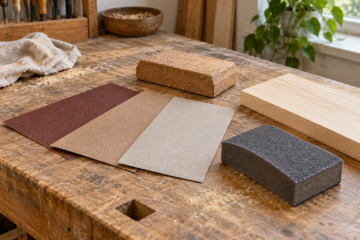
Good results start with a smooth, clean surface. For bare wood, sand evenly through the grits rather than skipping straight to a fine abrasive. A common sequence is 120 grit followed by 150 or 180 grit, depending on the wood and the finish maker’s directions. On veneer, use light pressure and stop before edges become thin. Remove dust with a vacuum and a clean, lint-free cloth; oily tack cloth residue can interfere with some finishes.
Test stain on an offcut or sample from the same wood. Apply it as directed, wipe consistently, and check it after it dries—not while wet. If using a conditioner or washcoat, test that too. Stain that sits too long can turn muddy or uneven, and wiping harder on one area can leave a lighter patch. Follow the stain’s recoat and drying times; sealing wood before the stain is fully dry can trap solvent or create adhesion problems.
Stained fronts need a protective clear finish because kitchen surfaces encounter moisture, grease, and frequent handling. Use a compatible cabinet-grade clear coat and follow its instructions for number of coats and sanding between coats. Pay particular attention to edges and the area around pulls, where finish wears first. For a DIY job, compare cabinet stain and clear-coat options by checking compatibility and application directions, not just the advertised sheen.
What to check before ordering
Ask whether the fronts are solid wood, veneered, or a combination, and request a finished sample of the actual species. Confirm that all fronts in an order will be selected for similar color and grain, especially with cherry. Look closely at the sample under both daylight and kitchen lighting: warm bulbs can make pale wood look more yellow, while dark stain can exaggerate differences between boards.
For a restrained stained finish, cherry is a reliable starting point. Pick white oak when you want grain to be a feature, and maple when you prefer a quieter face and are prepared to test for blotching. Birch can be a reasonable lower-cost choice if you accept more variation and test first. No species eliminates the need for a sample, sound surface preparation, and a durable topcoat; those steps matter as much as the wood you buy.
0 Comments