As an Amazon Associate I earn from qualifying purchases. This post may contain affiliate links at no extra cost to you.
Here is the pattern almost every woodworker falls into. You spend months comparing motors, fences and dust ports, bring the saw home, cut with the blade that came in the box, decide the saw is “fine”, and blame the tear-out on your technique. Every saw ships with a mediocre blade. Manufacturers know most buyers judge on the tool, not the consumable, so that is where the cost gets cut. Replacing it is the highest-return purchase in woodworking.
The blade is the only part of the saw that touches the wood. The motor spins it and the fence guides it, but the finish, the tear-out, the burn marks and the effort you feel in your hands all come from a few dozen small pieces of carbide. Five things decide whether a blade suits the job: tooth count, grind, kerf, hook angle and build quality. Almost everything else printed on the packaging is marketing.
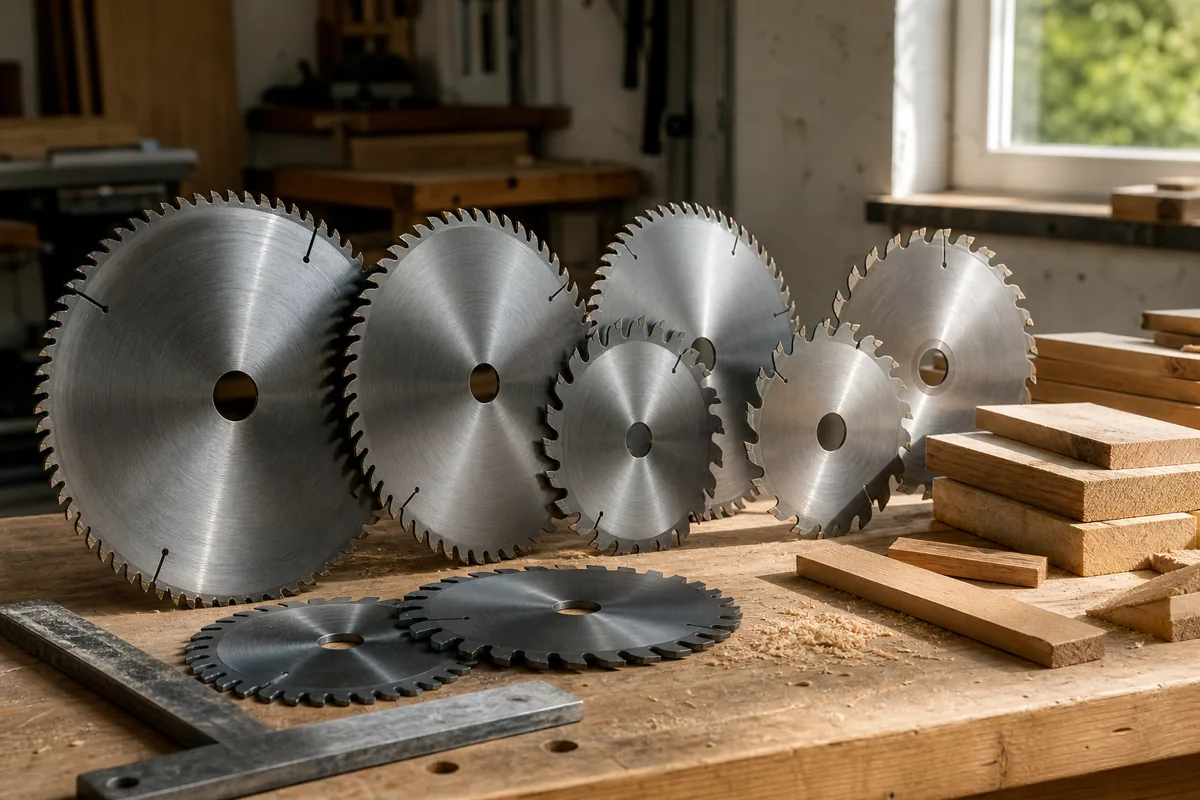
Tooth count: the main variable
| Teeth (10″ | ) | Cut type | Best for |
|---|---|---|---|
| 24T | Aggressive rip | Construction lumber, fast rips | |
| 40T | Combination | General purpose, all-round | |
| 60T | Fine crosscut | Plywood, trim, low tear-out | |
| 80T | Very fine | Melamine, veneer, mitres |
The principle: fewer teeth remove more material faster and rougher; more teeth cut slower and cleaner. Ripping along the grain wants fewer teeth; crosscutting and sheet goods want more.
What drives that principle is the gullet, the scooped space in front of each tooth that carries waste out of the cut. A 24-tooth blade has deep gullets with room for the long shavings that ripping produces. An 80-tooth blade has almost none, so pushing it through two inches of hard maple leaves the waste nowhere to go: heat builds, the edge scorches, and the blade ends up damaged rather than dull. High tooth counts belong in shallow cuts and thin or brittle material.
Tooth count also only means something next to diameter, because the real variable is tooth spacing around the rim. Forty teeth on a 7-1/4″ circular saw blade is a fine finish blade; forty on a 10″ table saw blade is a generalist; a 12″ mitre saw needs 80 or more to feel equally smooth. Compare within a size, never across sizes. Feed rate does some of the work extra teeth would: a 40-tooth blade fed patiently beats a 60-tooth blade shoved through the cut.
Grind type
ATB (alternate top bevel) — teeth angled alternately, slicing wood fibres cleanly. Best for crosscuts and plywood.
FTG (flat top grind) — flat teeth that chisel material out. Fast ripping, rougher finish.
TCG (triple chip grind) — alternating trapezoid and flat teeth. For laminate, melamine and non-ferrous metals.
Combination (ATBR) — groups of ATB teeth with a raker. The generalist compromise.
Grind decides how the tooth meets the fibre, which is why it outranks tooth count. ATB points are sharp and slightly fragile: they slice beautifully and chip early in abrasive material. TCG teeth are blunt by comparison, and that is precisely why they survive coated panels — the trapezoid tooth absorbs the shock and the flat tooth cleans up behind it. FTG leaves a flat-bottomed kerf, which makes it right for tenon cheeks and similar joinery. Choose the grind for the material first, then pick a tooth count within that grind.
Combination table saw blades
If you own one blade, a quality 40-tooth combination is the one. It rips acceptably and crosscuts well.
Fine finish crosscut blades
High tooth count with ATB grind for tear-out-free cuts in veneered sheet goods and mouldings.
Kerf width
Full kerf (about 1/8″) is stiffer and cuts straighter, but demands more power. Thin kerf (about 3/32″) wastes less material and suits underpowered saws — including most jobsite saws and cordless circular saws — but can deflect in heavy cuts.
Rule: full kerf on a 3HP cabinet saw; thin kerf on a 15A jobsite saw or a cordless circular saw.
Two consequences people miss. Your splitter or riving knife has to match the kerf you are cutting — a full kerf splitter behind a thin kerf blade binds, and a thin splitter in a wide kerf does nothing useful. And a wandering cut on a low-power saw is often a deflecting thin plate rather than a misaligned fence, so slow the feed before you blame the tool. On a cordless circular saw or track saw, thin kerf is not a compromise at all; it is why the cut finishes on one charge.
Hook angle
Positive hook angles pull the blade into the work — aggressive, good for ripping on a table saw. Low or negative hook is safer on miter saws and radial arm saws, where an aggressive blade can climb the material. Never put a high positive hook blade on a sliding miter saw.
In practice rip blades carry a strongly positive hook, combination blades a mild one, and mitre and radial arm blades zero or negative. Negative hook costs feed effort, and the payoff is control: the blade shaves instead of grabbing, which is what you want when the work is held still and the blade travels. A lower hook blade also behaves noticeably better in a table saw crosscut sled.
What you get at each price band
Price tracks a short list of physical things: the grade and size of the carbide tips, how flat and how well tensioned the steel plate is, whether the expansion slots are plugged to damp vibration, how consistent the grind is tooth to tooth, and how accurately the arbor bore is machined. More carbide also means more resharpenings before the blade is finished. You cannot see any of that on a shelf, so the bands are a useful proxy.
- Bargain bin, under roughly $25 for a 10″. Thin carbide, inconsistent plates, loud. Fine as a sacrificial blade for reclaimed lumber or anything that might hide a nail. Never judge your saw with one fitted.
- Roughly $30 to $60. The value zone for most hobby shops. Properly brazed carbide, a decent grind, a plate that cuts straight, one or two worthwhile resharpenings. Where a first combination blade should come from.
- Roughly $60 to $100. Better carbide, tighter runout, quieter, plates that stay flat when hot. Worth it on the blade you use most and on finish crosscuts in veneered plywood.
- Above $100. Industrial and specialty: coatings, unusual grinds, thick-carbide production blades. Real gains, but aimed at shops cutting all day.
Who each blade suits
- 24-tooth rip. For anyone breaking down rough or construction lumber regularly, ideally with a powerful saw. Skip it if you mostly cut sheet goods and dimensioned stock.
- 40-tooth combination. Everyone. If you buy one blade, buy this one, and buy it a band above where you were going to.
- 60 to 80-tooth ATB crosscut. Trim work, cabinets, veneered plywood, mouldings. Skip it if your work is all thick solid stock, where it will only burn.
- TCG. Melamine, laminate and non-ferrous metals. Pointless if you never cut coated panels, essential the day you do.
Common mistakes
Buying tooth count instead of grind. An 80-tooth ATB blade will chip melamine that a 60-tooth TCG cuts cleanly. Read the grind first.
Leaving the finish blade on the saw. The fastest way to ruin an expensive crosscut blade is a week of ripping 2x material with it. Changing blades takes two minutes.
Blaming the blade for the saw. Burn marks on one face of a rip, or a cut that closes on the blade, usually mean the fence is not parallel. No blade fixes alignment, so check it before you shop.
Ignoring the insert. A zero-clearance insert and a sacrificial backer board do more for underside tear-out than twenty extra teeth, and cost almost nothing.
Over-tightening the arbor nut. Snug, with the correct washers seated flat, is the specification. Cranking on it gains nothing and makes the next change harder.
Blade care
Most blades that get thrown away were never dull. Pitch and resin build up behind the teeth, friction rises, cuts start burning, and the blade feels finished when it is only dirty.
- ✔ Clean pitch build-up regularly — most “dull” blades are dirty
- ✔ Store blades in sleeves, not stacked bare
- ✔ Have quality blades professionally sharpened rather than replaced
- ✔ Match the blade to the material every time — one blade for everything is a compromise
- ✔ Let the blade reach full speed before contacting the workpiece
Safety notes
None of this matters if the blade comes apart at speed. Give every blade a look before it goes on the arbor.
- ✘ Never exceed the blade’s rated rpm
- ✘ Check for cracked carbide teeth before mounting
- ✘ Never use a blade with missing teeth
- ✘ Arbor washers matter — do not omit them
- ✘ Unplug before every blade change, without exception
FAQ
How many blades do I actually need? Three: a 24T rip, a 40T combination and a 60–80T fine crosscut. That covers nearly everything. Start with the combination and add the others when a job asks for them.
Are expensive blades worth it? Yes, up to a point — better carbide, better grind, more resharpenings. Diminishing returns above roughly $80–100 for a 10″ blade.
Can I sharpen carbide blades myself? Not properly. Professional sharpening is inexpensive and worth it on quality blades — usually cheaper than replacing at the same grade, which is the whole argument for buying good ones.
Will more teeth fix my tear-out? Only on the top face. The underside is a support problem, so a zero-clearance insert, a backer board or a scoring pass will do more than a higher tooth count.
Compare saw blades →

0 Comments