What's inside
As an Amazon Associate I earn from qualifying purchases. This post may contain affiliate links at no extra cost to you.
Buying Milwaukee band saw blades should not be a guessing game, yet it regularly is. A blade that cuts pipe all day on a Milwaukee 6020 or 2530-21 may chew through a thin-wall tube in minutes, while another handles that same tube cleanly but stalls out on a solid stock. The difference comes down to tooth pitch, blade geometry, and the quality of the weld where the two ends meet — specs that are printed on the package but rarely explained in the language a working tradesperson actually needs.
What separates the best Milwaukee band saw blades from mediocre ones is how well a specific blade matches the material you cut most. Variable-pitch blades handle mixed loads, fixed-pitch blades excel at one job, and thick-metal formulas are built for solid bar stock rather than conduit. Owner feedback consistently shows that cheap blades with poor welds break on the second or third cut, while premium bi-metal construction extends usable life across hundreds of cuts. The eight options below span compact 30-9/16-inch sizes through 44-7/8-inch standard and deep-cut formats, so you can match your saw, your material, and your budget.
As an Amazon Associate we earn from qualifying purchases at no extra cost to you.





Our Top Picks
 Milwaukee 48-39-0631 30-9/16" 12/14 TPI Compact Extreme Thick16 x 7 x 0.1 Inches1 PoundsCheck on Amazon
Quick Picks
| Product | Best for | Price |
|---|---|---|
| Milwaukee 48-39-0631 Extreme Thick | Solid stock on compact saws | $24.94 |
| FOXBC 35-3/8″ 10/14 TPI | General cutting on a budget | $19.99 |
| SHAFACE 44-7/8″ 24 TPI | Thin-wall and fine-finish cuts | $41 |
| LENOX 44-7/8″ 14 TPI 5-Pack | High-volume pipe and conduit | $38.40 |
| FOXBC 44-7/8″ 14/18 TPI | DeWalt/Milwaukee cross-compatibility | $21.99 |
| FOXBC 35-3/8″ 14/18 TPI | Versatile compact-saw work | $21.99 |
| Milwaukee 48-39-0511 Deep Cut | Standard deep-cut applications | $34.18 |
| Milwaukee 48-39-0609 Extreme Thick 35-3/8″ | Thick solid stock on full-size saws | $31.46 |
How We Picked
We evaluated each blade on four criteria drawn from published specifications and aggregated owner feedback: material construction (bi-metal vs. high-speed steel), tooth pitch suitability for common cutting scenarios, compatibility across Milwaukee’s portable band saw lineup, and cost per blade relative to reported lifespan. A blade that owners consistently describe as lasting through hundreds of cuts at a moderate price ranks higher than a cheaper blade that snaps after a handful of jobs. We also weighted pack sizes, since buying five blades at once lowers per-unit cost for high-volume users.
The 8 Best Milwaukee Band Saw Blades in 2026
Milwaukee 48-39-0631 Extreme Thick Metal (30-9/16″)
This is Milwaukee’s purpose-built blade for users who cut solid bar stock, angle iron, or heavy pipe on compact saws like the 2530-21. The 12/14 variable TPI tooth design starts cuts aggressively on thick material while the higher count keeps engagement smooth as the blade passes through. Bi-metal construction gives it the flexibility to resist snapping under torsional load. Owner feedback highlights clean burr reduction and minimal tooth stripping on dense steel.
- Variable pitch handles solid stock without snagging on entry
- Genuine Milwaukee engineering ensures consistent weld quality
- Priced higher per blade than third-party alternatives in this length
Skip this if your saw accepts the standard 35-3/8-inch blade, as you will find more options in that size.
FOXBC 35-3/8″ 10/14 TPI
FOXBC offers a variable-pitch blade at the lowest price per unit on this list, making it attractive for plumbers, electricians, and general contractors who burn through blades on mixed materials. The 10/14 TPI range suits medium-wall pipe, conduit, and light structural steel. Owners note that the 0.020-inch thickness provides reasonable rigidity without excessive heat buildup.
- Best price per blade in the roundup at under $7 each
- Variable pitch handles a wide mix of common jobs
- Weld consistency reports are less uniform than OEM Milwaukee blades
Pass on this if you mostly cut thick solid stock; a dedicated 8/10 or lower-pitch blade will outperform it.
SHAFACE 44-7/8″ 24 TPI Bi-Metal Deep Cut
The 24-TPI count makes this the finest-toothed blade in the group, designed for thin-wall tubing, sheet metal stacks, and any job where a smooth finish matters. Deep-cut geometry allows it to reach into awkward angles on Milwaukee saws that accept the 44-7/8-inch length. Bi-metal composition keeps teeth from chipping during long cuts on hard materials.
- High TPI delivers the cleanest cut edges of any blade listed here
- Bi-metal construction resists chipping on hardened steel
- Highest per-blade cost at roughly $13.67 each
Do not buy this for rough demolition or thick solid stock; low-pitch blades cut faster and last longer on those materials.
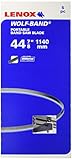
LENOX 8010738PW145 44-7/8″ 14 TPI (5-Pack)
LENOX is a trusted name in cutting tools, and this 5-pack targets users who want OEM-grade reliability without paying Milwaukee’s sticker price. The fixed 14 TPI suits medium-wall pipe, EMT, and threaded rod. Five blades in one package keeps per-unit cost competitive while the bi-metal construction earns consistent owner praise for long service life on repetitive pipe-cutting runs.
- Five-pack lowers per-blade cost for high-volume users
- Established brand with a long track record in blade metallurgy
- Fixed pitch is less forgiving on mixed or irregular materials
Skip this if your work varies wildly between thin conduit and thick bar stock; a variable-pitch blade adapts more easily.
FOXBC 44-7/8″ 14/18 TPI
FOXBC’s 44-7/8-inch variable-pitch blade doubles as a replacement for both DeWalt DW3986 and Milwaukee 48-39-0561, making it a smart pick for shops that run mixed tool brands. The 14/18 TPI range sits comfortably between aggressive rough cuts and cleaner finishing passes. At $21.99 for three blades, the value proposition is hard to ignore for general-purpose use.
- Cross-compatible with DeWalt and Milwaukee saws in one package
- Variable pitch offers a good balance of speed and finish
- Some owners report slightly less rigidity than OEM Milwaukee blades on heavy stock
Avoid if you primarily cut thick solid bar; you will want a lower-pitch, heavier-gauge option.
FOXBC 35-3/8″ 14/18 TPI
Same variable-pitch concept as the larger FOXBC above, but in the 35-3/8-inch format that fits Milwaukee’s most common portable band saws. The 14/18 TPI gives a smoother cut than the 10/14 option, making it better for users who need clean edges on conduit or thin-wall tube. Priced identically at $21.99 for three, it competes directly with the lower-pitch variant.
- Higher TPI produces noticeably cleaner edges than 10/14 blades
- Fits the most common Milwaukee portable saw length
- Not ideal for thick or very hard materials where lower TPI excels
Choose the 10/14 TPI FOXBC instead if your jobs skew toward heavy pipe or solid stock.
Milwaukee 48-39-0511 Standard Deep Cut
Milwaukee’s own 14 TPI deep-cut blade remains the go-to for users who want OEM performance without overthinking specs. The deep-cut geometry reaches into tight spaces and angled cuts that standard blades cannot match. At $34.18 for three, it carries a premium, but weld quality and metallurgical consistency are the reasons pros keep buying this SKU year after year.
- OEM quality control means fewer defective welds and consistent performance
- Deep-cut profile excels on angled and confined cuts
- Fixed 14 TPI is less versatile than variable-pitch alternatives
If your cuts are mostly straight and you value per-blade cost, third-party variable-pitch options deliver more flexibility for less money.
Milwaukee 48-39-0609 Extreme Thick Metal (35-3/8″)
The full-size companion to the 30-9/16-inch Extreme Thick, this blade uses an 8/10 TPI tooth pattern to tear through solid bar, heavy pipe, and dense structural steel. The low tooth count keeps gullets open for chip evacuation, preventing the binding that higher-TPI blades suffer on thick material. Milwaukee’s bi-metal construction and weld process are the main reasons to pay the $31.46 premium over third-party equivalents.
- 8/10 TPI is the best choice on this list for solid stock and heavy pipe
- Milwaukee weld and metallurgy reduce premature blade failure risk
- Overkill for thin conduit, EMT, or light-gauge material
Do not buy this if your typical work is conduit, thin-wall tube, or automotive trim; a 14 TPI or higher will cut faster and finish cleaner.
Buying Guide
Blade Length and Saw Compatibility
Milwaukee portable band saws use three primary blade lengths: 30-9/16-inch (compact saws like the 2530-21), 35-3/8-inch (most popular, fits the 6020 and 2791-20), and 44-7/8-inch (standard and deep-cut saws). Confirm your saw’s blade length before ordering. A 44-7/8-inch blade will not fit a compact saw, and attempting to run a 35-3/8-inch blade in a saw designed for the longer size causes tension issues and premature failure.
Fixed vs. Variable Tooth Pitch
Fixed-pitch blades like 14 TPI or 24 TPI cut faster and more consistently on a single material type. Variable-pitch blades such as 10/14 TPI or 14/18 TPI reduce vibration and noise while adapting to mixed loads, making them better for jobs where you switch between conduit, pipe, and light structural steel throughout the day. For dedicated work, choose fixed pitch. For general field use, variable pitch reduces blade changes.
Bi-Metal Construction and Weld Quality
Bi-metal blades combine a high-speed steel cutting edge with a flexible alloy back, giving you hardness at the tooth and toughness at the spine. The weakest point on any band saw blade is the weld where two ends join. Owner reports consistently flag cheap blades with inconsistent welds as the leading cause of mid-cut snapping. OEM Milwaukee and branded options like LENO X carry tighter tolerances on that joint, which is why they justify a higher per-blade price for users who cannot afford a broken blade on a job site.
Our Verdict
The best overall choice for most Milwaukee band saw owners is the FOXBC 35-3/8″ 14/18 TPI. It fits the most common saw size, offers variable pitch for mixed materials, and at $21.99 per three-pack it delivers strong value without the OEM markup. For a budget pick, the FOXBC 35-3/8″ 10/14 TPI at $19.99 is the cheapest usable option for general field cutting. If you spend your days on solid bar stock or heavy pipe, the Milwaukee 48-39-0609 Extreme Thick is worth every extra cent because its 8/10 TPI geometry and OEM weld quality are unmatched in this group for thick-material performance.
FAQ
Can I use DeWalt band saw blades in a Milwaukee portable saw?
Yes, provided the blade length matches your saw’s specifications. A 44-7/8-inch DeWalt blade fits a Milwaukee saw designed for that size, though Milwaukee’s own blades may have slightly different tolerances at the weld. Many owners report no meaningful difference in cut quality when swapping between brands of the same length.
How many cuts can I expect from a quality Milwaukee band saw blade?
Owner reports on OEM Milwaukee bi-metal blades frequently cite 150 to 300 cuts on medium-wall conduit before the blade needs replacement. Solid stock and hard materials will shorten that range significantly, while thin-wall tube and EMT can extend it. Blade life depends more on feed pressure and cutting speed than on the blade brand alone.
What does TPI mean and which number should I choose?
TPI stands for teeth per inch. Lower numbers (8/10) are for thick or hard materials, while higher numbers (18/24) suit thin-wall or soft materials that need a smooth edge. If you cut a wide range of materials on one job site, a variable-pitch blade in the 14/18 range gives you the most flexibility without constant blade swaps.
Are third-party blades like FOXBC as reliable as Milwaukee OEM?
Third-party bi-metal blades perform well for general cutting, but weld consistency and metallurgical quality control vary more than with OEM Milwaukee or established brands like LENO X. For occasional or budget-sensitive work, owners report satisfactory results. For daily high-volume use where a broken blade costs more in downtime than the savings on blade price, OEM remains the safer investment.


0 Comments