What's inside
As an Amazon Associate I earn from qualifying purchases. This post may contain affiliate links at no extra cost to you.
Maple and oak veneer can both produce a durable, attractive cabinet panel under a clear finish, but they do not look or work the same. Maple is usually the better choice for a quiet, modern panel with subtle grain. Oak is better when you want visible grain, stronger texture, and a more traditional appearance. The right decision also depends on how the veneer is laid up, what substrate is underneath, and how you prepare the surface before finishing.
As an Amazon Associate we earn from qualifying purchases at no extra cost to you.
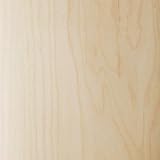


Appearance and Grain
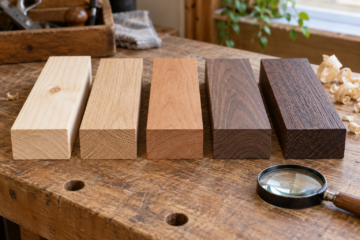
Maple veneer has a fine, relatively even grain. Hard maple is commonly pale cream to light tan, while soft maple can show slightly more color variation. Under a clear water-based finish, maple stays fairly light. Oil-based finishes and ambering clear coats warm it toward honey or straw.
Oak veneer has a much more obvious grain pattern, with cathedral shapes, open pores, and stronger color variation. Red oak tends toward pink, salmon, and warm brown tones. White oak is usually more neutral, gray-brown, and subdued. Quarter-sawn or rift-sawn oak can show straight grain and distinctive ray fleck, while ordinary plain-sliced oak gives the familiar cathedral pattern.
Clear coating does not hide defects or mismatched veneer leaves. On a broad cabinet door, maple’s subtle figure can make a small color mismatch less obvious than it would be on highly figured oak. However, maple’s pale surface also makes dark glue marks, scratches, and sanding swirls easy to see.
Maple vs. Oak at a Glance
| Characteristic | Maple veneer | Oak veneer |
|---|---|---|
| Visual character | Fine grain, clean and understated | Bold grain, open pores, more rustic or traditional |
| Typical clear-coat color | Very light to warm cream | Warm tan, reddish, or gray-brown depending on species |
| Scratch and defect visibility | Scratches and glue spots stand out strongly | Grain disguises minor marks better |
| Surface feel | Smoother, less textured | Open pores remain visible unless filled |
| Best style match | Contemporary, minimalist, Scandinavian | Traditional, farmhouse, craftsman, transitional |
| Typical cost | Often moderate to high, especially figured or matching veneer | Often economical, with many grade and cut options |
Choosing the Panel Construction
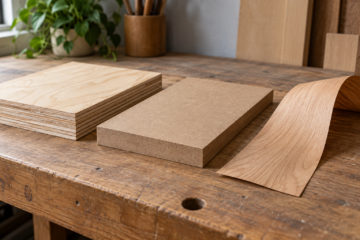
For a cabinet panel, buy factory-laminated veneer plywood or a quality veneered MDF panel rather than gluing thin veneer directly to a solid-wood frame unless you have the equipment and experience. A stable core reduces seasonal movement and makes the panel less likely to warp.
Veneer plywood is a good general choice for doors, end panels, and exposed cabinet sides. MDF-core veneer panels are very flat and machine cleanly, but their edges need reliable treatment. Use matching maple veneer edge banding or oak edge banding, and trim it carefully without cutting into the face veneer.
Check the face grade before buying. A cabinet-grade panel should have a consistent face, tight repairs, and no loose patches. Hold the panel at a low angle to a strong light. This reveals sanding scratches, veneer bubbles, knife marks, and uneven patches that may become obvious after clear coating. For a door or drawer front, confirm that the grain direction and leaf layout suit the finished dimensions.
Sanding and Surface Preparation
Veneer is thin, so aggressive sanding is the fastest way to ruin it. Start with 150-grit paper only if the surface has machining marks or a rough repair. Otherwise, begin at 180 grit and finish at 220 grit. Use a flat sanding block or a random-orbit sander with light pressure. Do not dwell on edges, corners, or one dark spot.
Maple commonly exposes sanding swirls because its grain is quiet and its color is light. Inspect it under raking light between grits. Oak hides some scratches in the grain, but its open pores can hold sanding dust and finish residue. Vacuum thoroughly and wipe with a clean, slightly damp microfiber cloth if the finish manufacturer permits it. Avoid soaking veneer or using a tack cloth that leaves resin behind.
Do not use a water-based pre-stain conditioner as a substitute for proper sanding when applying only clear finish. Conditioner is intended to control stain absorption and can interfere with some finishes. If you plan to stain maple, test the complete schedule on an offcut first. Maple can develop a muddy or uneven color, particularly with dark wiping stains.
Clear-Coat Choices
Water-based polyurethane or acrylic clear finish preserves a lighter maple appearance and adds little amber color. It also dries quickly, which is useful when coating multiple cabinet parts, but it can raise fine grain on the first coat and may show lap marks if overworked. Lightly scuff between coats with 320-grit paper after the finish has dried fully.
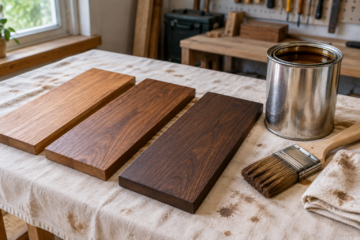
Oil-based polyurethane deepens both species and gives oak a rich, traditional tone. It provides good cabinet durability but dries slowly and can yellow noticeably over time. A waterborne lacquer or cabinet-grade waterborne finish is another practical choice when you want fast recoat times and low odor. For a reliable application, use a water-based clear wood finish rated for interior cabinets and follow its recoat window.
Apply at least three thin coats to a frequently handled door, sanding lightly between coats when directed. Do not assume a thicker coat is stronger; heavy coats can stay soft, sag on vertical panels, or trap dust. Finish all faces and edges to keep moisture absorption more balanced. On a floating or loose panel, coating one side only can contribute to cupping.
Which One Should You Buy?
Choose maple when you want a pale, uniform panel and are willing to spend more time inspecting and preparing the surface. It is especially suitable for flat slab doors where the clean grain is part of the design. A clear coat alone is often enough; staining is usually unnecessary and can make defects more conspicuous.
Choose oak when the grain is meant to be a feature or when you want a forgiving, widely available veneer. Oak is often the cheaper option, particularly in standard red oak plywood, and it is perfectly adequate for utility cabinets, shop storage, and many painted or clear-finished projects. If the open pores look too coarse, use a water-based wood grain filler before clear coating. Grain filling adds work but produces a flatter surface.
Before ordering a full sheet, buy or request a sample and apply the exact finish you intend to use. Clear coats can change the apparent difference more than expected: an oil finish may make red oak strongly orange, while the same finish can turn maple a soft golden brown. A sample also lets you test edge banding, sanding, and adhesion before the visible cabinet panel is at risk.
0 Comments