Key takeaways
- Same voltage does not mean same battery. Here is what actually fits, and why adapters are a false economy.
What's inside
As an Amazon Associate I earn from qualifying purchases. This post may contain affiliate links at no extra cost to you.
The most expensive misunderstanding in cordless tools is assuming that 18V means 18V. Voltage is only one of four things that must match, and the other three are why an adapter usually ends badly.
The mistake tends to play out the same way. You own tools on one platform, a bargain turns up on another, and somewhere in a marketplace listing there is a plastic block promising to bridge the two. It clicks on. The tool spins. Twenty seconds into the first real cut everything stops, the pack is hot, and neither device will tell you why. Voltage was never the problem. A battery pack is not a fuel tank; it is a component on a small data bus, and the tool is the other half of the conversation.
As an Amazon Associate we earn from qualifying purchases at no extra cost to you.


What has to match
1. Physical mount. Every brand uses its own rail and terminal geometry, deliberately. The mount is the moat around the platform, and no manufacturer has a commercial reason to standardise it.
2. Terminal layout. Beyond positive and negative, packs carry thermistor and data pins. The tool reads temperature and state through these. Two packs can share identical power contacts and still have nothing useful to say to one another.
3. Communication protocol. Modern packs and tools talk to each other. Milwaukee REDLINK, DeWalt and Makita all have their own systems. Traffic runs both ways: the tool asks whether it can draw more, the pack decides when to cut off. Break the link and both ends fall back to guessing.
4. Discharge rating. A pack that cannot supply the current a tool demands will sag, overheat and shut down. This is the failure people misread most often, because it presents as a dead battery or a faulty tool when it is really a small pack fitted to a hungry motor.
| Brand | Platform | Backward compatible? | Cross-brand? |
|---|---|---|---|
| DeWalt | 20V MAX | Yes, since 2011 | No |
| DeWalt | FlexVolt 60V | Runs 20V tools too | No |
| Milwaukee | M18 | Yes | No |
| Milwaukee | M12 | Yes, separate from M18 | No |
| Makita | LXT 18V | Yes | No |
| Makita | XGT 40V | Separate platform | No |
| Ryobi | ONE+ 18V | Yes, since 1996 | No |
The good news: within a platform, things mostly work
Ryobi’s ONE+ compatibility record is remarkable — packs from decades apart still fit. DeWalt 20V MAX and Milwaukee M18 have both held compatibility since launch. Makita LXT likewise. If you stay inside one platform, you rarely have a problem.
Two caveats stop that being a blank cheque. First, a brand is not a platform: a 12V line and an 18V line from the same maker, in the same colour of plastic, share a logo and nothing else. Second, “it fits” is a lower standard than “it works well”. A compact pack will latch onto a big circular saw and run it, badly, for a few cuts before sag and heat end the job. Backward compatibility protects the fit, not the performance.
Genuine replacement batteries
Batteries are consumables. Budget for replacements every three to five years and buy the capacity you actually need.
Choosing a pack: the criteria and how to weigh them
Once the platform is settled, the decision comes down to four numbers and one judgement call.
Capacity (amp-hours). Tank size, nothing more. Doubling amp-hours roughly doubles runtime and adds most of the weight of a second pack to whatever you are holding. Compact packs suit drills, drivers and anything used overhead; mid-size is the sensible default for general work; the biggest packs belong on tools you set on the floor or push along it.
Output rating. Several brands sell a higher-output version of the same voltage and the same amp-hour figure, built on cells that deliver current faster. Worth paying for if you run saws, grinders, blowers or large impact wrenches. Pointless on a drill, where the pack is never the bottleneck.
Charger speed. A faster charger often beats buying a third pack. Two packs plus a charger that turns one around before you flatten the other is a working system; three packs and a slow charger is three packs sitting flat on the bench.
Stock age. Lithium cells age on the calendar as well as on the cycle counter, so a pack that has sat part-charged in a warehouse for two years does not start life at the capacity on the label. Buy where stock moves.
Genuine or aftermarket. The judgement call, and the reason for the next two sections.
The bad news: adapters
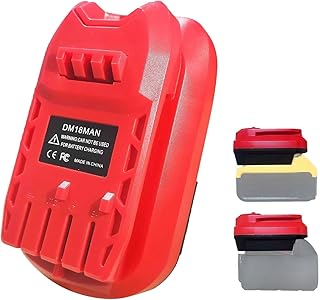
Third-party adapters that let a Makita pack run a DeWalt tool exist. They physically work. What they do not do is pass the protection data between pack and tool, which means the tool’s electronics cannot manage the battery properly.
Specifically: the tool cannot read cell temperature, so it will not back off as the pack heats, and the pack cannot see what the tool is asking for, so its own cutoff works blind. Add the adapter’s own contact resistance and you have a joint that warms under load in a system where nothing is watching temperature.
Consequences range from disappointing (poor performance, early shutdown) to expensive (voided warranty on both items) to dangerous (thermal runaway in a pack pushed past its limits). For a $40 saving on a $200 tool, it is not a good trade.
One narrow exception deserves naming: a manufacturer’s own adapter within its own family, sold by the brand to run its older tools from a newer pack, with the data path designed in. That is a different product from an unbranded block, however similar the photographs look.
- ✘ Adapters void warranty on both the tool and the battery
- ✘ Protection circuits cannot communicate across an adapter
- ✘ Cheap aftermarket packs are a genuine fire risk
- ✘ Insurance may not look kindly on a fire started by modified equipment
Aftermarket batteries: a qualified maybe
Not all third-party packs are equal. Established aftermarket brands with real protection circuitry, cell balancing and thermal cutoffs are usable for light-duty tools. Anonymous marketplace packs with implausible amp-hour claims are not — the cells are frequently recycled and the protection minimal.
Rule of thumb: if the price is less than a third of genuine, the difference came out of the cells or the safety circuit.
Genuine, at or near full price
Suits anyone whose tools earn money, anyone running high-draw tools, and anyone who wants the tool warranty left intact. Save here by sizing to the job rather than by switching brands: two mid-size packs usually serve better than one enormous one.
Reputable aftermarket, mid-market pricing
What separates good from bad in this band is disclosure. A pack worth buying states its cell format, describes a protection scheme, carries a warranty of a year or more from a seller likely to still be trading, and claims a capacity that is plausible for its physical size. A listing that dodges all four is selling price alone. Suits hobby users with modest tools — drills, drivers, lights, inflators — where the pack never approaches its limit. Skip it for saws and grinders, and skip it entirely if the tool pays your wages.
Under a third of genuine
The arithmetic does not close. Cells, protection board, case and shipping cannot all come out of that price, and it is never the case that was cut. The tells are consistent: a capacity figure above anything the brand itself sells in that body size, a seller name that reads like a random string, no warranty terms, one listing covering four brands. Suits nobody.
The mistakes that cost the most
- Buying the tool because the tool is cheap. A bare-tool bargain on a platform you do not own is not a bargain. You are buying the platform, and the packs will cost more than the tool.
- Drifting into two platforms. It happens one purchase at a time and ends with three chargers, six packs and nothing interchangeable.
- Buying capacity when the problem is charging. Most people who feel short of runtime are short of charging throughput instead.
- Blaming the tool for the oldest pack. One tired pack in a rotation of four feels exactly like an intermittent tool fault. Test with a known good pack before diagnosing anything.
- Binning dead packs. Lithium cells do not belong in household waste. Take them to a battery recycling point.
Battery care that actually extends life
Heat and time do most of the killing. Cycles matter, but hobby packs are usually retired long before use wears them out — they die sitting fully charged through two summers in a hot space. Every habit below targets one or the other.
- ✔ Store at partial charge, not empty or full, if unused for months
- ✔ Keep packs out of hot vehicles — heat kills lithium cells faster than cycles
- ✔ Let a hot pack cool before charging
- ✔ Do not run a pack completely flat repeatedly
- ✔ Charge indoors on a hard surface, not on a workbench covered in sawdust
One extra that does not fit in a list: write the purchase month on each pack. It turns a vague suspicion that one of them is tired into something you can act on.
FAQ
How long do batteries last? Typically 3–5 years, or 500–1,000 charge cycles, whichever comes first. Storage conditions move that range more than anything else you control.
Can I use a bigger battery on a small tool? Yes, within the platform — more runtime, more weight. No downside beyond ergonomics.
Does a higher amp-hour pack make a tool more powerful? Not directly, because amp-hours are runtime. Larger packs do tend to sag less under heavy load, so a demanding tool can feel stronger on one. On a drill you will notice only the weight.
Is it safe to leave packs on the charger? Modern chargers stop when full, but long-term storage on a charger is not ideal. Take them off.
Check battery prices →
0 Comments