What's inside
As an Amazon Associate I earn from qualifying purchases. This post may contain affiliate links at no extra cost to you.
Our Top Picks
 1/2 pt Minwax 13407 Clear Pre-Stain Wood Conditioner1/2 Pint3 x 3.25 x 3 inches0 PoundsCheck on Amazon


What makes a good base for a dark chocolate finish
A smooth, dark chocolate finish depends as much on the wood as on the stain or topcoat. The easiest boards to color evenly have a fine, consistent texture and no strong contrast between earlywood and latewood. Open pores can look attractive, but they remain visible under a clear finish unless you fill them. Unevenly absorbent woods may turn blotchy when stained.
For a reliable result, choose the species for the look you want, then test the full finish schedule on an offcut from the same board. A stain that looks rich on one species can turn muddy or nearly black on another. Sanding also matters: stopping around 150 or 180 grit usually leaves enough tooth for stain to enter. Sanding much finer can reduce color uptake, particularly on dense hardwoods.
As an Amazon Associate we earn from qualifying purchases at no extra cost to you.


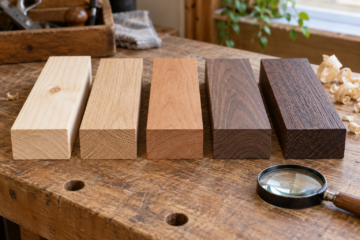
Compare common species
| Species | Texture and color behavior | Best use | Main trade-off |
|---|---|---|---|
| Walnut | Fine to medium texture; naturally brown, with darker heartwood | Deep, refined chocolate tone with a clear finish | Often costs more, and stain may obscure its natural color variation |
| Cherry | Fine, close grain; warm reddish-brown that deepens with light exposure | Smooth furniture and cabinetry with a warm brown finish | Can blotch under stain, especially on irregular grain |
| Mahogany or sapele | Medium texture; often warm brown with visible ribbon or stripe figure | Chocolate color with lively grain | Figure can make color look uneven; pores may need filling |
| Maple | Very fine, pale, dense surface | A smooth, uniform painted or carefully controlled stained surface | Prone to blotching and can take dark stain unevenly |
| Red oak | Coarse, open pores; pronounced grain | Budget projects where visible grain is welcome | Pores stay visible unless filled; dark stain can emphasize grain contrast |
Best natural choice: walnut
Walnut is the most straightforward pick when the goal is a dark, smooth-looking brown without disguising the wood. Its natural color already sits near chocolate, so a clear oil- or water-based finish can deepen it without a heavy stain. Choose boards with consistent heartwood if you want a uniform look; pale sapwood will remain noticeably lighter unless you color it separately.
Walnut is not pore-free. Under a glossy finish, its pores can show as small dark marks, but many people consider that part of the wood’s character. If you want a glassier surface, use a compatible grain filler before topcoating. Walnut is also a poor place to spend money on a very dark stain without testing: it can cover up the natural color that made the species worth buying.
Warm alternatives: cherry and mahogany
Cherry gives a fine, smooth surface and a warm brown result, but it needs a test panel. It can absorb stain unevenly, leaving darker clouds or marks near end grain. A thin washcoat or a product labeled as a pre-stain conditioner can reduce the contrast, though it may also make the overall color lighter. Apply it consistently, follow the label’s timing, and test the same stain over it before treating the project.
Mahogany and sapele suit a chocolate finish when you want visible grain rather than a plain brown field. Their natural red or golden tones can shift a brown stain warmer than expected. Some boards have pronounced ribbon figure, which changes appearance with viewing angle; that is a feature, not a sanding defect. For a quieter result, choose boards with straighter grain and consider a pore filler for a smoother topcoat.
Budget choices: maple and red oak
Maple can produce a clean, fine-textured surface, but dark color is harder to control than its smooth grain suggests. Its dense areas absorb less stain, while softer patches may turn much darker. Dye often gives more even color than pigment stain on maple, but it still requires careful application and a test piece. For a low-risk chocolate look, use a tinted clear finish or a gel stain designed for the job rather than assuming a standard wiping stain will be uniform.
Red oak is usually the practical lower-cost choice for a dark finish, particularly on a large project. It takes stain readily, but its open pores create a strong grain pattern. Stain colors the pores dark, which can make the surface look striped. That may be exactly right for a rustic cabinet or table; it is not the best route to a visually seamless surface. Filling the grain adds labor and may cost more than choosing a finer-textured species for a small project.
Prepare, test, and finish
Sand evenly with the grain, moving through roughly 120, 150, then 180 grit for most stain jobs. Remove sanding dust with a vacuum and a clean, lint-free cloth; avoid leaving oily residue that could interfere with adhesion. Sand end grain to the same final grit as the faces, then apply stain sparingly there or seal it first, because end grain usually drinks in more color.
Make a sample large enough to show both face grain and an edge, and apply every planned step: conditioner or washcoat, stain or dye, and topcoat. Check it after the finish dries, since wet stain and clear coats can look different. If the surface turns too dark, muddy, or blotchy, change the species or the color method rather than trying to hide the problem under extra coats.
For a controlled dark brown, compare a dark-brown wood dye with a wiping stain on your sample. A dye can color fine-grained wood more evenly; a wiping stain is often simpler and cheaper on open-grained oak. If you choose a stain, a pre-stain wood conditioner may help on cherry or maple, but it is no substitute for testing.
For most buyers, walnut is the safest choice for a naturally rich chocolate surface, cherry is the warmer alternative, and red oak is the value option when prominent grain is acceptable. Pick the board and finishing method together, not by stain color alone.

0 Comments