What's inside
As an Amazon Associate I earn from qualifying purchases. This post may contain affiliate links at no extra cost to you.
A clear finish puts the handle wood on display, so the best choice is usually a close-grained, stable hardwood that is comfortable to hold and easy to seal. Maple is the practical default; cherry and walnut offer warmer color, while beech is a good lower-cost alternative. The right pick depends on the handle’s shape, exposure to water and how much contrast you want against the board.
As an Amazon Associate we earn from qualifying purchases at no extra cost to you.



Our Top Picks
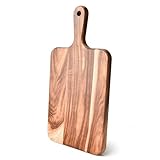
 Acacia Wood Cutting Board and Chopping Board with17"L x 13"W17 x 13 x 0.75 Inches4 PoundsCheck on Amazon
 Samhita Acacia Wood Paddle Cutting Boards with handle15"L x 7"W15 x 7 x 0.65 inches1.1 poundsCheck on Amazon
 Sawysine Irregular Acacia Wood Cutting Board with Grip16.9"L x 11.8"W16.93 x 11.81 x 0.79 inches1.42 PoundsCheck on Amazon
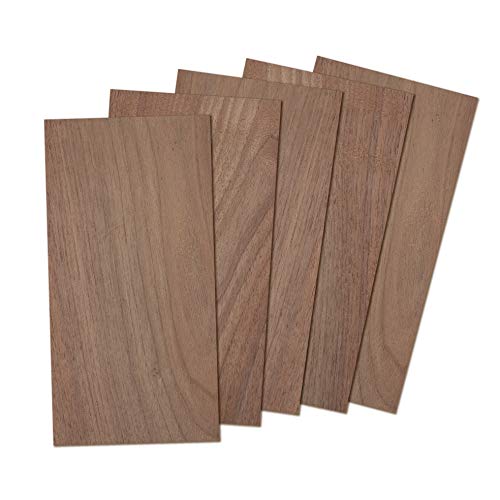
 Barrington Hardwoods Domestic Variety Pack 5 Walnut3/4" x 2" x 12"12 x 2 x 0.75 inchesCheck on Amazon

What matters in handle wood
A handle is not a cutting surface, but it still gets wet, handled with food-contaminated fingers and washed often. Choose wood that is hard enough to resist dents, has a fairly even grain and is free of cracks, knots and loose grain around the attachment points. Stability matters too: a handle that moves as humidity changes can loosen fasteners or open a gap where water collects.
For a clear finish, inspect the actual blank rather than choosing by species alone. Avoid checks, pith, conspicuous mineral streaks if you want an even color, and grain that runs out sharply at a narrow neck. Long grain running along the handle is less likely to split under pulling or twisting than short grain across it.
Best species compared
| Wood | Appearance under clear finish | Strengths | Trade-offs |
|---|---|---|---|
| Hard maple | Pale cream, usually subtle grain | Hard, widely available, clean look | Can show water marks; plain boards may look ordinary |
| Cherry | Warm pink-brown, darkens with light | Easy to shape and sand; comfortable, understated color | Softer than maple; color changes over time |
| Black walnut | Rich brown with visible grain | Distinctive contrast; machines and finishes well | Costs more; lighter sapwood can make color uneven |
| Beech | Pale tan with fine, consistent grain | Good value; hard and relatively uniform | Can move with moisture; less dramatic appearance |
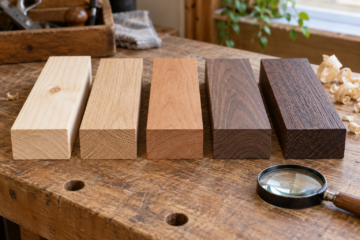
Hard maple is the safest all-round buy for a light-colored handle. Cherry is a good choice if you want a warmer tone and are willing to accept dents more readily. Walnut suits a darker accent, but select a piece with continuous grain at the narrowest part of the handle. Beech is fine for a budget build when the blank is dry and the handle can be sealed carefully.
For a pale, plain handle, look for hard maple blanks. A walnut blank is worth the extra cost when color contrast is part of the design. These are search links, not endorsements of any particular listing; check dimensions, moisture condition and defects before buying.
Choose a finish for the way you wash it
Because a handle is outside the food-contact cutting area, it does not need the same surface treatment as the board face. It still benefits from a finish that slows water uptake and is suitable for incidental food contact once fully cured. A film finish such as a properly cured, food-contact-suitable varnish can provide better water resistance than oil, but a chipped film is harder to maintain and can look rough at an edge.
For a simple, repairable finish, use a food-contact-appropriate drying oil or board finish according to its label. These finishes are easy to refresh but do not make wood waterproof; repeated soaking can still cause swelling, raised grain or a loose joint. Avoid treating “natural” as proof of suitability, and do not use an uncured finish on a handle that will be used with food.
Do not put the whole board in a dishwasher. Heat and long exposure to water can split the wood, distort the handle or weaken its attachment regardless of species or finish. Hand-wash, wipe dry promptly and let the board dry upright with air reaching both faces.
Prep the handle before finishing
Sand the handle progressively, for example with 120, 180 and 220 grit. Remove scratches from each grit before moving on; clear finishes make cross-grain marks more visible, not less. Ease sharp edges so they feel comfortable, but keep enough material around screw holes or pins to resist splitting. Vacuum or brush off dust rather than rubbing it into the grain.
If the wood will be exposed to water, raise the grain before the final sanding: wipe it lightly with a damp cloth, let it dry, then sand the fuzz back with 220 grit. Apply thin coats and follow the product’s stated drying and cure times. A finish can feel dry to the touch while still being soft or unsuitable for regular handling.
For a smooth, low-build finish, food-contact-suitable wood finish is a useful search category. Read the label for intended use, application method and full cure time rather than assuming every product sold for cutting boards has the same water resistance.
Buying and building checks
Buy a blank thick enough to shape without leaving thin, fragile sections. Check that it is flat, dry and free of end checks; if the seller gives a moisture reading, roughly 6–10% is typical for indoor woodworking stock, though local conditions vary. A visibly wet blank can shrink after assembly and leave a gap at the joint.
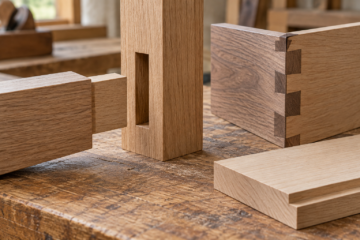
Pay particular attention to how the handle attaches. A beautiful species will not compensate for a weak joint, short screws or a narrow neck with grain running across it. Seal exposed end grain well, since it absorbs moisture faster than face grain. If the handle is removable, keep finish out of the threads and mating surfaces where it could interfere with a tight fit.
Maple is the sensible choice for durability and a light, clean look. Cherry is easier to shape and adds warmth; walnut brings contrast; beech saves money when appearance is secondary. In every case, a sound blank, grain aligned with the handle and careful washing habits matter more than choosing the most expensive wood.

0 Comments