

Key takeaways
- Compare the best table saw blades for fine woodworking, from 40-tooth combination blades to 60-tooth finish blades, with specs on kerf, grind and carbide.
What's inside
As an Amazon Associate I earn from qualifying purchases. This post may contain affiliate links at no extra cost to you.
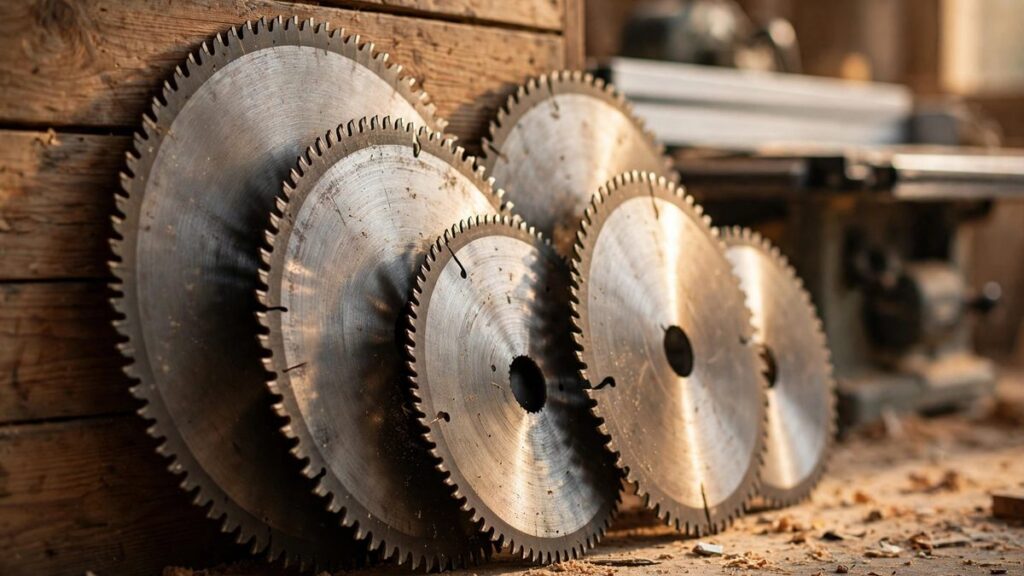
- Top Pick: Forrest Woodworker II WW10407125
- Runner-up: Freud Premier Fusion P410
- Also consider: Freud LU83R010 Thin Kerf Combination Blade
The fastest answer: if you want one blade that rips and crosscuts cleanly enough for furniture work, start with a 40-tooth combination blade such as the Forrest Woodworker II or the Freud Premier Fusion P410. If your saw has a smaller motor, a 50-tooth thin-kerf combination blade like the Freud LU83R010 removes less material and feeds more easily. For crosscut-heavy work and sheet goods, a 60-tooth finish blade such as the CMT 221.060.10 or the Diablo D1060X leaves a smoother edge. The five blades below cover those roles across premium, mid-range, and budget tiers, and each one is a standard 10-inch blade with a 5/8-inch arbor that fits most cabinet, contractor, and hybrid table saws.
As an Amazon Associate, we earn from qualifying purchases.
Table of Contents
- Quick Picks
- Forrest Woodworker II WW10407125
- Freud Premier Fusion P410
- Freud LU83R010 Thin Kerf Combination Blade
- CMT 221.060.10 Industrial Cabinetshop Blade
- Diablo D1060X Fine Finish Blade
- How to Choose a Table Saw Blade for Fine Woodworking
- FAQ
- Conclusion
- Product and ASIN Reference
Quick Picks
- Best overall, premium tier: Forrest Woodworker II WW10407125 — a 40-tooth full-kerf ATB blade with C-4 carbide and a hand-tensioned plate, built for glue-ready rips and polished crosscuts.
- Best general-purpose value, mid-range tier: Freud Premier Fusion P410 — a 40-tooth Hi-ATB full-kerf blade that crosscuts veneered plywood cleanly and still rips solid stock.
- Best for lower-powered saws, mid-range tier: Freud LU83R010 — a 50-tooth thin-kerf combination blade with a grouped ATB and flat-raker grind for easy feeding.
- Best for cabinet and sheet-goods work, mid-range tier: CMT 221.060.10 — a 60-tooth TCG cabinetshop blade with a PTFE-coated full-kerf plate for melamine, laminate, and plywood.
- Best fine finish on a budget tier: Diablo D1060X — a 60-tooth Hi-ATB thin-kerf blade with TiCo carbide and laser-cut stabilizer vents for smooth crosscuts.
Forrest Woodworker II WW10407125

The Woodworker II is the blade most fine woodworkers measure combination blades against. Forrest builds it in the United States with 40 alternate top bevel teeth tipped in C-4 sub-micrograin carbide, and each plate is hand tensioned so it runs flat and true at speed. The full 1/8-inch kerf gives the plate real stiffness, which helps the blade track straight on long rips in thick hardwood, while the 30-degree bevel on the current grind slices crosscut fibers cleanly enough that edges often go straight to glue-up. Forrest also runs a factory sharpening service, so the blade can be restored to its original geometry instead of being replaced.
This is the premium pick of the group, and it suits cabinet and contractor saws with enough power to push a full-kerf plate through dense stock. Owners of smaller benchtop saws may prefer one of the thin-kerf blades below.
Specs
- Model: WW10407125
- Diameter: 10 inches
- Teeth: 40, alternate top bevel (ATB) grind
- Carbide: C-4 sub-micrograin carbide tips
- Kerf: 0.125 inch (full kerf)
- Arbor: 5/8 inch
- Hook angle: 20 degrees
- Plate: hand-tensioned steel, made in the USA
- Best for: ripping and crosscutting solid wood on cabinet and contractor saws
Freud Premier Fusion P410
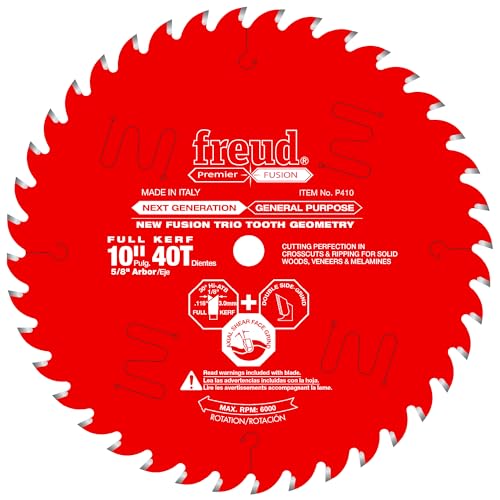
Freud’s Premier Fusion P410 takes a different route to the same one-blade goal. Its 40 teeth use a high alternate top bevel grind with a steep 30-degree bevel, a double side grind, and a shear face angle that slices fibers instead of chopping them. In published terms, that geometry is why the Fusion crosscuts veneered plywood and melamine with very little tear-out while still ripping stock up to moderate thickness. The teeth are Freud’s TiCo hi-density carbide on a full-kerf plate with laser-cut anti-vibration slots and a Perma-SHIELD non-stick coating that resists heat, corrosion, and pitch build-up.
The P410 sits in the mid-range to premium tier and is a strong fit for furniture makers who cut a lot of sheet goods alongside solid wood. A thin-kerf sibling, the P410T, exists for smaller saws, but the full-kerf P410 listed here is the version that suits 3-horsepower cabinet saws best.
Specs
- Model: P410
- Diameter: 10 inches
- Teeth: 40, Hi-ATB grind with double side grind
- Carbide: TiCo hi-density carbide
- Kerf: 0.126 inch (full kerf)
- Plate: 0.098 inch with anti-vibration slots
- Arbor: 5/8 inch
- Hook angle: 18 degrees
- Coating: Perma-SHIELD non-stick coating
- Best for: general-purpose ripping and crosscutting, veneered plywood
Freud LU83R010 Thin Kerf Combination Blade
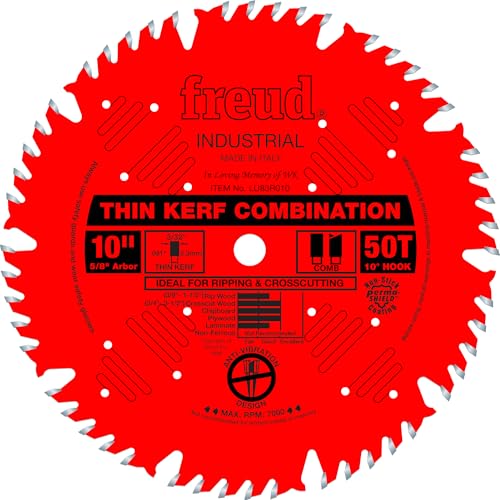
The LU83R010 is Freud’s industrial combination blade in a thin-kerf format, and it is the pick that makes the most sense on contractor, hybrid, and jobsite saws with modest motors. Its 50 teeth are arranged in groups of four alternate top bevel teeth followed by one flat-top raker, with a deep gullet ahead of each group. The ATB teeth score the edges of the cut for clean crosscuts, the raker cleans out the middle, and the deep gullets clear chips quickly during rips. Because the kerf is only 0.091 inch wide, the blade removes noticeably less material per pass than a full-kerf blade, so the saw works less hard in thick stock.
The trade-off is plate stiffness: a thin plate can flex slightly in demanding cuts, and many woodworkers pair thin-kerf blades with a blade stabilizer. For shops that rip and crosscut all day on a smaller saw, the LU83R010 remains a mid-range staple.
Specs
- Model: LU83R010
- Diameter: 10 inches
- Teeth: 50, combination grind (ATB groups with flat-top raker)
- Carbide: TiCo hi-density carbide
- Kerf: 0.091 inch (thin kerf)
- Arbor: 5/8 inch
- Coating: Perma-SHIELD non-stick coating
- Construction: anti-vibration design, laser-cut plate
- Best for: combination ripping and crosscutting on lower-powered saws
CMT 221.060.10 Industrial Cabinetshop Blade

CMT’s 221.060.10 comes from the Italian maker’s industrial line and is built for cabinet shops that live on sheet goods. The 60 teeth use a triple-chip grind, alternating a trapezoidal tooth with a flat tooth, which is the geometry that holds up best in abrasive man-made materials such as melamine, laminate, particleboard, and veneered plywood. The full-kerf plate is PTFE coated in CMT’s signature orange, which sheds pitch and runs cooler, and the carbide is a micrograin formula brazed for heavy production use. On solid wood it crosscuts very cleanly, though the triple-chip grind is slower to rip thick stock than a combination blade.
Choose this blade if most of your table saw work is breaking down panels and crosscutting parts to final size. It is a mid-range industrial blade that pairs well with a dedicated rip blade for thick hardwood.
Specs
- Model: 221.060.10
- Diameter: 10 inches
- Teeth: 60, triple-chip grind (TCG)
- Carbide: micrograin carbide tips
- Kerf: 0.126 inch (full kerf)
- Plate: 0.087 inch
- Bore: 5/8 inch
- Coating: PTFE non-stick orange coating
- Best for: melamine, laminate, plywood, and clean crosscuts in solid wood
Diablo D1060X Fine Finish Blade

The D1060X is the budget-friendly way to get a genuinely fine finish from a 10-inch saw. Diablo, Freud’s value line, gives it 60 high alternate top bevel teeth in TiCo hi-density carbide, a super thin 0.098-inch laser-cut kerf, and laser-cut stabilizer vents that reduce vibration and wobble so the cut edge stays polished. The Perma-SHIELD coating limits corrosion and pitch build-up, and the thin kerf keeps feed effort low on compact and jobsite saws. Diablo rates the blade for fine finish work in wood, plywood, and melamine, and it is at its best crosscutting and trimming rather than ripping thick hardwood all day.
For woodworkers setting up a first shop, or anyone who wants a dedicated finish blade to swap in for final cuts, the D1060X covers that role at a budget tier without giving up carbide quality.
Specs
- Model: D1060X
- Diameter: 10 inches
- Teeth: 60, Hi-ATB grind
- Carbide: TiCo hi-density carbide
- Kerf: 0.098 inch (super thin kerf)
- Arbor: 5/8 inch
- Coating: Perma-SHIELD non-stick coating
- Construction: laser-cut plate with stabilizer vents
- Best for: fine crosscuts, trim work, plywood, and melamine on any 10-inch saw
How to Choose a Table Saw Blade for Fine Woodworking
Match tooth count to the cut. Tooth count is the single biggest driver of cut quality. Blades with 24 to 30 teeth rip quickly but leave a rougher edge. Combination blades with 40 to 50 teeth balance ripping speed against crosscut quality, which is why three of the five blades above sit in that range. Finish blades with 60 to 80 teeth crosscut and cut sheet goods most cleanly, but feed slowly and can burn thick stock on rips. Most fine woodworking shops end up with a combination blade for daily use plus a higher-tooth finish blade for final crosscuts.
Pick a grind for your material. Alternate top bevel teeth slice wood fibers at an angle and are the standard for clean crosscuts in solid wood. A high ATB grind, with a steeper bevel, is gentler on brittle veneers and melamine faces. Combination grinds add a flat-top raker tooth that clears the kerf during rips. Triple-chip grinds pair a trapezoidal tooth with a flat tooth and last longest in abrasive sheet goods such as laminate and particleboard. Flat-top grinds are for dedicated ripping and for cutting flat-bottomed grooves.
Decide between full kerf and thin kerf. A full-kerf blade, at 0.125 inch wide or more, has a thicker, stiffer plate that resists deflection and suits saws of about 3 horsepower and up. A thin-kerf blade, around 0.091 to 0.098 inch, removes less material, wastes less wood, and lets smaller motors work comfortably, at the cost of some plate stiffness. Match the kerf to your saw’s riving knife or splitter as well, since the knife must be thinner than the kerf but thicker than the plate.
Check the basics before ordering. Confirm the blade diameter matches your saw, usually 10 inches, and that the arbor or bore is 5/8 inch. Look for carbide that can be resharpened several times, laser-cut expansion slots and anti-vibration features that keep the plate quiet and stable, and a coating that resists pitch if you cut much pine or plywood. Finally, buy the tier that matches your workload: budget blades cut well but carry less carbide, mid-range industrial blades add plate quality and longevity, and premium blades add the flattest plates and the longest service life between sharpenings.
FAQ
How many teeth should a table saw blade have for fine woodworking?
For a single all-purpose blade, 40 to 50 teeth is the practical range: it rips at a reasonable pace and crosscuts cleanly enough for most furniture parts. If you mostly crosscut or cut plywood and melamine, a 60-tooth finish blade leaves a smoother edge. Shops that rip thick hardwood often add a dedicated 24-tooth ripping blade and swap blades for each job.
Is a thin-kerf or full-kerf blade better?
Neither is universally better; it depends on the saw. Full-kerf blades have stiffer plates that deflect less in hard, thick stock, and they suit cabinet saws with stronger motors. Thin-kerf blades remove less material, so lower-powered contractor and jobsite saws feed more easily and waste less wood. The blade also has to suit your saw’s riving knife, which is sized for one kerf range or the other.
Can one blade handle both ripping and crosscutting?
Yes. Combination and general-purpose blades in the 40-tooth to 50-tooth range are designed to do both jobs without a blade change, using mixed tooth geometry such as ATB teeth with a flat raker. The compromise is that a combination blade rips a little slower than a dedicated rip blade and crosscuts a little less cleanly than a dedicated 60-tooth or 80-tooth finish blade.
How long does a carbide table saw blade last?
Carbide teeth last far longer than steel teeth, and service life depends mostly on what you cut: abrasive sheet goods dull edges faster than clean solid wood. A quality blade can be professionally resharpened several times before the carbide becomes too small, which is one reason premium and mid-range industrial blades often cost less over their working life than budget blades that get replaced instead of sharpened.
Conclusion
For fine woodworking, the blade matters more than almost any other table saw accessory. Start with the Forrest Woodworker II WW10407125 if you want a premium 40-tooth blade that can stay on the saw for nearly everything, or the Freud Premier Fusion P410 for similar versatility with an edge in sheet goods. The Freud LU83R010 brings the same combination-blade idea to smaller saws in thin-kerf form, the CMT 221.060.10 covers cabinet and panel work with a durable triple-chip grind, and the Diablo D1060X delivers a fine finish at a budget tier. Match tooth count and grind to the cuts you make most, keep the blade clean and sharp, and any of these five will leave edges that need little work before glue-up or finishing.
Related guides
More from Amazon
Programs that pair well with the guide above. Offers and eligibility are set by Amazon and may change.
A free business account with business pricing and bulk-buying tools for work, shop or home office.
Create a business accountFree shipping on eligible items, Prime Video and more. Eligible new members can start with a free trial.
Start a Prime free trialAudiobooks and podcasts to listen to on the go. Eligible new members can start with a free trial.
Try Audible freeAd-free music streaming. Eligible new subscribers can start with a free trial.
Try Music Unlimited freeAs an Amazon Associate we earn from qualifying purchases.




Write Your Review
No reviews yet. Be the first to share your experience!