What's inside
As an Amazon Associate I earn from qualifying purchases. This post may contain affiliate links at no extra cost to you.
For stained interior French doors, the best wood is usually clear, straight-grained poplar if you want a painted-looking stain in a controlled color, or cherry if you want a naturally warm, even finish and can spend more. Oak is a strong choice when you want prominent grain. The right pick depends on whether you want the wood itself to show, how much sunlight the doors get, and whether you are buying unfinished doors or finishing them yourself.
As an Amazon Associate we earn from qualifying purchases at no extra cost to you.


Choose by the finish you want
Stain does not hide differences in grain, color, or board quality the way paint does. On a French door, those differences are especially visible across the many narrow muntins and rails. Ask for a sample of the actual door wood, not just a stain chip, and test the full schedule: sanding, conditioner or sealer if needed, stain, and topcoat.
Also confirm whether the door is solid wood, veneered, or a combination. Veneer can look excellent, but sanding through a thin face is an expensive mistake. If you are buying prehung doors, ask which parts are solid and whether the manufacturer permits field staining.
Wood comparison
| Wood | Appearance with stain | Practical trade-off | Best fit |
|---|---|---|---|
| Cherry | Fine, even grain; deepens toward reddish brown with age | Usually costly; sunlight changes its color | Warm, refined look without bold grain |
| White oak | Strong grain, often with ray flecks; medium to dark stains stay legible | Can look busy on small muntins; heavier than poplar | Visible grain and a durable hardwood surface |
| Red oak | Open, pronounced grain; stains readily | Pink or red undertones can shift the final color | Traditional oak appearance at a commonly lower price |
| Poplar | Generally fine grain, but green, gray, or brown streaks may show | Often inexpensive; takes many stains unevenly | Paint, or a carefully tested dark finish |
| Maple | Subtle grain and a pale base | Can blotch, especially with dark stain | Light, natural finishes with controlled preparation |
Which wood to buy
Cherry is the best all-around choice for a warm, stained door when budget allows. Its close grain produces a more consistent surface than open-grained oak, and it usually needs less effort to achieve an even medium-brown finish. Expect the color to darken with time and light exposure; a sample that looks pale today may not match a new door in a few years.
White oak is best when grain is part of the design. It is a good choice for clear or medium stains and can take darker colors while retaining visible grain. Red oak can cost less and is perfectly serviceable, but its warm undertone may make gray or neutral-brown stain look reddish. Do not choose between the two from a stain name alone—test a board.
Poplar is fine if the doors will be painted. It is widely available and typically costs less than cherry or oak. For a transparent stain, its mixed green and brown coloring can make adjacent stiles and rails look like they came from different doors. A very dark stain can disguise some variation, but it does not make poplar equivalent to a consistent fine-grained hardwood.
Maple suits light finishes only with careful testing. Its tight grain looks clean, but color can collect unevenly. If you want maple with a darker stain, look for a product specifically intended to reduce blotching and test it on the same grade and cut of maple as the door.
Prepare the surface without damaging it
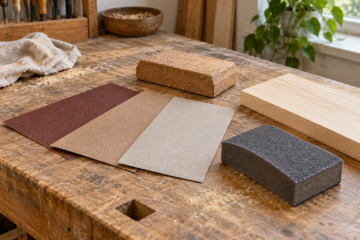
Unfinished solid-wood doors commonly arrive sanded, but inspect them under light from the side. Glue squeeze-out, handling marks, and scratches can become obvious after stain. Start around 120 or 150 grit if the surface needs correction, then finish at 180 grit; for many stains, sanding much finer can reduce absorption and leave a lighter, less even color. Follow the door maker’s instructions, particularly for veneer.
Sand with the grain on broad surfaces. On muntins and inside corners, use a fine sanding sponge or folded abrasive rather than rounding sharp profiles. Vacuum thoroughly and wipe with a clean, dry cloth. Avoid soaking the wood with water or solvent before staining unless the finish system specifically calls for it.
For blotch-prone maple or poplar, use a compatible wood conditioner, washcoat, or gel stain system, but do not assume one product fixes every species. These treatments can also reduce color depth. Compare a conditioned sample with an untreated one before committing. A set of unfinished wood sample boards is useful for testing color and finish compatibility, though a scrap from the actual door is better.
Apply stain and protect the finish
Work with the door laid flat if possible, and stain one face or section at a time. Follow the label’s wet-time and wipe-off directions: leaving stain on longer does not always produce a darker, more even result. Wipe excess from corners and muntin joints, where it can pool and dry tacky. Let the stain dry for the full stated time before topcoating; trapped solvent can cause poor adhesion or a soft finish.
For interior doors, a water-based clear finish tends to preserve a lighter, less amber appearance and dries relatively quickly. Oil-based polyurethane usually adds warmth and can be more forgiving to brush, but it ambers and takes longer to cure. Apply thin coats, lightly scuff between coats as directed, and keep dust off the wet surface. A water-based interior clear finish is a practical category to compare if you want to limit color shift.
French doors have many edges and joints, so do not flood the finish into glass stops, hinges, or the meeting edges. If the doors are hung, protect the floor and hardware, and allow the coating to cure before closing them tightly. Fresh finish can stick to weatherstripping or the paired door, even when it feels dry to the touch.
Before you order
Request the species, whether the faces are veneer, the grade, and a sample finished with your intended stain. Check both sides: color and grain can vary within a door, and paired doors should be selected as a set. If your target is a uniform dark brown, clear cherry or a tested oak may be a safer purchase than inexpensive poplar. If the doors will be painted, poplar is often the sensible way to save money.
For a DIY finish, buy enough stain and clear coat for the full pair plus a test piece, and use one product system from compatible manufacturers where possible. The cheapest wood is a good deal only when its natural variation suits the finish you plan to apply.
0 Comments