What's inside
As an Amazon Associate I earn from qualifying purchases. This post may contain affiliate links at no extra cost to you.
The Ryobi 15-piece router bit set is a practical 1/4-inch-shank starter assortment for trim work, edge shaping, grooves, and basic joinery, but it is not a complete solution for heavy hardwood production or large panel-raising cuts. Its value depends less on having 15 bits than on whether its mix matches the projects you actually build.
As an Amazon Associate we earn from qualifying purchases at no extra cost to you.


Our Top Picks


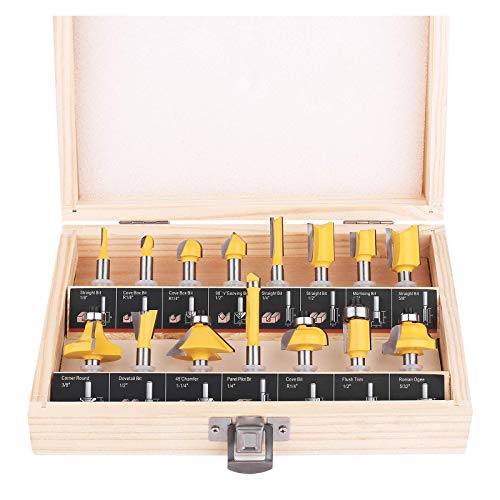
What the Ryobi 15-piece router bit set includes
Ryobi has sold 15-piece 1/4-inch router-bit assortments under different package numbers and regional listings, so the printed insert supplied with your set is the final authority. The commonly advertised assortment contains the following profiles. Measurements below describe the typical cutting diameter or radius category, not a guarantee that every production run has identical dimensions.
| Bit or profile | Typical size in the assortment | Primary use | Useful material limit |
|---|---|---|---|
| 1/4-inch straight bit | 1/4 in cutting diameter | Shallow grooves, dados, mortises, and template work | About 1/4 in per pass in hardwood; deeper in softwood with multiple passes |
| 3/8-inch straight bit | 3/8 in cutting diameter | Wider dados, shelf grooves, and general recesses | About 1/8–1/4 in per pass |
| 1/2-inch straight bit | 1/2 in cutting diameter | Wide grooves and pattern-routing jobs | Keep early passes near 1/8 in in hardwood |
| 1/4-inch roundover | 1/4 in radius | Small eased edges, toys, shelves, and thin trim | Best on stock at least about 1/2 in thick |
| 3/8-inch roundover | 3/8 in radius | Furniture edges and larger hand-friendly profiles | Best on stock at least about 3/4 in thick |
| 1/2-inch roundover | 1/2 in radius | Large soft edges and table components | Usually needs 1-inch-or-thicker stock for a full profile |
| 1/4-inch cove | 1/4 in radius | Decorative channels and inside edge details | Use shallow passes; narrow workpieces need secure clamping |
| 3/8-inch cove | 3/8 in radius | Furniture and cabinet decoration | Several light passes in hardwood |
| 1/2-inch cove | 1/2 in radius | Large concave molding details | Requires thick stock and a stable router setup |
| Chamfer bit | Commonly 1/4–1/2 in cutting size | Beveled edges, frame details, and easing corners | One light pass may work in softwood; step down in hardwood |
| Rabbeting bit | Typically about 1/2 in cutting diameter | Back-panel rebates, case shoulders, and glass-frame work | Take the full depth in multiple passes if the rebate is deep |
| Flush-trim bit | Typically about 1/2 in cutting diameter | Following a template or trimming veneer and edging flush | Keep template overhang modest; remove excess in stages |
| V-groove bit | Small to medium V profile | Sign lettering, panel lines, and decorative grooves | Shallow passes are safer and produce cleaner points |
| 45-degree bevel or similar edge bit | Usually a small-to-medium bevel | Decorative bevels and box edges | Do not remove the entire bevel in one pass on dense wood |
| Ogee or Roman-ogee bit | Medium decorative profile | Cabinet doors, shelf edges, and furniture moldings | Needs sufficiently thick stock and multiple passes |
The profile names and exact sizes can overlap in manufacturer listings: for example, a package may identify a decorative edge as an ogee while another identifies a similar cutter as a Roman ogee. Check the etched marking or package diagram before planning a project around one specific radius.
Shank size and router compatibility
The defining specification is the 1/4-inch shank. These bits fit Ryobi compact routers and full-size Ryobi routers equipped with a 1/4-inch collet, as well as compatible routers from other manufacturers. They do not fit a 1/2-inch collet unless the router maker provides an approved reducing collet, and a 1/2-inch collet cannot accept a 1/4-inch bit without the correct adapter.
Insert the shank fully while leaving a small gap at the bottom of the collet, then withdraw it slightly before tightening. Do not grip the cutter portion, and do not leave most of the shank exposed. A short effective insertion increases the chance of vibration or pullout.
How much project coverage does it provide?
For a beginner, coverage is good for four common categories:
- Edge treatment: roundovers, chamfers, coves, and an ogee cover most basic shelf, tabletop, and box edges.
- Grooves and recesses: three straight bits cover several common dado and groove widths, although they do not replace a complete sizing system.
- Template work: a flush-trim bit is useful for duplicating parts, trimming laminate, and cleaning up curved components.
- Decorative work: the V-groove and shaped edge cutter add sign, panel, and cabinet details.
Coverage is weaker for serious joinery. You may still need a larger straight bit, a dedicated pattern bit with a top bearing, a rabbeting bit with interchangeable bearings, a dovetail set, a mortising bit, and a panel-raising bit. The set should therefore be viewed as a general-purpose foundation rather than a cabinetmaking system.
Cutting limits that matter more than the bit count
Router bits remove material at high speed, so the practical limit is usually heat, vibration, and the router’s control—not whether the cutter can technically reach a particular depth. A useful starting rule is to remove approximately 1/8 inch per pass in hardwood and dense plywood, increasing only when the router remains stable and the cut is clean. Softwood can often tolerate a deeper pass, but a deep cut still increases kickback risk.
A full-profile roundover illustrates the sizing issue. A 1/4-inch-radius roundover needs roughly 1/2-inch-thick stock to form the complete quarter-circle. A 1/2-inch-radius bit generally needs stock close to 1 inch thick. On thinner material, the bit may cut into the face or leave a partial profile. Test on scrap with the same thickness before routing the project.
Large-profile bits also impose a speed limit. Use the router manufacturer’s recommended maximum speed for the cutter diameter, keep both hands on the router, and feed steadily. Never force a dull or smoking bit through hardwood.
Who should buy it?
| Situation | Fit of this set | Better buying decision |
|---|---|---|
| First router, occasional shelves and small furniture | Strong fit | Buy the set if the router accepts 1/4-inch shanks and you also have straightedge guides and clamps |
| Limited workshop space | Good fit | One compact case supplies varied profiles without separate storage |
| Frequent cabinet or built-in construction | Partial fit | Use it as a starter set, then buy task-specific bearing, mortising, and joinery bits |
| Mostly hardwood, production routing, or thick slabs | Limited fit | Consider premium individual bits and a 1/2-inch-shank router system where supported |
| Already owning many 1/4-inch bits | Weak fit | Buy individual profiles you need rather than duplicating common roundovers and straights |
Durability and ownership realities
In a mixed kit, straight bits and flush-trim bearings often show wear first because they are used for deeper cuts and template contact. The cutting edges may remain usable while the bearing becomes noisy, stiff, or contaminated with resin. A bearing that does not spin freely should be replaced rather than lubricated with a random household oil.
Clean pitch and dust from the cutters after use with a resin-safe bit cleaner and a soft brush. Do not scrape carbide with steel or clamp bits against one another in the case. Store them dry, keep the cutting edges separated, and inspect for chipped carbide before every use. A chipped bit can ruin a workpiece and create an unsafe imbalance.
These are general-purpose consumer-grade bits, so lifespan depends heavily on material and technique. Clean softwood and plywood are comparatively forgiving; abrasive MDF, laminates, particleboard, and dirty reclaimed lumber shorten edge life. Feed too slowly and the bit rubs instead of cuts, creating heat. Feed too quickly and the cut becomes rough or the router may bog down.
Bottom line
The Ryobi 15-piece router bit set makes sense for a beginner or occasional woodworker who wants broad coverage at a general market price typically below buying 15 comparable individual bits. Its 1/4-inch shank, several edge profiles, straight cutters, rabbeting capability, and flush-trim function cover many household woodworking jobs. It is less suitable for a professional who needs exact bearing sizes, long-term production durability, large panel profiles, or specialized joinery. Buy it for variety and convenience, then replace the most-used cutters individually when wear or project requirements justify the upgrade.


0 Comments