What's inside
- The short answer: choose the JET 16-32 for narrower work and tighter space; choose the 22-44 when you regularly sand panels wider than 16 inches and want more capacity per pass.
- JET 16-32 vs. 22-44: the practical differences
- Choose by the work you actually do
- What double passes demand from alignment
- Feed speed, finish, and stock removal
- Dust collection: plan for real airflow, not just a port size
- Ownership costs and common wear points
- Bottom line
- What to Look For When Running Either Sander
- Which One Should You Buy?
- Common Mistakes When Buying a Drum Sander
- Questions
As an Amazon Associate I earn from qualifying purchases. This post may contain affiliate links at no extra cost to you.
Our Top Picks

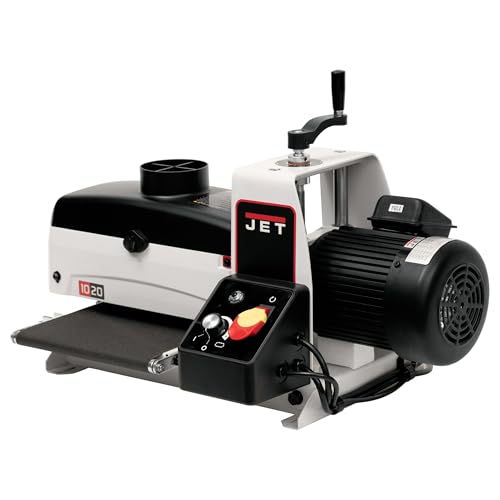


The short answer: choose the JET 16-32 for narrower work and tighter space; choose the 22-44 when you regularly sand panels wider than 16 inches and want more capacity per pass.
Both are open-end drum sanders: their single drum sands one face of a board at a time, and you can feed a wider panel through again after turning it end-for-end. That double-pass method is useful, but it depends on keeping the drum aligned and overlapping the passes consistently. Neither model replaces a planer for removing substantial stock quickly; drum sanders excel at controlled finishing, thicknessing thin or figured stock, and sanding glued-up panels.
JET 16-32 vs. 22-44: the practical differences
The model numbers indicate the approximate maximum sanding width in one pass. The 16-32’s drum is about 16 inches long; the 22-44’s is about 22 inches. Both can handle work roughly twice that width with two passes, provided the material and pass technique suit the machine.
As an Amazon Associate we earn from qualifying purchases at no extra cost to you.


| Specification | JET 16-32 | JET 22-44 |
|---|---|---|
| Maximum width, one pass | About 16 in. | About 22 in. |
| Maximum width, two passes | About 32 in. | About 44 in. |
| Typical conveyor speed range | 0–10 ft/min | 0–10 ft/min |
| Drum speed | About 1,720 rpm | About 1,720 rpm |
| Drum abrasive | 2-in.-wide strip | 3-in.-wide strip |
| Typical dust-collection connection | 4-in. port | 4-in. port |
| Best fit | Small shop, narrow stock, occasional panels | Frequent wide panels, more working room |
Specifications can vary by exact generation and configuration, so check the manual and nameplate for the particular machine you are buying. The key distinction is capacity, not a fundamentally different sanding process. The 22-44’s wider drum and abrasive can cover more of a panel in each pass, while the 16-32 is easier to justify when most stock is narrower and floor space or budget is limited.
Choose by the work you actually do
| Your situation | Better fit | Why |
|---|---|---|
| Mostly boards and parts under 16 in. wide | 16-32 | You avoid paying for width you rarely use. |
| Cabinet doors, tabletops, or panels commonly 16–22 in. wide | 22-44 | More of each panel fits in one pass, reducing double-pass work. |
| Panels 22–32 in. wide, only now and then | Either, with trade-offs | The 16-32 can handle them with careful double passes; the 22-44 is more convenient. |
| Regular panels wider than 32 in. | 22-44 | Its approximate 44-in. two-pass capacity gives more useful coverage. |
| Limited floor space or occasional use | 16-32 | The smaller capacity is often a better match for a compact shop. |
| Frequent production of wide, flat parts | 22-44 | Greater width can mean fewer passes and less handling per panel. |
These are open-end machines, not pass-through sanders with unlimited width. “32 inches” or “44 inches” describes an approximate double-pass capacity, not a guarantee that every panel of that width will sand perfectly. Long, heavy, flexible, or uneven panels need careful support and feed control. For work wider than the machine’s two-pass capacity, a larger-format sander may be a better choice.
What double passes demand from alignment
With a panel wider than the drum, you sand one half, then turn the panel end-for-end and run the other half through. The aim is for the abrasive to blend across the center without leaving a ridge or sanding a hollow. This is where setup and technique matter more than the nominal maximum width.
- Check drum parallelism. The drum should sit parallel to the conveyor table. A skewed drum can sand one edge deeper and make the overlap difficult to blend.
- Use a shallow cut. Lower the drum in small increments, especially when first tuning a machine or sanding a wide panel. Heavy cuts increase heat, loading, and the risk of uneven results.
- Keep the panel registered. Mark the centerline or use a consistent reference edge, and feed the panel in the same orientation each time. Turn it end-for-end for the second pass, rather than flipping it face-down.
- Overlap steadily. Let the drum cross the center seam enough to blend the two passes. If a ridge persists, check alignment and feed consistency before taking off more material.
- Support long stock. Infeed and outfeed support helps keep a wide panel level as it meets and leaves the conveyor.
Before sanding valuable stock, check alignment using the manufacturer’s procedure and a test board. A simple practical check is to compare the sanding marks or measured thickness at both sides of a test piece, then adjust according to the manual. Do not assume the machine will stay perfectly aligned after moving, changing a stand, or adjusting the table.
Feed speed, finish, and stock removal
Both models typically offer a variable conveyor speed from roughly 0 to 10 feet per minute. The slower end gives the abrasive more time on the work and is useful for a finer finishing pass or difficult material. Faster feed can improve throughput on a light pass with a sharp, clean abrasive. The right setting also depends on grit, wood species, width, and how much material you are removing.
For example, a 6-foot board takes about 36 seconds to travel through at 10 feet per minute, or about 72 seconds at 5 feet per minute, not counting loading and repeat passes. That simple estimate illustrates why feeding more slowly can make a noticeable difference in batch time. It does not mean that one speed suits every board: watch for burning, chatter, or deep scratches, and adjust the cut depth, abrasive condition, and feed rate together.
Use a planer or another suitable machine for faster, heavier stock removal when the stock allows it. A drum sander is especially useful for thin parts that could be risky to plane, figured grain that may tear out under knives, and bringing assembled panels to a consistent finish. Avoid feeding loose, unstable, or very short pieces unless the manual specifically permits them.
Dust collection: plan for real airflow, not just a port size
Both models use a 4-inch dust port, but port diameter is not the same as required airflow. As a practical target, plan for roughly 400 CFM or more at the machine under working conditions; a collector advertised at that number may deliver less once duct length, elbows, filters, and a restrictive hose are included. A system that can maintain approximately 400–600 CFM at the sander is a more comfortable range for frequent use.
Use a short, smooth 4-inch connection where possible, keep the filter clean, and check that the hose and collector are not clogged. Fine sanding dust can escape when airflow is weak, and abrasive buildup can reduce collection further. A properly sized dust collector and suitable respiratory protection are sensible shop controls; do not rely on the machine’s port alone to contain dust.
Ownership costs and common wear points
The recurring consumable is the abrasive strip. Wider work, coarse grits, resinous woods, and aggressive cuts can load or wear it sooner. Keep spare strips in the widths required by the machine, and clean or replace the abrasive when it stops cutting efficiently rather than compensating with excessive pressure or a very slow feed. Keep the conveyor clean as well: dust and pitch can affect how stock tracks.
When comparing prices, treat the purchase price as only part of the decision. Allow for abrasives, dust collection, infeed and outfeed support, and the space to move long panels safely. General market prices vary with model generation and included equipment, so compare current quotes for the exact configuration rather than assuming every 16-32 or 22-44 package is identical.
Bottom line
For a small shop sanding mostly narrow boards, the JET 16-32 is the more proportionate choice: it offers the same basic open-end approach without committing to the larger machine’s capacity and footprint. Choose the 22-44 if wide panels are routine, or if repeated double passes would slow work you do often. In either case, good drum alignment, light passes, consistent panel registration, and dust collection with adequate airflow matter more to the finished surface than chasing the maximum width printed in a specification.
What to Look For When Running Either Sander
Abrasive grit sequence
Drum sanders reward patient grit progression. A common sequence starts around 80 grit to flatten, then moves to 100, 120, and 150, with finer grits only if the finishing plan demands them. Skipping more than one step leaves deeper scratches that the next paper may not erase, and jumping to a very fine grit too early can burnish the surface instead of cutting it. Light cuts, often around 1/64 inch or less per pass, are a widely used starting point for coarse paper; follow the manufacturer’s guidance for the machine.
Conveyor feed and tracking
Both machines move the work on a conveyor belt, and the belt must track straight with even pressure under the drum. A belt that drifts or slips produces uneven feed marks. Confirm the speed range and adjustment method on the listing for the model you pick, and expect to recheck tracking occasionally.
Stock suited to a drum sander
These machines excel at flattening glued-up panels, thicknessing thin stock, and leveling joints. They are poorly suited to very short pieces, since the stock must span the gap between the drum and the conveyor support, and to boards carrying dried glue or resin, which clog the abrasive quickly. Cleaning sticks made from crepe rubber can extend paper life by lifting residue from the surface.
Drum height control
Look at how the head is raised and lowered, and how the thickness is read. A smooth crank and a clear scale make small, repeatable adjustments easy, while a sticky or imprecise mechanism makes you guess. Setting the depth by a small fraction of a turn between passes is part of the routine, so it should feel controlled rather than loose.
Which One Should You Buy?
| If you… | Choose… |
|---|---|
| Build small cabinets, boxes, and drawer parts | The 16-32 |
| Have a small shop with limited floor space | The 16-32 |
| Glue up tabletops and wide panels | The 22-44 |
| Want fewer double passes on wide stock | The 22-44 |
| Rarely sand wider than 16 inches | The 16-32, saving space and effort |
Common Mistakes When Buying a Drum Sander
- Buying capacity you do not need. A wider machine takes more floor space, more dust collection, and larger replacement paper.
- Assuming it replaces a planer. A drum sander removes small amounts of stock, so it is a finishing tool, not a thicknessing workhorse.
- Underestimating dust. Fine sanding dust needs substantial airflow at the machine, so plan the collector before the sander arrives.
- Overlooking consumables. Abrasive strips wear out, and a stock of the grits you use should be part of the plan.
- Taking heavy cuts. Aggressive passes burn paper, stall the conveyor, and leave visible lines.
Questions
Why do I see lines across a panel after sanding?
Lines usually trace back to a loaded or damaged strip, a drum that is not level, or a final grit that was too coarse. Resin buildup is another common cause.
Can I sand narrow stock?
Yes, but sanding narrow pieces in the same lane repeatedly wears one spot on the paper. Spreading work across the drum’s width distributes the wear.
Do these machines need a stand?
Many owners add a stand or mobile base for stability and convenient height, so confirm what ships with the model.
Is a drum sander good for figured wood?
It is a popular choice for figured or tricky grain, because the abrasive does not tear out the way a planer knife can.

0 Comments