What's inside
As an Amazon Associate I earn from qualifying purchases. This post may contain affiliate links at no extra cost to you.
The Genmitsu CNC 3018-PRO is a sensible starter machine for small signs, engraving, and shallow cuts in wood, provided you plan around its compact work area and modest rigidity. It is not a good fit for large panels, fast production, or deep cuts in hardwood without patience and careful setup.
As an Amazon Associate we earn from qualifying purchases at no extra cost to you.


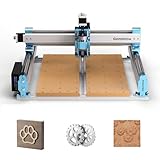

What the 3018-PRO can—and cannot—fit
“3018” describes the machine’s approximate working envelope: about 300 × 180 mm (11.8 × 7.1 in) of X–Y travel. That is travel, not guaranteed usable stock size. Clamps, cutter clearance, and the shape of the workpiece can reduce the practical area. Its Z travel is roughly 45 mm (1.8 in), but the space available for material is lower once the spindle mount, bit, and bed height are considered.
Dimensions and included hardware can vary by package and revision, so check the exact listing before buying. The figures below are useful planning estimates, not a substitute for confirming a specific machine’s documentation.
| Planning detail | Approximate 3018-PRO figure | What it means for a project |
|---|---|---|
| X–Y travel | 300 × 180 mm (11.8 × 7.1 in) | Suited to coasters, small signs, tags, and decorative panels; leave room for workholding. |
| Z travel | About 45 mm (1.8 in) | Enough for shallow relief and engraving, but not a promise that a 45 mm-thick blank will fit. |
| Spindle class | Typically a low-power DC spindle, around 775 motor size | Best treated as a light-duty engraving and routing setup, not a full-size router. |
| Frame and motion | Compact aluminum-frame kit with lead-screw axes | Small footprint, but cutting forces and looseness can show up as chatter or poor detail. |
| Typical work materials | Wood, plastics, and some soft metals with suitable tooling and conservative cuts | Material suitability depends on the bit, feed, depth, rigidity, and machine configuration. |
Wood-cutting performance: think shallow passes
For wood, the main limitation is not whether the spindle can turn a bit; it is whether the frame, workholding, and cutter can stay stable while the bit removes material. The 3018-PRO is most comfortable doing engraving, lettering, and shallow profiles in plywood, softwood, and other relatively forgiving stock. Small cutters and light passes reduce the cutting force that can flex the machine or pull the work loose.
Dense hardwood, wide cutters, and deep slots are less forgiving. They can produce chatter, fuzzy edges, stalled cuts, or broken bits if the feed and depth are too aggressive. A CNC 3018-PRO can cut more demanding stock in carefully chosen conditions, but it is better to regard that as slow, light-duty work—not as evidence that the machine can routinely hog out hardwood like a larger, more rigid router CNC.
A practical starting point for a first wood job
- Choose a flat blank that fits within the machine’s travel, with extra margin for clamps and tool movement.
- Secure the stock firmly to a spoilboard. If it shifts, even a shallow cut can spoil the job or break a cutter.
- Use a sharp, small-diameter cutter appropriate for the wood and toolpath. Avoid asking a tiny bit to remove a wide, deep channel in one pass.
- Set a conservative depth per pass, then make a test cut in scrap. Listen for chatter and check that the edges are clean before running the full design.
- Keep chips clear and avoid unattended operation. A small CNC still has a rotating cutter, moving axes, and dust-producing work.
There is no single reliable feed-and-depth recipe for every 3018-PRO: spindle condition, cutter geometry, wood species, and machine tuning all matter. Use the tool maker’s guidance as a starting point, and adjust based on test cuts rather than forcing a struggling machine through the job.
Assembly and setup: budget time for tuning
The 3018-PRO is commonly sold as a kit, so assembly is part of the purchase. Expect to install the frame and gantry, fit the lead screws and motors, mount the spindle, connect wiring, and square the axes. The instructions and included accessories differ by package; confirm whether a control board, offline controller, power supply, and spindle are included before comparing prices.
Assembly accuracy affects cut quality. A frame that is out of square can make a rectangular design come out skewed, while loose couplers or gantry parts can introduce backlash and vibration. Before cutting, check that the gantry moves smoothly, screws are secure, the spindle is aligned, and the work surface is level enough for the job. Recheck fasteners after initial use, since vibration can loosen them.
Software and controller setup can also take longer than the physical build. Confirm the machine’s controller and firmware instructions, set the correct work origin, and test axis movement with the bit clear of the stock. A short air-cut—running the toolpath above the material—helps catch wrong dimensions, origin mistakes, or unexpected travel before a cutter touches the work.
Which buyer is the compact size right for?
| Your situation | Fit | Reason |
|---|---|---|
| First CNC, low budget, occasional small projects | Good starting point | Compact and relatively approachable, with room to learn CAD/CAM and workholding. |
| Limited bench space and projects under roughly 300 × 180 mm | Potentially a good fit | Its travel is useful for small parts, but measure the full machine footprint and allow room for access and dust control. |
| Frequent production or deep cuts in hardwood | Usually the wrong scale | Slow, conservative passes and a light frame limit throughput; a more rigid, larger machine is a better match. |
| Large signs, furniture parts, or full-size panels | Poor fit | The work area is too small unless the design can be divided into accurately registered sections. |
| Buyer who wants a ready-to-run appliance | Use caution | Kit assembly, calibration, software setup, and troubleshooting are part of ownership. |
Upgrades worth considering—and their limits
Useful improvements depend on the problem you are trying to solve. Better workholding, a flat spoilboard, and a dust-management plan can improve results without changing the machine’s basic architecture. A sharper set of suitable cutters helps with edge quality, but cutters remain consumables: they dull, collect resin, and can snap when overloaded.
Some owners look at spindle, controller, limit-switch, or frame upgrades. Check compatibility with the specific 3018-PRO revision before buying parts; connector, voltage, mounting, and firmware details can differ. A spindle upgrade may improve available power, but it does not automatically make the frame more rigid or increase travel. Likewise, a larger cutter can raise cutting forces and make chatter worse. If your regular jobs exceed the machine’s travel or rigidity, upgrading to a more capable CNC is often more effective than turning the 3018-PRO into a chain of add-ons.
Ownership realities and verdict
Keep the lead screws and rails free of chips, inspect fasteners and couplers, and clean the spindle area after dusty jobs. Wood dust can accumulate around moving parts and electronics, while resin can build up on cutters. A loose workpiece, a dull bit, or an overly ambitious pass is more likely to cause a disappointing cut than a lack of advanced features.
Choose the Genmitsu 3018-PRO if you want an affordable way to learn CNC routing and mainly make small, shallow wood projects, and you are comfortable assembling and tuning a kit. Skip it if your work demands large panels, reliable production speed, or routine deep hardwood cutting. Its compact size is a genuine advantage for a small bench—but only when your projects fit inside the usable area, not merely inside the machine’s advertised travel.
0 Comments