RP Woodworks

  • Home
  • Reviews
  • Projects
  • Tools
  • Woodworking Techniques
  • About

Staining & Dyes

Choosing and applying wood stains, dyes, toners and color washes for even, predictable color.

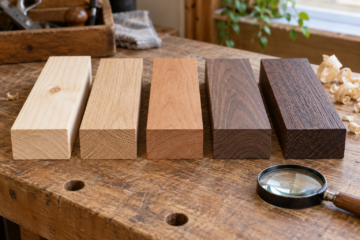
AI-generated editorial illustration: five wooden board samples showing different grain textures and colors.
Staining & Dyes

Best Wood for a Stained Interior Handrail

The best wood for a stained interior handrail is usually red oak: it is widely available, holds up well to daily contact, and takes stain more predictably than many cheaper softwoods. But the right choice depends on the look you want and whether you are staining a new rail or Read more

By , 2 weeksSeptember 25, 2026 ago
AI-generated editorial illustration: five wooden board samples showing different grain textures and colors.
Staining & Dyes

Best Wood for Stained Kitchen Cabinet Face Frames

For stained kitchen cabinet face frames, the best wood is usually hard maple, red oak, white oak, cherry, or alder. The right choice depends less on strength than on how much grain, color variation, and blotching you are willing to accept. Face frames are narrow, highly visible parts, so inconsistent Read more

By , 2 weeksSeptember 25, 2026 ago
AI-generated editorial illustration: five wooden board samples showing different grain textures and colors.
Staining & Dyes

Best Wood Species for a Pale Whitewash on Furniture

A pale whitewash works best when the wood underneath has a quiet grain and a light, even color. Species matters: the same white stain can look airy on maple, striped on oak, and muddy on red-toned pine. Before choosing a product, test it on the actual furniture—ideally on an inconspicuous Read more

By , 2 weeksSeptember 25, 2026 ago
AI-generated editorial illustration: five wooden board samples showing different grain textures and colors.
Staining & Dyes

Best Wood Species for an Even Honey-Colored Stain

A warm honey-colored stain looks simple, but the final color depends as much on the wood as the stain. The best results come from species with a fairly even grain, moderate absorption, and a naturally warm base color. Oak, ash, alder, and pine can all work, but they do not Read more

By , 2 weeksSeptember 25, 2026 ago
AI-generated editorial illustration: five wooden board samples showing different grain textures and colors.
Staining & Dyes

Best Wood for Stained Interior Door Casing

Interior door casing is visible at eye level, so uneven stain, glue marks, and mismatched grain show more than they do on many trim boards. The best wood depends on the look you want and how much preparation you’re willing to do. For most stained casing, poplar is a poor Read more

By , 2 weeksSeptember 25, 2026 ago
AI-generated editorial illustration: five wooden board samples showing different grain textures and colors.
Staining & Dyes

Best Wood for a Stained Bathroom Towel Shelf

For a stained bathroom towel shelf, the best all-around choice is straight-grained white oak. It is hard, stable when properly dried, and takes stain more evenly than many open-grained woods. Teak is a strong alternative if you want a naturally water-resistant wood and are willing to pay more. The shelf’s Read more

By , 2 weeksSeptember 25, 2026 ago
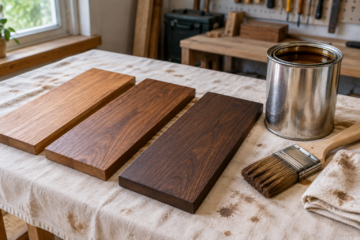
AI-generated editorial illustration of wood stain
Staining & Dyes

How to Choose a Stain Color for Warm and Cool Wood Tones

Choosing a stain color is easier when you look at the wood’s undertone before you look at the stain can. A finish that looks neutral on one species can turn orange, muddy, or gray on another. The goal is not to make every board match a color sample; it is Read more

By , 2 weeksSeptember 25, 2026 ago
AI-generated editorial illustration of wood stain
Staining & Dyes

How to Compare Transparent, Semi-Transparent, and Solid Wood Stains

Wood stain labels describe how much grain and color variation will remain visible—not how much protection the finish provides. A transparent stain shows the most wood; a solid stain hides the most. Between them, semi-transparent stain adds color while leaving much of the grain visible. The right choice depends on Read more

By , 2 weeksSeptember 25, 2026 ago
AI-generated editorial illustration of wood stain
Staining & Dyes

How to Wipe Back Wood Stain for a More Even Color

Why wipe back stain? Wiping back means applying stain, letting it sit briefly, then removing the excess with a clean cloth. It gives you more control over color than brushing on stain and leaving a thick film. The technique works well with penetrating oil-based and water-based stains, but it cannot Read more

By , 2 weeksSeptember 25, 2026 ago
AI-generated editorial illustration of wood stain
Staining & Dyes

How to Layer Wood Dye and Stain for a Custom Color

Layering wood dye and stain is a practical way to get a color that is deeper, warmer, or more even than either product can produce alone. Dye changes the wood’s base color by soaking into the fibers, while stain usually leaves more color in the pores and on the surface. Read more

By , 2 weeksSeptember 25, 2026 ago

Posts pagination

Previous 1 … 6 7 8 … 16 Next
Recent Posts
  • Best Woodworking Clamps: Which Types to Buy and How Many You Need
  • Best Pocket Hole Jigs in 2026: Kreg, Massca and Milescraft Compared
  • Best Dovetail Jigs: Fixed, Multi-Template and Variable-Spacing Options Explained
  • Best Compact Wood Routers: Corded vs Cordless Picks for Edge Work and Trimming
  • How to Repair a Wood Split Caused by a Screw (Even in Thin Teak)
Recent Comments
No comments to show.
Archives
  • October 2026
  • September 2026
Categories
  • Clear Coats & Topcoats
  • Finish Problems & Fixes
  • Gift Guides
  • Grain Filling & Sealing
  • Guides
  • Oils & Waxes
  • Painting & Priming
  • Sanding & Surface Prep
  • Shop Setup & Safety
  • Staining & Dyes
  • Tool Troubleshooting
  • Tools
  • Wood Finishing
  • Wood Species & Lumber
  • Woodworking Techniques
Hestia | Developed by ThemeIsle