

Our Top Picks
 WEN Benchtop Belt and Disc Sander with 46-inch Disc w/ Cast Iron Base22 x 11 x 12.5 inchesCheck on Amazon
What's inside
As an Amazon Associate I earn from qualifying purchases. This post may contain affiliate links at no extra cost to you.
- Top Pick: Makita 9403 4 by 24 Inch Belt Sander
- Runner-up: Makita 9903 3 by 21 Inch Belt Sander
- Also consider: WEN 6321 7-Amp 3 by 21 Inch Belt Sander
A belt sander is the tool to reach for when a surface needs fast, even stock removal. A random-orbit sander is better for fine finishing, but neither it nor a hand plane levels a rough board, strips an old finish, or flattens a glued-up panel as quickly as a belt sander. The right model depends on the size of the work, the material, and how often it will be used.
This guide covers handheld belt sanders for doors, tabletops, decks, and floors, plus two benchtop belt and disc sanders for small parts. Each pick is described from its published specifications, including belt size, motor power, belt speed, weight, and dust collection.
As an Amazon Associate, we earn from qualifying purchases.
Quick answer
For heavy stock removal on large, flat surfaces, choose the Makita 9403, with its 11-amp motor and 4 by 24 inch belt. For mixed work that needs speed control, choose the Makita 9903. For occasional home use on a budget, choose the WEN 6321. For benchtop sanding of small parts, choose the WEN 6502T or the compact WEN 6515T.
How to choose
Start with belt size. A 4 by 24 inch belt covers a wide area and levels large panels with fewer passes, but the sander is heavier and harder to control on narrow parts. A 3 by 21 inch belt is the most common handheld size, with belts that are easy to find in many grits, and it suits doors, cabinet parts, and general woodworking. A 1 by 30 inch benchtop belt is made for edges, curves, and small pieces rather than broad surfaces.
Motor power matters when the belt is under load. A higher amp rating usually means the sander holds its speed better when pressed into hardwood or an old finish. An 11-amp motor is built for sustained, heavy removal, while a 7-amp motor is enough for occasional smoothing and paint removal on softwood.
Speed control is the next decision. A single-speed sander is simple and suits straightforward stock removal. A variable-speed dial lets the belt run slower for paint, veneer, and softwood, and faster for rough lumber. Dust collection and weight also matter: a dust bag keeps much of the dust off the workpiece, a dust port allows connection to a shop vacuum, and a heavier sander stays flat while a lighter one is easier to use overhead. Check belt-change design, belt tracking, cord length, included grit, and warranty length before buying.
Makita 9403 4 by 24 Inch Belt Sander

The Makita 9403 is the heavy-duty pick in this guide, and the premium tier choice for large, flat work. Its 11-amp motor drives a 4 by 24 inch belt at 1,640 feet per minute, which gives it the fastest stock removal of the handheld models here. That combination suits levelling glued-up panels, smoothing rough-sawn boards, refinishing tabletops, and working on floors and decks where a wide belt saves time.
Makita lists the noise level at 84 dB, and the labyrinth construction seals the motor and bearings against dust. The front grip is large and positioned for control, and the sander can sand flush to a wall. The dust bag swivels a full 360 degrees, so it can be moved out of the way. This is a single-speed sander, and at 12.6 pounds it suits bench and floor work better than overhead sanding.
Specs:
- Belt size: 4 by 24 inches
- Motor: 11 amps, corded electric
- Belt speed: 1,640 feet per minute
- Noise level: 84 dB
- Weight: 12.6 pounds
- Dust collection: 360-degree swivelling dust bag
- Warranty: 1-year limited
- Tier: premium
- ASIN: B0000223IY
Makita 9903 3 by 21 Inch Belt Sander

The Makita 9903 is the versatile premium pick for woodworkers who want one handheld belt sander for mixed work. Its 8.8-amp motor drives a 3 by 21 inch belt, the most widely stocked handheld belt size, and the variable-speed dial runs from 690 to 1,440 feet per minute. That range lets the same tool strip a finish at high speed and then slow down for paint, veneer, and softwood.
Electronic speed control maintains constant speed under load, and the auto-tracking belt system keeps the belt centred. The sander sands flush to a wall with its nose and side, which helps in corners and along edges. Makita lists the noise level at 84 dB, and the published weight is 9.5 pounds, which makes it easier to handle than the larger 9403 on doors and cabinet parts.
Specs:
- Belt size: 3 by 21 inches
- Motor: 8.8 amps, corded electric
- Belt speed: 690 to 1,440 feet per minute, variable
- Noise level: 84 dB
- Weight: 9.5 pounds
- Cord length: 16.4 feet
- Dust collection: dust bag included
- Warranty: 1-year limited
- Tier: premium
- ASIN: B000056NOC
WEN 6321 7-Amp 3 by 21 Inch Belt Sander
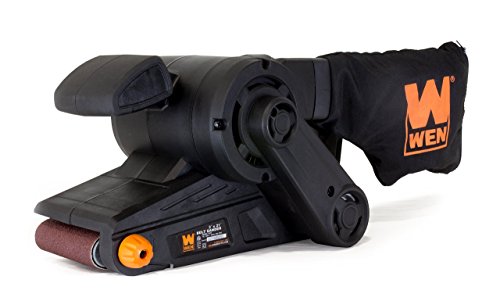
The WEN 6321 is the budget tier pick for occasional home use. It uses the same 3 by 21 inch belt size as the Makita 9903, so belts are easy to find, but it is a simpler single-speed machine with a 7-amp motor. The belt runs at 820 feet per minute, which is enough for smoothing rough lumber, stripping paint, knocking down edges, and cleaning up deck boards and furniture parts.
At 6.2 pounds it is the lightest handheld sander in this guide, which makes it easier to use on vertical surfaces and for longer sessions. The front roller can reach into tight corners, and a lock-on button allows continuous sanding without holding the trigger. A detachable dust bag is included, and belt changes use a tool-free release lever. There is no variable speed, so delicate work needs a finer grit and a light touch.
Specs:
- Belt size: 3 by 21 inches
- Motor: 7 amps, corded electric
- Belt speed: 820 feet per minute, single speed
- Weight: 6.2 pounds
- Dust collection: detachable dust bag
- Belt change: tool-free release lever
- Warranty: 2-year
- Tier: budget
- ASIN: B012VQCCRY
WEN 6502T Benchtop Belt and Disc Sander
The WEN 6502T is a benchtop belt and disc sander, and the mid-range pick for shop work on small parts. Instead of moving the sander over the workpiece, the workpiece is moved across a fixed belt or disc, which gives steady control for edges, ends, and small pieces. The belt measures 4 by 36 inches and the disc measures 6 inches, so the two stations cover long edges and flat ends in one machine.
A 4.3-amp motor drives the belt at up to 1,900 surface feet per minute and the disc at up to 3,600 RPM. The belt bed tilts from 0 to 90 degrees, which allows horizontal sanding and vertical edge work, and a tension release lever makes grit changes quick. The cast iron base helps keep the machine stable on the bench, and the published net weight is 41 pounds. The package includes a miter gauge, an 80-grit belt, and a 2-1/4 inch dust port.
Specs:
- Belt size: 4 by 36 inches
- Disc size: 6 inches
- Motor: 4.3 amps, corded electric
- Belt speed: up to 1,900 surface feet per minute
- Disc speed: up to 3,600 RPM
- Belt bed tilt: 0 to 90 degrees
- Base: cast iron
- Weight: 41 pounds
- Dust port: 2-1/4 inches
- Tier: mid-range
- ASIN: B07KL4QGSQ
WEN 6515T Benchtop Belt and Disc Sander
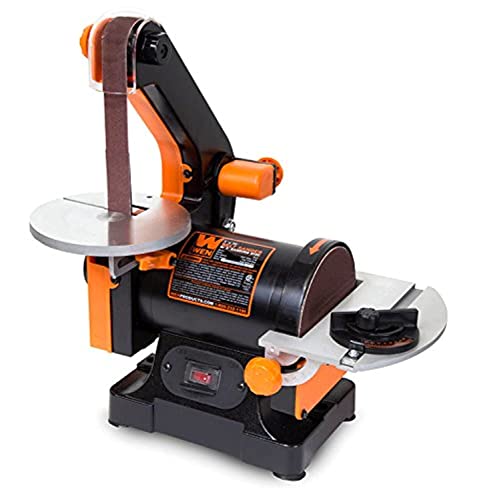
The WEN 6515T is the compact benchtop pick, and the budget tier choice for detail and small-part sanding. It pairs a narrow 1 by 30 inch belt with a 5 inch sanding disc, which suits tight corners, curves, and small wooden parts that would be hard to hold against a wide belt. The belt runs at up to 3,160 feet per minute and the disc runs at up to 3,450 RPM, driven by a 2.3-amp motor.
At 16 pounds it is much lighter than the 6502T, and its smaller footprint fits a crowded bench. The package includes an 80-grit disc, a 100-grit belt, a miter gauge, and two dust ports. The narrow belt removes material slowly on broad surfaces, so it is not the right tool for levelling a tabletop or a door, but for small boxes, craft parts, and edge work on thin stock, the size is an advantage.
Specs:
- Belt size: 1 by 30 inches
- Disc size: 5 inches
- Motor: 2.3 amps, corded electric
- Belt speed: up to 3,160 feet per minute
- Disc speed: up to 3,450 RPM
- Weight: 16 pounds
- Dust collection: two dust ports
- Tier: budget
- ASIN: B07KL4BQF5
Who should skip
A belt sander is not the right tool for every sanding job. If the work is mainly fine finishing, a random-orbit sander with fine grit will leave a smoother surface with less risk of gouging. If the work involves delicate veneer, thin edge banding, or a single small repair, a hand sanding block or a detail sander gives more control. Buyers with very limited bench space should think carefully before choosing a benchtop model, because it needs a stable bench and clear space in front of the belt and disc.
FAQ
What belt size should I choose for general woodworking?
A 3 by 21 inch belt is a good starting point for general woodworking, because it suits doors, cabinet parts, and furniture, and replacement belts are widely stocked. A 4 by 24 inch belt covers large panels faster but is heavier, while a 1 by 30 inch benchtop belt suits small parts rather than broad surfaces.
Is variable speed worth it on a belt sander?
Variable speed is worth it when the work includes paint, veneer, softwood, and other materials that can burn or gouge at full speed. A slower belt gives more control on delicate surfaces, while a faster belt removes material quickly on rough lumber. For simple stock removal, a single-speed model is often enough.
How do I avoid gouging wood with a belt sander?
Keep the sander moving, let the weight of the tool do the work, and avoid pressing down hard or tilting it onto one edge. Start with a coarse grit for removal, then move to a finer grit for smoothing, and sand with the grain where possible. A variable-speed model set to a lower speed also helps on softer material.
Do I need a benchtop belt sander as well as a handheld one?
A benchtop belt and disc sander is useful for small parts, edges, and ends that are hard to hold steady by hand, while a handheld belt sander is better for large surfaces, doors, and installed work. Many small shops use both, but a buyer who only sands large boards can start with a handheld model and add a benchtop machine later.
Final verdict
The best belt sander depends on the size of the work and how much control is needed. For heavy, large-scale stock removal, the Makita 9403 is the strongest handheld pick in this guide. For mixed woodworking with speed control, the Makita 9903 is the most versatile handheld choice. For occasional home use, the WEN 6321 gives a useful 3 by 21 inch format at a budget tier. For shop work on small parts, the WEN 6502T covers more work with its wider belt and larger disc, while the WEN 6515T is the compact choice for detail work.
Related guides
More from Amazon
Programs that pair well with the guide above. Offers and eligibility are set by Amazon and may change.
A free business account with business pricing and bulk-buying tools for work, shop or home office.
Create a business accountFree shipping on eligible items, Prime Video and more. Eligible new members can start with a free trial.
Start a Prime free trialAudiobooks and podcasts to listen to on the go. Eligible new members can start with a free trial.
Try Audible freeAd-free music streaming. Eligible new subscribers can start with a free trial.
Try Music Unlimited freeAs an Amazon Associate we earn from qualifying purchases.


Write Your Review
No reviews yet. Be the first to share your experience!