

Our Top Picks
What's inside
As an Amazon Associate I earn from qualifying purchases. This post may contain affiliate links at no extra cost to you.
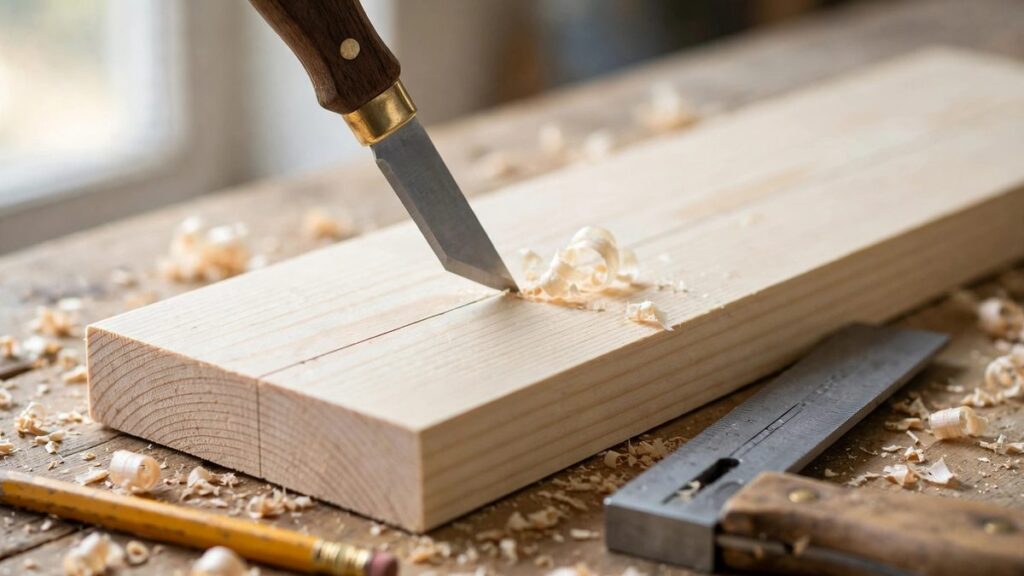
- Top Pick: Aeglemana Woodworking Marking Knife
- Runner-up: Malomke Marking Knife
- Also consider: Conclusion
The best marking knife for most woodworkers is a dual-bevel spear point with a thin, resharpenable blade and a handle that will not roll off the bench. A knife line beats a pencil line for joinery because it severs the wood fibers, leaving a fine groove that a chisel or saw can register against instead of a wide graphite mark that invites a gap. The five knives below cover the main shapes worth buying: a premium Czech spear point, two mid-range wooden-handled knives with leather sheaths, and two budget options that still use real tool steel. Each pick lists its published specifications so you can compare blade steel, thickness and handle design before choosing.
As an Amazon Associate, we earn from qualifying purchases.
Table of Contents
- Quick Picks
- Narex Dual Bevel Marking Knife
- Clarke Brothers Marking Knife
- Aeglemana Woodworking Marking Knife
- Qianying Marking Knife
- Malomke Marking Knife
- How to Choose a Marking Knife
- FAQ
- Conclusion
Quick Picks
- Best overall: Narex Dual Bevel Marking Knife — hardened stainless spear point, rosewood handle and finger indents for close control.
- Best with a sheath: Clarke Brothers Marking Knife — high carbon steel blade, cherry handle and a real leather sheath included.
- Best long handle: Aeglemana Woodworking Marking Knife — an 8.7 inch overall length for users who prefer a fuller grip.
- Best budget Japanese style: Qianying Marking Knife — 5CR15 steel, double bevel and a leather sheath at the budget tier.
- Best budget beech handle: Malomke Marking Knife — chromium-vanadium steel with a classic beech wood handle.
Narex Dual Bevel Marking Knife
Narex, made by Mikov in the Czech Republic, is the name most often recommended for a first serious marking knife, and this dual bevel model shows why. The blade is AISI 420 stainless steel hardened and tempered to HRC 57, so it shrugs off shop humidity better than plain carbon steel while still taking a fine edge on ordinary stones. The spear point tip is ground to 55 degrees with a 25 degree grind on both bevels, which means the knife cuts a clean, symmetrical line whether you pull it toward you from the left or the right side of a square. That symmetry is the main reason to choose a dual bevel for general layout: one knife handles dovetail baselines, shoulder lines and hinge outlines in both directions without swapping tools.
The detail that sets this knife apart is the set of laser cut finger indents in the blade. They give your index finger a positive grip point close to the tip, which improves pressure control on short, precise strokes. The handle scales are Mexican rosewood, hand sanded and polished, and secured with two brass pins. The handle profile is deliberately square rather than round, so the knife stays where you put it on the bench instead of rolling toward the floor. At just over an ounce, it is a light, nimble tool suited to fine joinery rather than heavy striking.
Specs
- Blade material: AISI 420 stainless steel, hardened to HRC 57
- Blade profile: dual bevel spear point with finger indents
- Tip angle: 55 degrees, with a 25 degree grind on both bevels
- Blade length: 1-7/8 inches
- Blade thickness: 0.060 inches
- Blade width: 1/2 inch
- Handle: Mexican rosewood, 4 inches long, brass pins
- Overall length: 5-7/8 inches
- Weight: 1.13 ounces
- Origin: Czech Republic
Clarke Brothers Marking Knife
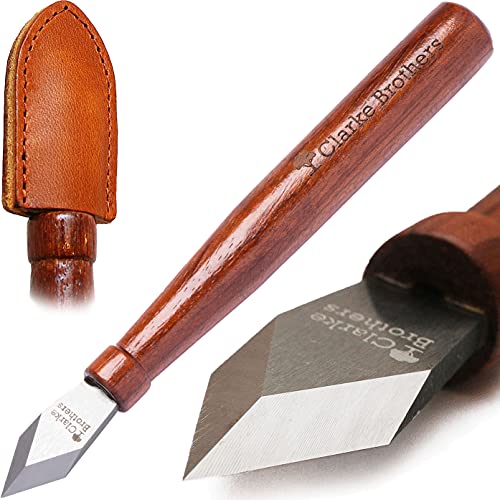
The Clarke Brothers knife is a traditional English style marking knife built around a high carbon steel blade and a turned cherry wood handle. Carbon steel is the classic choice for layout work because it sharpens quickly to a very keen edge on a fine stone, and this blade uses a chisel and compound bevel edge that registers flat against a square or straightedge on one side. The blade is 5.5 centimeters long, a practical size that reaches into dovetail sockets and hinge mortises without excess length getting in the way.
The standout feature at this tier is the real leather sheath included in the box. A marking knife lives on the bench and in the apron pocket, and a sheath protects both the edge and everything the edge might touch. The knife is light at 1.76 ounces, and the smooth cherry handle suits a pencil style grip for pulling lines along a rule. Choose this one if you want a straightforward, single purpose layout knife from an established tool brand, with edge protection included rather than bought separately.
Specs
- Blade material: high carbon steel
- Blade edge: chisel, compound bevel
- Blade length: 5.5 centimeters
- Overall length: 160 millimeters
- Handle: cherry wood
- Weight: 1.76 ounces
- Included: real leather sheath
- Part number: WMK by CB
Aeglemana Woodworking Marking Knife

The Aeglemana is the longest knife in this roundup at 8.7 inches overall, and that extra handle length is its reason to exist. Woodworkers with larger hands, or anyone who finds short marking knives cramped, get a fuller grip and more leverage on long pulls along a straightedge. The blade is high carbon steel with a double bevel, so it marks in both directions and suits general joinery layout, from tenon shoulders to edge joint lines and inlay outlines.
The handle is solid wood with an ergonomic shape, and the package includes a leather sheath plus a transparent safety storage box, which is a thoughtful combination for a tool that may travel between bench, toolbox and site. The double bevel design means neither face is perfectly flat, so for the finest dovetail transfer work a single bevel may register a touch more positively against a square, but for everyday layout this knife covers the same ground as the premium picks at a mid-range tier.
Specs
- Blade material: high carbon steel
- Blade profile: double bevel
- Overall length: 8.7 inches
- Handle: solid wood, ergonomic shape
- Included: leather sheath and safety storage box
- Part number: RDA-008
Qianying Marking Knife
The Qianying takes its styling from Japanese marking knives, with a compact double beveled blade and a composite wood handle. The blade steel is 5CR15 high carbon steel, a stainless grade that resists corrosion in damp shops and holds a serviceable edge for layout work. Because the blade is beveled on both sides, it can be pulled along a square in either direction, which speeds up repetitive marking when you are laying out a batch of identical parts.
At 4.1 ounces it is the heaviest knife here, and the extra weight helps the edge track steadily on long grain lines. A leather blade protective sheath is included, which matters at this tier because many budget knives ship with no edge protection at all. This is the pick for a beginner who wants the Japanese knife feel and a sheath in the box while staying in the budget tier, accepting that the composite handle is less refined than the rosewood and cherry handles above.
Specs
- Blade material: 5CR15 high carbon steel
- Blade profile: double bevel, Japanese style
- Handle: composite wood
- Weight: 4.1 ounces
- Included: leather blade protective sheath
Malomke Marking Knife

The Malomke is a simple, honest budget knife: a chromium-vanadium steel blade in a beech wood handle, with no extras competing for your money. Chromium-vanadium steel is a step up from the unbranded mystery steel found in the cheapest scribing tools, and it hones to a fine point that severs fibers cleanly across the grain. The blade is double beveled, so it works from either side of a square, and the overall length of 6.06 inches is close to the classic Western marking knife format.
Beech is a traditional European handle wood, plain but durable, and the classic styling will feel familiar to anyone used to continental bench tools. At 2.08 ounces the knife has a little more presence in the hand than the lightest picks without becoming clumsy. There is no sheath in the box, so plan to store it in a tool roll or drawer insert to protect the point. For a first marking knife, or a second knife kept at a second bench, it covers the essentials at the budget tier.
Specs
- Blade material: chromium-vanadium steel
- Blade profile: double bevel
- Overall length: 6.06 inches
- Handle: beech wood
- Weight: 2.08 ounces
- Model: Marking Knife
How to Choose a Marking Knife
Bevel type comes first. A single bevel knife has one flat face that registers dead flat against a square, which makes it the most precise choice for transferring dovetail lines. A dual or double bevel knife has a spear point ground on both sides, so it marks in either direction with either hand, at the cost of a tiny amount of registration precision. Most general layout work suits a dual bevel; dedicated hand cut joinery rewards a single bevel.
Blade thickness matters more than blade length. Thin blades, around 0.060 inches, slip into the narrow spaces between dovetail pins and flex less against a rule on delicate work. Thicker blades feel sturdier for striking and for scoring end grain, but can wedge in tight layouts. For all round use, stay at the thinner end of the range.
Steel choice is about maintenance. Carbon steel sharpens fastest and keenest but needs a wipe of oil in humid shops. Stainless grades such as AISI 420 and 5CR15 trade a little ultimate keenness for corrosion resistance. Chromium-vanadium sits between the two. Hardness around HRC 57 to 61 holds an edge through a project without becoming brittle or hard to hone.
Handle shape is a safety feature. A square or faceted handle will not roll off the bench, and finger indents near the blade give control on short strokes. Longer handles suit larger hands and long pulls; short handles suit a pencil grip for detail work. Finally, look for a sheath or plan safe storage, because an unprotected point dulls quickly and is a hazard in a drawer.
FAQ
Why use a marking knife instead of a pencil?
A knife severs the wood fibers and leaves a fine groove, so a chisel or saw can register in the line and cut exactly where you marked. A pencil line has real width, and cutting to the wrong edge of it can open a visible gap in a joint. Pencils still suit rough layout and marks that will be planed away, but joinery lines belong to the knife.
What is the difference between a single bevel and a dual bevel marking knife?
A single bevel knife has one flat face and one ground bevel, so the flat face sits perfectly against a square and gives the most accurate registration in one direction. A dual bevel knife is ground on both sides of a spear point, so it marks in both directions and with either hand, but neither face is completely flat against the guide.
How do I sharpen a marking knife?
Hone the bevel on a fine waterstone or diamond plate with light pressure, then lap the flat face briefly to remove the wire edge. Keep the factory bevel angle rather than regrinding it. A few strokes on a leather strop maintains the edge between full sharpenings, and a keen edge should score a clean line with light pressure alone.
Can a marking knife replace a marking gauge?
No, they do different jobs. A gauge has a fence that rides an edge and scribes lines parallel to it at a set distance, which a freehand knife cannot repeat reliably. A knife excels at lines across the grain, transferring shapes from one part to another, and outlining joinery against a square. Most benches need both.
Conclusion
For most woodworkers, the Narex Dual Bevel is the right first marking knife: hardened stainless steel, a true spear point, finger indents and an anti-roll rosewood handle in a compact, light package. The Clarke Brothers is the alternative for anyone who prefers carbon steel and wants a leather sheath included, while the Aeglemana suits larger hands with its longer handle. On a budget, the Qianying and Malomke both deliver real tool steel and double bevel convenience without filler features. Whichever you choose, keep it sharp and store the point covered, and your layout lines will reward you with tighter joints.
Related guides
More from Amazon
Programs that pair well with the guide above. Offers and eligibility are set by Amazon and may change.
A free business account with business pricing and bulk-buying tools for work, shop or home office.
Create a business accountFree shipping on eligible items, Prime Video and more. Eligible new members can start with a free trial.
Start a Prime free trialAudiobooks and podcasts to listen to on the go. Eligible new members can start with a free trial.
Try Audible freeAd-free music streaming. Eligible new subscribers can start with a free trial.
Try Music Unlimited freeAs an Amazon Associate we earn from qualifying purchases.



Write Your Review
No reviews yet. Be the first to share your experience!