As an Amazon Associate I earn from qualifying purchases. This post may contain affiliate links at no extra cost to you.
Here is the situation almost every hobby shop runs into. You hook your shop vac to a 13-inch planer, take one pass on a wide board, and the hose packs solid with shavings before you reach the end of the cut. Meanwhile a friend with a single-stage dust collector complains that his machine barely picks up sawdust from a random orbit sander. Both people bought a capable tool. Both people bought the wrong tool for that job. The dust collector vs shop vac question is not about which machine is stronger, it is about which kind of airflow each one produces.
The misconception worth killing first: people talk about these machines as if they sit on the same scale, with the shop vac as the small version and the dust collector as the big version. They are not on the same scale at all. They are two different answers to two different problems, and understanding the mechanism makes the buying decision almost obvious.
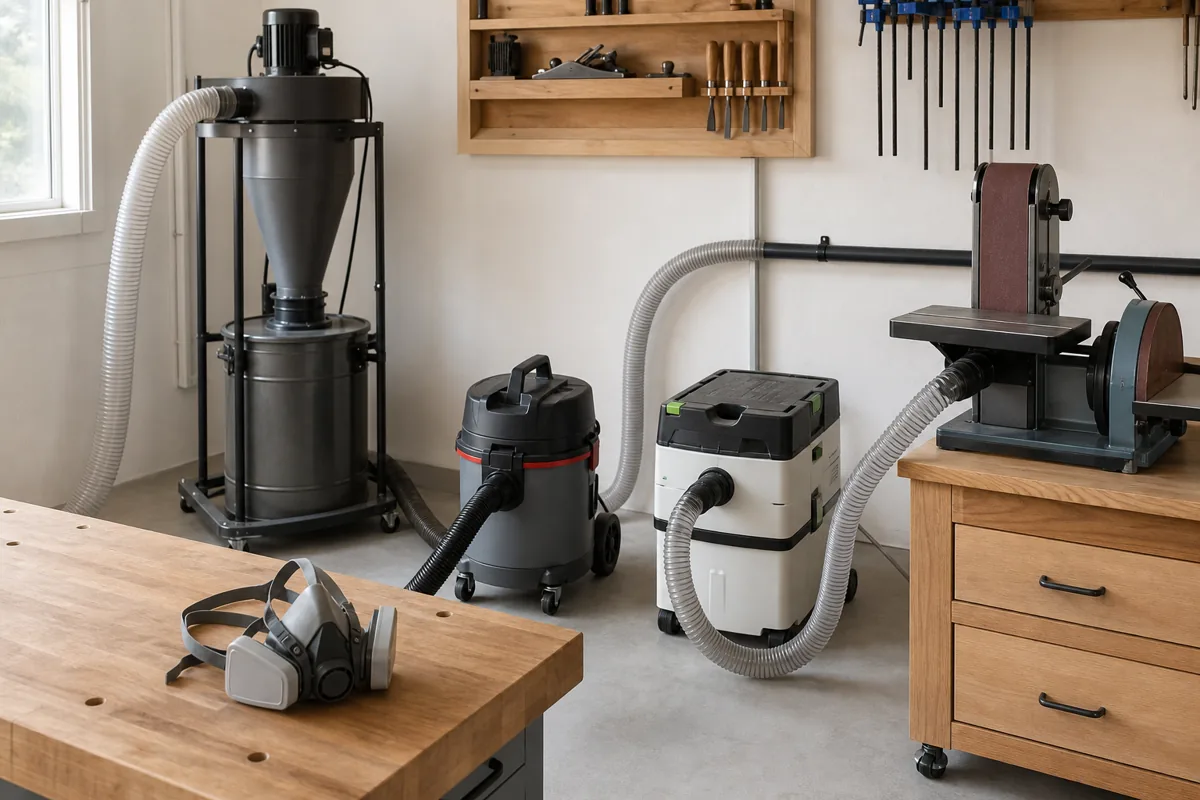
The mechanism: high volume versus high suction
Think about drinking. A wide boba straw moves an enormous amount of liquid with very little effort, but if you pinch it anywhere the flow dies. A coffee stirrer moves almost nothing by volume, but it will pull thick syrup up a long, narrow path because you can generate real pressure through it. Neither straw is better. They are tuned for different jobs.
A dust collector is the boba straw. It uses a big, relatively slow impeller and a 4-inch or larger duct to move a huge volume of air, measured in CFM (cubic feet per minute). That volume is what captures the cloud of chips a jointer, planer, table saw, or bandsaw throws off. What a dust collector does not have is much static pressure, which is the ability to keep pulling when the path gets restrictive. Choke it down to a 1-1/4-inch hose and the airflow collapses.
A shop vac is the coffee stirrer. Small, fast impeller, narrow hose, low CFM, high static pressure. That pressure is why it will pull water out of a flooded basement, suck nails out of a garage corner, and keep working through a 2-1/2-inch hose with a filter bag installed. It is also why it fails at the planer: the tool generates chips faster than a narrow hose can carry them, so the hose becomes a pipe full of packed shavings.
Once you see it that way, the rule falls out on its own. Tools that produce a large volume of chips at a large port want a dust collector. Tools with a small port, and cleanup work, want a shop vac.
Dust collector vs shop vac: side by side
| Factor | Dust Collector | Shop Vac |
|---|---|---|
| Airflow character | High CFM, low static pressure | Low CFM, high static pressure |
| Typical port size | 4 inch and up | 1-1/4 to 2-1/2 inch |
| Best on | Planer, jointer, table saw, bandsaw, lathe | Sanders, routers, track saw, miter saw, cleanup |
| Wet pickup | No | Yes, most models |
| Mobility | Wheeled base or fixed with ducting | Carry or roll anywhere |
| Noise character | Lower pitch, less piercing | Higher pitch, more fatiguing |
| Footprint | Takes real floor space | Fits under a bench |
| Fine dust capture | Depends entirely on filter grade | Depends entirely on filter grade |
Notice the last row. Neither machine is inherently a fine-dust machine. That depends on the filter, and it is where most shops quietly lose.
The dust you should actually be worried about
Chips on the floor are a housekeeping problem. The dust that matters for your lungs is the invisible fraction, the particles small enough to stay airborne for hours and travel deep into your respiratory system. Wood dust is classified as a carcinogen by health agencies, and hardwood dust in particular has documented long-term risk. That is the part a shop vacuum with a stock paper filter, or a dust collector with a 30-micron cloth bag, will happily blow back into the room.
A standard single-stage collector bag acts as a coarse strainer. It stops the chips and passes a lot of the fine stuff. Upgrading to a fine pleated cartridge filter, or moving to a cyclone that separates chips before they ever touch the filter, is usually a bigger air-quality improvement than buying a machine with a higher horsepower rating. Same on the vacuum side: a HEPA-rated or fine-dust-rated filter plus a collection bag changes what leaves the exhaust, and it also keeps the filter from loading up and killing your suction after twenty minutes of drywall sanding.
The second thing that matters is capture at the source. A tool port that catches dust before it becomes airborne beats a room air filter running afterward. Shrouds, over-arm blade guards, and properly fitted hoods do more for your air than another 200 CFM at the machine.
Wall-Mount or Portable Dust Collector for Machine Tools
If you own a planer, jointer, or cabinet saw, this is the category that solves your problem. Look for a 4-inch inlet, a fine pleated cartridge filter rather than a coarse cloth bag, and a stated CFM figure that is honest about being measured with the hose attached. A wall-mounted unit is worth serious consideration in a small shop because it buys back floor space you actually need for infeed and outfeed.
Where a shop vac is the smarter buy
For a lot of readers, the shop vac is genuinely the right first purchase, and not as a compromise. If your work centers on a track saw, random orbit sander, router, miter saw, and hand tools, a good vacuum with a fine filter and automatic tool-start will handle nearly everything you do. Those tools have small ports engineered for high static pressure, and a dust collector connected to them with an adapter will underperform badly.
The upgrade that transforms a shop vac is a cyclone separator placed ahead of it. A cheap plastic cyclone on a bucket will drop out the overwhelming majority of chips and dust before they reach the filter, which means the vacuum keeps full suction through a long session instead of fading. It also stops you from burning through expensive bags. If you only make one accessory purchase this year, make it that one.
Cordless vacuums from the major battery platforms, DeWalt XR, Milwaukee FUEL, and Makita LXT, are worth a look if you work away from outlets or do a lot of on-site trim work. They are not replacements for a corded unit at the bench, but for follow-around cleanup and pairing with a cordless track saw they are legitimately useful.
Shop Vacuum With Fine Dust Filtration
The features that matter here are a fine or HEPA-rated filter, a 2-1/2-inch hose port with common adapters, and a tool-triggered outlet so the vacuum starts with your sander. Auto filter cleaning is a real convenience if you sand drywall or MDF. Skip the peak horsepower marketing numbers and read the sealed suction and airflow specs instead.
How to choose, in order
Start with your largest chip producer, not your average tool. If a thickness planer or jointer is in the shop, or you know one is coming, plan on a dust collector and treat the vacuum as your second machine. If your biggest port is 2-1/2 inches, buy the vacuum and spend the leftover money on a cyclone separator and a better filter.
Then check your electrical situation and your ceiling. A larger collector may want a 240V circuit, and ducting decisions are much easier before you fill the walls with cabinets. Finally, be realistic about hose length. Every foot of flex hose and every tight elbow costs you airflow, and long runs of corrugated hose are the single most common reason a perfectly good collector seems weak.
- ✔ Dust collector moves the volume of air that big machines require
- ✔ Shop vac handles wet pickup, cleanup, and small-port power tools
- ✔ A cyclone separator dramatically extends filter and bag life
- ✔ Fine filtration upgrades improve air quality more than added horsepower
- ✘ Neither machine covers the whole shop well on its own
- ✘ Coarse stock filters pass the fine dust that actually matters
- ✘ Long flex hose runs and adapters quietly destroy performance
- ✘ Dust collectors need floor space, ducting planning, and sometimes a dedicated circuit
Frequently asked questions
Can I use a shop vac on a table saw or planer? On a small benchtop saw with a 2-1/2-inch port, a vacuum can work acceptably, especially with a separator ahead of it. On a planer or jointer it will clog, because those tools produce chips faster than a narrow hose can carry them away. That is a volume limitation, not a suction limitation, and no amount of horsepower fixes it.
Is a dust collector overkill for a one-car garage shop? Not necessarily, but the format matters more than the size. A wall-mounted or compact wheeled unit with a fine cartridge filter gives you the airflow your machines need without eating the floor. If you have no machine with a 4-inch port, though, your money is better spent on a good vacuum, a cyclone, and source capture at each tool.
Do I still need an air filter or a mask if I have good collection? Yes, wear respiratory protection for dusty operations. Collection at the source is the first and most effective line of defense, an ambient air cleaner helps with what escapes, and a properly fitted respirator protects you during sanding and while cleaning out filters and bags. Treat them as layers rather than alternatives.
If you take one idea away from this, make it the straw analogy. Volume moves chips, pressure moves through restrictions, and no single machine is great at both. Most well-set-up small shops end up with a collector on the big machines, a vacuum with fine filtration for everything else, and a separator in front of whichever one they use most.
Check prices on Amazon →
0 Comments