As an Amazon Associate I earn from qualifying purchases. This post may contain affiliate links at no extra cost to you.
Most workshop injuries do not come from the moment somebody ignores safety gear entirely. They come from wearing gear that looks right and does almost nothing. Foam earplugs jammed in halfway. A dust mask with a metal nose strip that seals against nothing. Safety glasses rated for a stray splinter sitting in front of a lathe throwing fist-sized chunks. A useful shop safety equipment checklist is not a shopping list, it is a list of specific hazards paired with the specific mechanism that stops each one.
So this guide works backward from physics. What is actually trying to hurt you, how does that damage happen, and what property of a piece of equipment interrupts it. Once you understand the mechanism, the buying decision usually makes itself, and you stop paying for features that do not address your hazard.
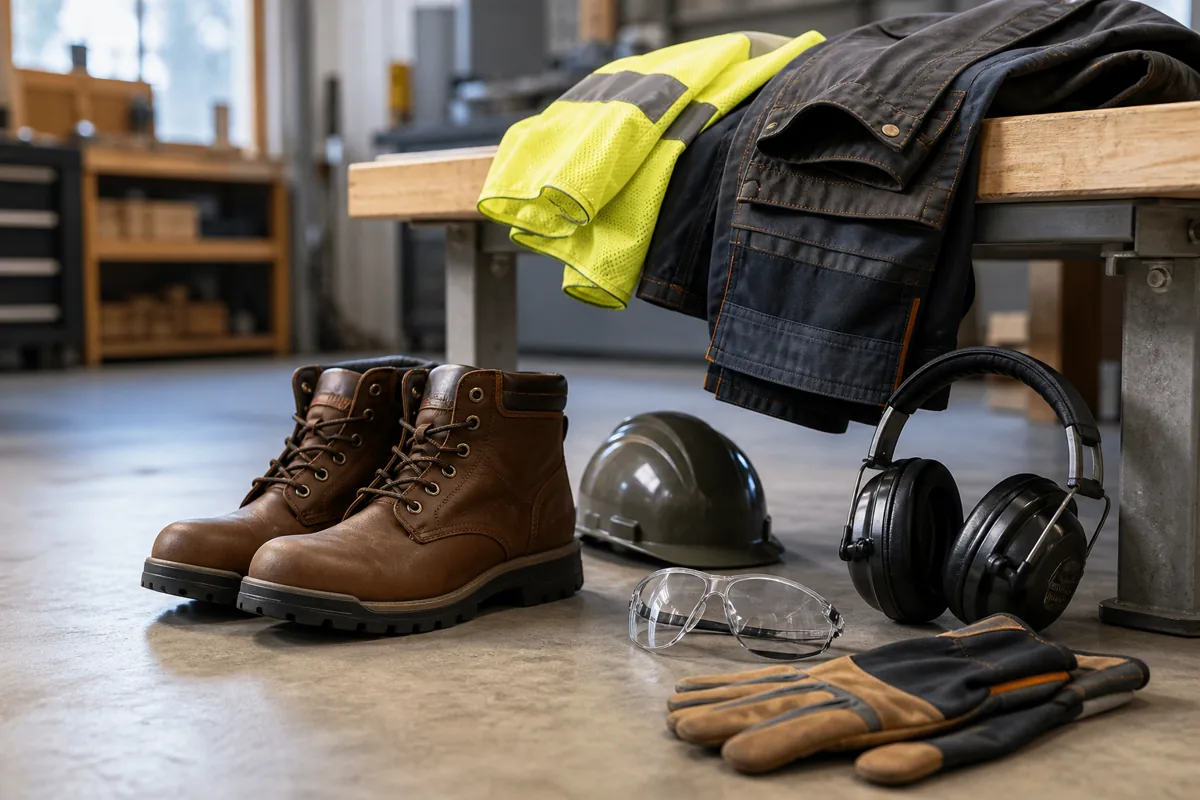
The Hazard-First Shop Safety Equipment Checklist
Think of your shop as producing four different kinds of energy that your body handles badly: sound pressure, flying mass, airborne particles, and stored energy in spinning or heated things. Every item below maps to one of those.
| Hazard | What actually causes harm | Gear that interrupts it | Spec that matters |
|---|
| Hazard | What actually causes harm | Gear that interrupts it | Spec that matters |
|---|---|---|---|
| Noise | Cumulative pressure damage to inner ear hair cells | Muffs or plugs | NRR rating and seal quality |
| Impact | Small mass at very high velocity | Sealed safety glasses or face shield | ANSI Z87.1, plus Z87+ for impact |
| Fine dust | Particles under 10 microns reaching deep lung tissue | Respirator plus air handling | NIOSH N95 or better, and CFM at the tool |
| Cuts and abrasion | Blade or abrasive contact with skin | Gloves, but only away from rotating tools | Task-matched, never loose fitting |
| Fire | Finish rags and dust igniting or self-heating | ABC extinguisher, metal rag can | Rated ABC, mounted near the exit |
Notice the last column. That is where money gets wasted. Two respirators can look identical and behave completely differently because one is rated for nuisance dust and one filters submicron particles.
Hearing: The Injury You Cannot Feel Happening
The misconception here is that hearing damage is about pain. It is not. Nothing hurts at 100 decibels, which is roughly what a router or a shop vac puts out. The damage is mechanical fatigue on hair cells in the cochlea, and those cells do not regenerate. It accumulates the way sun exposure accumulates on skin, and by the time you notice a ringing after a long session you have already spent some of a fixed budget.
Here is the part that matters more than the number on the package: noise reduction depends almost entirely on seal, not on material. A muff with a good cushion over bare skin outperforms a higher-rated muff worn over eyeglass temples or a hat brim, because any air gap lets sound pressure bypass the cup. Same with foam plugs. Rolled thin, inserted deep, allowed to expand in the canal, they work extremely well. Pinched and pushed in at the entrance, they are earrings.
For a home shop, a decent pair of muffs hanging on the wall next to the switch beats a better pair in a drawer. Convenience is a safety spec. If you take calls or listen to music, Bluetooth muffs remove the temptation to pull protection off between cuts, which is when short high-intensity exposures happen anyway.
Hearing Protection: Muffs and Plugs
Buy for seal and comfort before you chase the highest NRR number. Something in the mid-20s NRR that you will actually wear all afternoon protects you far more than a bulky top-rated muff you take off after ten minutes. If you wear safety glasses, look for thin, low-profile cushions designed to seal around temple arms.
Eyes and Face: Rated Glasses Versus Fashionable Glasses
Common misconception: safety glasses are about the lens being strong. Partly true, but most eye injuries in a wood shop come from debris arriving at an angle, not straight on. Chips ricochet off the fence, off the ceiling, off your own bench. Wraparound coverage and a close fit to the brow are doing at least as much work as lens hardness.
Look for the ANSI Z87.1 marking, and specifically Z87+ where high-velocity impact is covered. Unmarked glasses sold as “safety style” are not the same product. For anything that spins a large workpiece, lathe work above all, step up to a full face shield. The mechanism changes there: you are no longer worried about a chip, you are worried about a bowl blank or a chunk of bark leaving the chuck with real mass behind it. A shield distributes and deflects that; a pair of glasses simply is not in the path.
Anti-fog coatings sound like a comfort feature. Treat them as a safety feature, because a fogged lens gets lifted, and a lifted lens protects nothing.
Lungs: Where Most Home Shops Are Quietly Failing
This is the big one, and the one people get most wrong. The visible sawdust on the floor is not the hazard. Anything you can see and feel is large enough that your nose and throat catch it. The particles that matter are the ones you cannot see, roughly 10 microns and smaller, because they travel past those defenses into the deep lung and stay there. Hardwood dust in particular is classified as a carcinogen with prolonged exposure, and species like walnut, cocobolo and western red cedar add sensitization on top of that.
Two different systems address this and they are not interchangeable. Capture at the source, meaning dust collection or extraction at the tool, reduces how much fine dust ever enters the room air. Personal protection, meaning a respirator, protects you from what escapes. Air filtration units hanging from the ceiling handle what is left in suspension over hours. If you only do one, do capture, because a respirator does nothing for the dust that settles on every surface and gets kicked back into the air tomorrow.
Sizing matters more than brand. Small-diameter shop vac hoses move high suction at low volume, which suits sanders and routers. A dust collector moves high volume at low suction, which is what a table saw or planer throat needs. Putting a shop vac on a jointer is a very common mismatch and it is why the chute clogs.
Respirators for Fine Wood Dust
A NIOSH-rated N95 is the realistic floor for sanding and machining. Disposables are fine for occasional work; a reusable half mask with replaceable cartridges is cheaper over a year and seals better. Facial hair breaks the seal on any tight-fitting mask, which is the case for a powered air-purifying respirator or a loose-fitting hood instead.
- ✔ Source capture reduces exposure for everyone in the space, not just the operator
- ✔ A reusable half mask usually pays for itself within a season of regular sanding
- ✔ Ceiling air filtration keeps working after you leave the shop, when fine dust is still airborne
- ✘ A dust mask without a NIOSH rating does not filter the particle sizes that matter
- ✘ Any tight-fitting respirator loses most of its protection over stubble or a beard
- ✘ Shop vacs cannot supply the airflow volume that large machines require
Hands, Fire, and the Gear People Forget
Gloves are the most misunderstood item on any shop safety equipment checklist. For handling rough lumber, glue-ups, sharpening or finishing chemicals, they are genuinely protective. Around any rotating tool, a table saw blade, a drill press, a lathe, a router, they are a hazard, because fabric that catches pulls your hand in rather than releasing. The rule is simple: gloves for handling, bare hands for feeding. That is not a stylistic preference, it is about what happens when cloth contacts a spinning surface.
Push sticks, push blocks and featherboards belong here too, even though nobody thinks of them as safety equipment. They exist to keep your hands outside the blade’s zone and to keep the workpiece against the fence so it cannot pinch and launch backward. A riving knife or splitter on a table saw is the single most effective anti-kickback device most shops can add, because it holds the kerf open behind the blade so the offcut cannot bind against the rising teeth.
Fire gets ignored until it cannot be. Oil finishes cure by oxidizing, and oxidation releases heat. A wadded rag traps that heat faster than it dissipates, which is how a pile of rags reaches ignition on its own with nobody in the building. Lay finishing rags flat to dry or drop them in a listed metal oily waste can. Keep an ABC extinguisher mounted where you would be standing on your way out, not in the back corner behind the machine you are running.
Round it out with a real first aid kit that includes gauze and pressure dressings rather than just adhesive bandages, closed-toe shoes, and a shop layout where nothing forces you to reach across a running tool.
Table Saw Safety Accessories
If your budget is tight, this category returns the most safety per dollar spent. A featherboard, a good push block with a heel, and a splitter or riving knife address kickback directly, which is the mechanism behind a large share of serious table saw injuries. These are cheap and they work every single cut.
Frequently Asked Questions
Is a dust mask from the hardware store good enough for sanding? Only if it carries a NIOSH rating such as N95. Unrated “nuisance dust” masks are designed to keep visible debris off your face and do not reliably filter the submicron particles that reach deep lung tissue. Check for the rating printed on the mask itself, not just on the box.
Do I need both hearing protection and a dust collector, or does one matter more? They address unrelated injuries and neither substitutes for the other. That said, hearing protection is the cheaper fix, so start there and build dust collection as budget allows. Both types of damage accumulate silently over years, which is exactly why they get postponed.
Are safety glasses enough for a lathe? No. Turning stores real kinetic energy in a large workpiece, and a blank or a chunk of bark coming off the chuck carries far more mass than a chip off a saw blade. Use a full face shield for turning, and glasses underneath it if you like. Reserve glasses for cutting, drilling and assembly work.
Building Your Checklist in Order
If you are starting from nothing, buy in this order: rated eye protection, hearing protection, a NIOSH-rated respirator, push blocks and a splitter for the table saw, an ABC extinguisher and metal rag can, then dust collection sized to your largest machine, then ceiling air filtration. That sequence is not about price, it is about how quickly each item pays back in reduced risk. Everything at the top of that list is cheap, and everything at the top addresses either an irreversible injury or a fast one.
Store all of it within arm’s reach of where you use it. Gear that requires a trip across the shop gets skipped on the one cut that mattered.
Check prices on Amazon →
0 Comments