As an Amazon Associate I earn from qualifying purchases. This post may contain affiliate links at no extra cost to you.
Most people blame the saw when a jigsaw cut leans out of square, burns the edge, or lifts veneer off the top face. The saw is usually fine. A jigsaw blade is a thin steel tongue clamped at one end and completely unsupported at the other, and nearly everything you dislike about jigsaw cuts traces back to that one fact. Choosing the best jigsaw blades for woodworking comes down to three things: how much that unsupported blade is allowed to bend, how fast it can clear chips, and which face of the board you have decided to keep clean.
The blades that came in the box were picked to cut something fast, not clean, and most 100-piece variety kits hide two useful wood blades among tile and metal blades you will never reach for. Four or five deliberate choices beat the big kit on every cut a wood shop actually makes.
| Blade type | Best for | What to expect |
|---|---|---|
| Coarse HCS, 6-8 TPI, side-set | Softwood, framing, subfloor, sink cutouts | Very fast, wide kerf, ragged on both faces |
| Ground tooth, 10-12 TPI | Hardwood and plywood finish cuts | Clean cut face, moderate speed, your default |
| Reverse tooth, 10-12 TPI | Melamine, veneered panels, prefinished flooring | Crisp top face, torn underside, saw wants to hop |
| Narrow scroll blade | Tight curves, inside cutouts, thin stock | Turns a small radius, bevels if forced |
| Bi-metal progressor | Thick hardwood, glue-ups, reclaimed lumber | Shrugs off heat and hidden nails, flexes instead of snapping |
| Carbide tooth or grit | Laminate, MDF, particleboard | Long life in glue-heavy sheet goods, chips if flexed |
Why Jigsaw Cuts Go Wrong Before You Even Pick a Blade
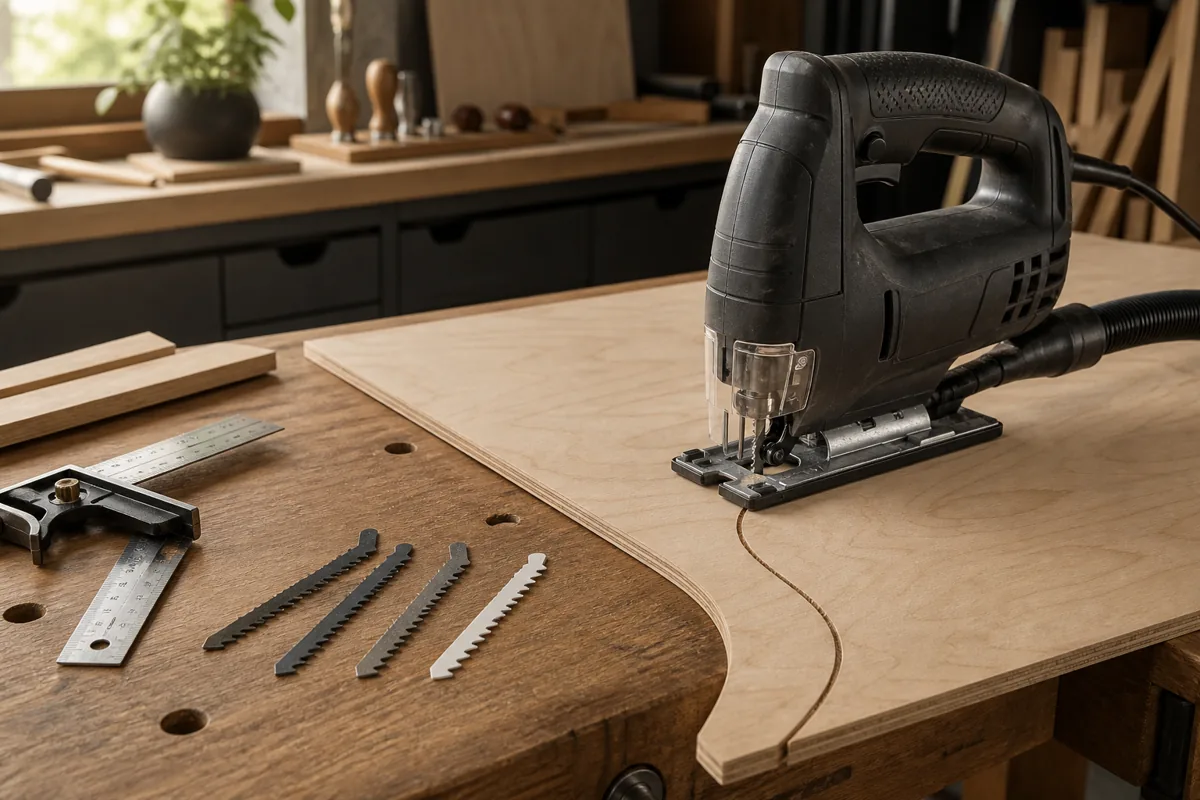
Picture holding a plastic ruler by one end and pushing it edge-on through a block of hard cheese. It bows. A jigsaw blade does the same thing. It is gripped only at the top by the plunger and steadied by a small roller guide above the shoe, so the bottom inch is on its own. Feed pressure bows the blade backward and the teeth at the bottom of the cut trail behind the teeth at the top. That trailing edge is why so many jigsaw cuts come off the saw a degree or two out of square, and it gets worse with thicker stock, narrower blades, and harder pushing.
Two more mechanisms matter. Orbital action swings the blade forward on the cutting stroke instead of moving it straight up and down, which mimics leaning into a handsaw: much faster, much rougher, and it fights your steering in a curve. Tooth direction matters just as much. Standard blades cut on the upstroke, dragging chips up and out through the top face, which is why the underside stays crisp, the top frays, and plywood gets cut good face down.
Blade Anatomy: Pitch, Steel, and Geometry
Tooth pitch is a chip clearance decision
Each gullet between teeth has one job: carry a chip all the way out of the kerf. Too few teeth in the material and the blade grabs and hammers. Too many and the dust has nowhere to go, so it recirculates, heats up, glazes the edge, and dulls the teeth. Keep roughly three teeth engaged and no more than a dozen or so in three-quarter inch hardwood. A 10 to 12 TPI blade lives in that window. A 20 TPI metal blade in the same board will smoke and quit.
Steel decides what the blade survives
High carbon steel is soft, flexible, and cheap, which is fine in pine and construction plywood and hopeless in maple. High speed steel is harder and handles heat but snaps when twisted. Bi-metal welds an HSS tooth strip to a spring steel body, so the teeth hold an edge through heat and the odd nail while the body flexes instead of shattering. Carbide is for abrasive material: glue lines in MDF and particleboard, laminate, and composites where steel gives up early.
Geometry, width, and shank
Milled teeth with a side set behave like a handsaw. They cut a kerf wider than the blade body, clear chips fast, and leave a torn edge. Ground teeth are sharpened finer and often taper-ground for a narrow kerf and a near-finish face, but with less clearance they burn if you push. Width and thickness control tracking: a wide, thick body holds a line and refuses to turn, while a narrow scroll blade turns beautifully and wanders under side pressure. T-shank is the standard clamp on nearly everything current, including DeWalt XR, Milwaukee FUEL, and Makita LXT saws.
Ground-Tooth T-Shank Wood Blades, 10-12 TPI
If you buy one pack, buy this one. It is the closest thing to a do-everything wood blade: clean enough in birch plywood, capable in three-quarter inch hardwood, stiff enough to stay reasonably square. Buy a multipack of one length rather than an assortment, because you will burn through your favorite and ignore the rest.
How to Choose the Best Jigsaw Blades for Woodworking
Work backward from the cut. Which face has to look good, how thick is the stock, is the line straight or curved, and could there be anything nasty inside the board? Those four answers pick the blade.
Straight or gentle cuts in plywood or three-quarter inch hardwood with the good side down: ground 10 to 12 TPI, orbital off or on the lowest setting. Finished face up, as with melamine shelving or prefinished flooring: reverse tooth, and accept that the hidden side gets chewed. Rough carpentry where speed is the point: coarse side-set HCS at full orbital. Anything over an inch thick, glued up, or salvaged: bi-metal.
Bi-Metal Progressor Blades
Variable tooth pitch along the blade plus a body that bends rather than breaks. This is what you want in thick hardwood, glued-up panels, and reclaimed lumber that might be hiding a fastener. Not a finish blade, but it keeps cutting long after a cheap HCS blade would be smoking or in two pieces.
Curves are a width problem, not a tooth count problem. A standard quarter-inch-wide blade will not follow a tight arc no matter how carefully you steer, and forcing it just shoves the unsupported bottom sideways so the cut comes out beveled. Use a narrow scroll blade, drop orbital to zero, ease off the feed, and let the blade cut its way around instead of steering it around.
Reverse-Tooth (Down-Cut) Blades
Worth owning if you cut sheet goods with a finished face. The teeth point down, so cutting happens on the downstroke and the top veneer gets pressed into the panel instead of torn out of it. Keep firm downward pressure on the saw, because that same action tries to lift the shoe off the work.
- ✔ Clean top face in melamine and veneered plywood
- ✔ Lets you keep the good side up on panels too big to flip
- ✔ Usually no tape or scoring needed
- ✘ Tearout moves to the underside
- ✘ Lifts the saw off the work, so cuts can hop
- ✘ Slower feed rates from poorer chip clearance
- ✘ Wrong choice for tight curves and thick hardwood
Three Misconceptions Worth Unlearning
Misconception one: more teeth means a cleaner cut. Tooth count is a chip clearance decision. Past a certain point the gullets fill, dust rides in the kerf, and heat glazes the wood. Fine-tooth blades give you burn marks in hardwood, not glass. Tooth geometry and blade stiffness are what produce a clean face.
Misconception two: reverse-tooth blades give a clean cut. They give one clean face. Every bit of tearout that would have appeared on top moves to the bottom. If both faces matter, use a ground blade, back the underside with a sacrificial sheet, and score your line first, or leave a hair of material for a router or block plane.
Misconception three: a cut that drifts means a dull blade or a tired saw. Nine times out of ten it is deflection. You are pushing too hard, running a blade too narrow for the thickness, using high orbital in a curve, or steering sideways through an arc. Slow the feed, step up to a wider body, drop the orbital, and if squareness is critical, cut proud and finish the edge on another tool.
Jigsaw Blade FAQ
Can one blade handle both hardwood and plywood? Mostly. A ground-tooth blade around 10 to 12 TPI is the practical compromise if you keep orbital low and the feed slow. What it cannot do is protect a finished top face or survive a hidden nail.
Why is my cut beveled even with a brand new blade? Side pressure, not sharpness. Confirm the shoe is locked at 90 degrees, then switch to a narrower blade for tight radii, turn orbital off, and stop forcing the feed. A blade that is bending cannot cut square.
How long should a jigsaw blade last? Treat blades as consumables. HCS can dull within a few feet of hard maple, while bi-metal and carbide run several times longer. Burning, extra pushing effort, or a change in pitch means it is done, and a dull blade deflects more, so cuts start drifting before the blade truly fails.
Buy a handful of the blades you actually use instead of a drawer full of blades you do not, replace them earlier than feels reasonable, and most complaints about jigsaws quietly disappear.
Check prices on Amazon →

0 Comments