As an Amazon Associate I earn from qualifying purchases. This post may contain affiliate links at no extra cost to you.
Here is the problem almost every shop runs into with dust collection for table saw work: you hook a shop vacuum to the 2.5-inch port on the back of the cabinet, make a few rip cuts, and the top of the saw is still coated in fine powder. The floor has a pile on the outfeed side. Your nose knows it. So you buy a bigger vacuum, and nothing improves. The vacuum was never the bottleneck.
A table saw throws dust in two directions at once. The teeth on the front of the blade climb up through the workpiece and fling chips forward and upward, above the table. The teeth on the back drag material down into the cabinet. A single port under the blade can only ever catch the second half. If you have not addressed above-table capture, you are working on half the problem no matter what you plug in.
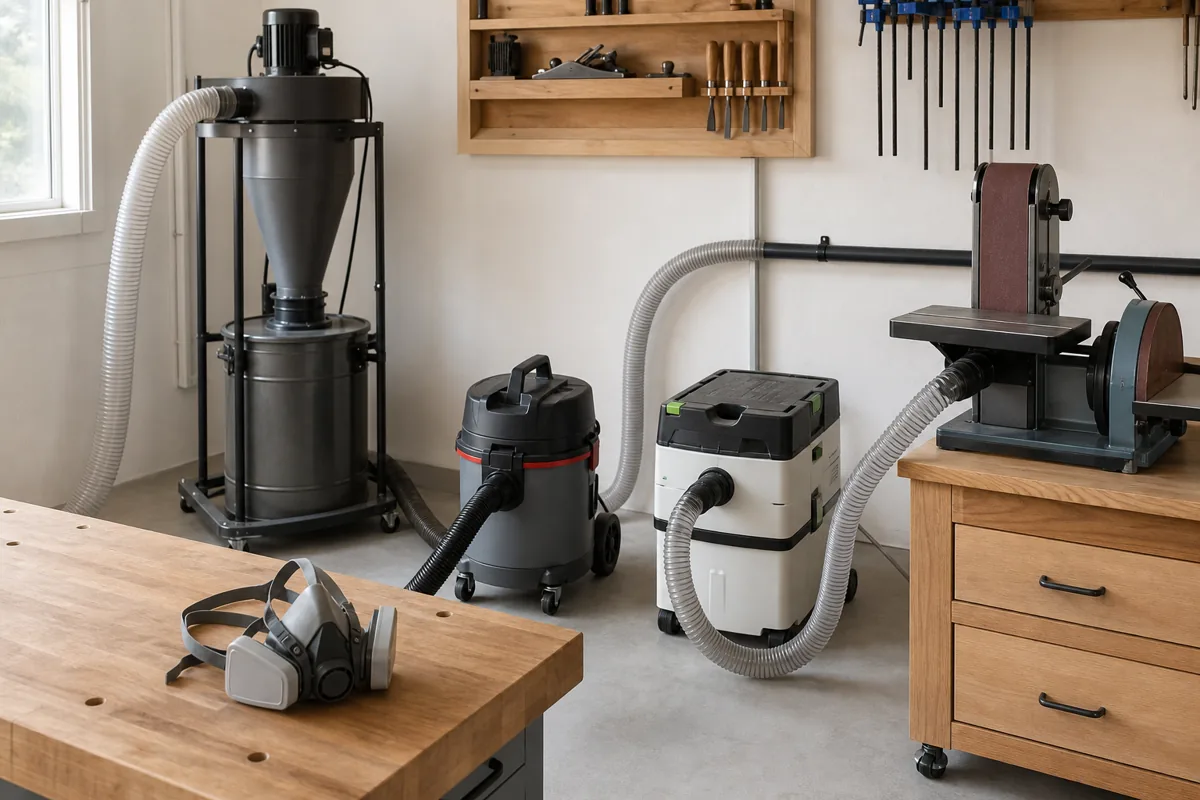
The Mechanism: Airflow Moves Dust, Suction Does Not
The misconception worth naming first is that dust collection is about suction. It is not. Suction, measured in inches of water lift, is what pulls material through a narrow restriction, which is why a shop vacuum is excellent at cleaning a crevice or pulling chips through a half-inch router hose. Dust collection is about volume of moving air, measured in CFM (cubic feet per minute), because you are not lifting a single chip through a straw. You are trying to keep an entire cloud of airborne particles moving fast enough that it never gets a chance to settle or escape.
Think of it like a river versus a garden hose nozzle. The nozzle has tremendous pressure at a tiny opening and moves almost no water. The river has almost no pressure and moves enormous volume. Dust in a cabinet saw behaves like silt: it needs a current, not a jet.
The practical number that gets thrown around for a table saw is roughly 350 to 400 CFM at the machine to control the cabinet, and a good deal more if you are also feeding an above-blade guard pickup at the same time. A typical shop vacuum moves in the low hundreds of CFM at the motor and considerably less at the end of a long 2.5-inch hose, because narrow hose is a brutal restriction. A single-stage dust collector on a 4-inch line moves several times that volume at a fraction of the pressure. Same job, entirely different tool for it.
Where Your Setup Is Probably Losing Air
Before spending money, find the leaks. Air takes the easy path, and a cabinet saw has plenty of easy paths.
Hose diameter. Doubling a hose from 2.5 inch to 4 inch does not double the airflow, it roughly quadruples the cross-sectional area available. Necking a 4-inch collector down to a 2.5-inch port with an adapter throws away most of what you paid for. If your saw only has a small port, an aftermarket or shop-built 4-inch plate on the cabinet back is one of the highest-value modifications you can make.
Long flexible hose. Corrugated flex hose has several times the friction of smooth-wall duct. Ten feet of flex to reach a saw in the middle of the floor can eat a meaningful chunk of your CFM. Use rigid duct for the run and flex only for the last few feet.
The open bottom. Many contractor and hybrid saws have an open or partially open cabinet base. Air rushes in there instead of through the blade slot, so nothing gets pulled past the blade. Sealing the base with plywood and closing the motor cover opening changes performance dramatically and costs almost nothing.
The throat plate and blade slot. You want air moving down through the throat plate opening, which is what carries above-table dust into the cabinet. A zero-clearance insert helps cut quality but reduces that intake path, which is another reason above-table capture matters more once you install one.
Clogged filter or full bag. A single-stage collector with a loaded filter can lose half its performance without any obvious sign. If your collector suddenly seems weak, check the filter before blaming the ducting.
Choosing Hardware: Matching The Tool To The Job
| Option | Best For | Rough Airflow Class | Real Limitation | ||
|---|---|---|---|---|---|
| Shop vacuum on 2.5″ | port | Job site saws, occasional cuts, guard hose | Low CFM, high lift | Clogs and stalls on volume, loud, small bin | |
| Single-stage collector, 1 to 1.5 HP | One machine at a time in a small shop | Mid CFM on 4″ | line | Needs a fine filter | bag units pass fine dust |
| Single-stage with cyclone separator | Small to mid shops wanting less filter cleaning | Mid CFM | Separator adds some pressure loss | ||
| 2 HP cyclone collector | Cabinet saw plus above-blade pickup | High CFM | Cost, footprint, 240V circuit | ||
| Above-blade guard pickup | Capturing the dust a cabinet port cannot | Adds to whatever feeds it | Blocks some sight lines | must clear the fence |
The pattern in that table is worth stating plainly. Vacuums win on small ports and portability. Collectors win on volume. Cyclones win on filter maintenance and fine-dust capture. Nothing wins at above-table dust except an actual above-table pickup.
Wall-Mount Dust Collector With Fine Filter
For a one-car garage shop, a wall-mount unit in the 1 to 1.5 HP class gets the motor off the floor and pairs well with a short 4-inch run to the saw. Prioritize a canister or pleated filter rated in the 1-micron range over a cloth bag; the bag is what lets the dangerous fine fraction back into your air. Expect to run one machine at a time.
Above-Table Capture Is Not Optional
This is where most guides go quiet, and it is the part that actually determines whether your shop air stays clean. The front of the blade is a small fan blowing sawdust at your face. An overarm blade guard with a 2.5-inch hose sitting an inch above the stock catches that stream before it disperses. Once dust spreads into the room, no collector is going to chase it down; you are then relying on an air cleaner and a respirator to deal with what is already floating.
Two ways to feed it. Run the guard hose off a dedicated shop vacuum, which suits the small hose diameter well and lets you switch it on with the saw. Or wye it into your main collector, which is simpler but splits your available airflow between two branches, so it only works if the collector has volume to spare.
- ✔ Captures the forward-thrown dust a cabinet port physically cannot reach
- ✔ Keeps the blade and cut line visible instead of buried in powder
- ✔ Doubles as a blade guard, which is a genuine safety gain
- ✔ Small 2.5-inch hose pairs naturally with a shop vacuum you already own
- ✘ Overarm mounting eats space behind or above the saw
- ✘ Hose management gets in the way of wide crosscuts and sled work
- ✘ Must be removed or swung clear for non-through cuts like dadoes
- ✘ Adds another hose to trip over if the shop layout is tight
Overarm Blade Guard Dust Collection Kit
If your cabinet is already sealed and ducted and the tabletop still gets dusty, this is the missing piece rather than a bigger collector. Check the mounting style against your saw and your ceiling height before buying, and confirm the arm clears your fence at full rip capacity. Shop-built versions from plywood and a vacuum fitting work fine if you would rather spend the afternoon than the money.
Fine Dust, Filters, And What Actually Hurts You
The chips on the floor are the least important thing in this discussion. They are annoying and they are a slip hazard, but they fall out of the air quickly. The particles that matter are the ones small enough to stay airborne for hours and travel deep into your lungs. Wood dust is classified as a carcinogen by health agencies, and hardwood species get singled out most often.
This is why filtration rating matters as much as airflow. A standard 30-micron cloth bag on a budget collector captures the sawdust you can see and passes the fraction you cannot, effectively turning the collector into a machine that stirs fine dust around the room. Upgrading to a pleated cartridge in the 0.5 to 2 micron range, or venting outdoors if your climate and setup allow it, is the fix. An ambient air cleaner running after you shut the saw off is a useful supplement, not a substitute for capture at the source.
Cyclone Dust Separator For Shop Vacuum
If a shop vacuum is what you have and a collector is not in the budget, a pre-separator between the saw and the vacuum solves the worst vacuum problem: filter loading. Most of the chips drop into the bucket, so airflow stays consistent through a long session instead of dying after ten cuts. It will not turn a vacuum into a dust collector, but it makes the vacuum you own behave much better.
Frequently Asked Questions
Can I just use a shop vacuum for my table saw? For a portable job site saw with a small port, yes, and it is often the intended pairing. For a cabinet or hybrid saw with a 4-inch port, a vacuum will underperform badly because it moves too little air volume. A reasonable compromise is a collector on the cabinet and a vacuum on the blade guard, which puts each tool where its strengths are.
Do I need a cyclone, or is a single-stage collector enough? Single-stage with a good pleated filter controls dust well for one machine at a time. The cyclone’s advantage is that it drops nearly everything into the bin before it reaches the filter, so airflow stays steady and you clean the filter far less often. If you run a saw and jointer regularly, or dislike filter maintenance, the cyclone earns its cost.
Why does my saw still throw dust after I hooked up a collector? Almost always one of three things: the cabinet base is not sealed so air enters the wrong way, the hose is necked down or too long and flexible, or there is no above-table pickup and you are watching the front of the blade do what it always does. Check them in that order, since the first two are free to fix.
Get the mechanism right and the shopping list writes itself. Seal the cabinet, use the largest duct the saw will accept, feed it with a collector rated in volume rather than lift, add filtration fine enough to catch what you cannot see, and put a pickup above the blade where half the dust actually goes. Do those four and a modest setup will outperform an expensive one that ignores them.
Check prices on Amazon →
0 Comments