As an Amazon Associate I earn from qualifying purchases. This post may contain affiliate links at no extra cost to you.
You are halfway through a rip in 3/4 plywood, the motor note drops, and the circular saw blade stops spinning while the motor still hums or the saw goes silent entirely. Most people reach for a new saw at this point. That is usually a mistake, because a saw that stalls under load and a saw that never spins at all are two completely different problems, and neither one is normally fatal.
Here is the mechanism, because it explains every fix that follows. A circular saw is a motor spinning an arbor, and the blade is clamped to that arbor by friction from a single bolt pressing an outer washer against the blade. Power travels from motor to gears to arbor to clamped blade to wood. A stall means something in that chain lost either torque or grip. Torque loss means the motor cannot push hard enough. Grip loss means the arbor is turning but the blade is not coming with it. Figure out which one you have and the repair list shrinks to one or two items.
| Symptom | What it actually means | First thing to check |
|---|---|---|
| Motor hums, blade stops in the cut | Torque loss under load | Dull blade, binding kerf, wrong depth |
| Motor spins freely, blade slips | Clamping failure | Arbor bolt torque, missing or flipped washer |
| Nothing spins, no sound | No power delivery | Brushes, cord, switch, battery contacts |
| Spins then stops with a burning smell | Motor or gearbox distress | Vents, brush length, gear grease |
| Blade stops only in long rips | Kerf closing behind the blade | Riving knife or wedge, board support |
The misconception: a stalling saw is a weak saw
The most common belief in home shops is that a saw which bogs down needs more amps or more volts. Shop owners upgrade from a 13-amp corded saw to a 15-amp model, or from an entry-level cordless to a brushless platform, and the stall follows them to the new tool. That is because the overwhelming majority of stalls are cutting-condition problems, not power problems.
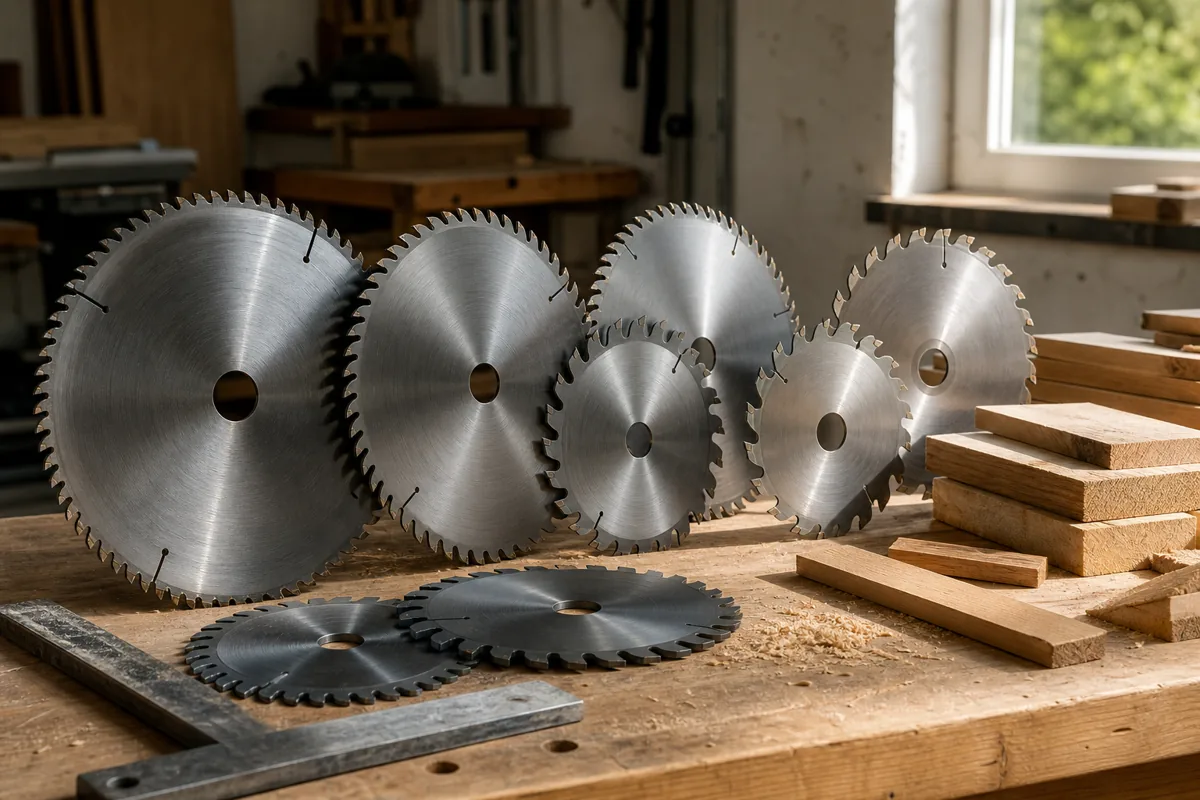
Think of the blade as a row of tiny chisels on a rim. Each tooth has to slice a chip and eject it out of the kerf. When teeth go dull, they stop slicing and start rubbing, and rubbing converts your motor’s torque into heat instead of chips. The saw does not lose power; the workpiece starts absorbing it. That is why a dull blade makes a strong saw feel gutless while a sharp blade makes a modest saw feel unstoppable.
The second cutting-condition problem is kerf closure. Solid lumber holds internal stress, and plywood sags. When you rip a long board unsupported in the middle, the two halves pinch the blade behind the teeth. Now the blade body, which has no cutting edges on its sides, is being squeezed by wood. That is a brake. A 15-amp motor loses to a pinched blade every single time, which is exactly why table saws have riving knives and why you should drop a wooden wedge into a long rip kerf as you go.
When the motor runs but the circular saw blade stops spinning
This is the tell-tale grip failure, and it is more common than people expect on saws that have had a blade change. Pull the battery or unplug the saw, then look at the arbor stack. You should find, in order, the inner flange against the motor housing, the blade, the outer washer, and the bolt. Two things go wrong here.
First, the arbor bolt on most circular saws is reverse-threaded, so it tightens counterclockwise on a right-blade saw. People who assume standard threads end up loosening it while trying to snug it, and a blade held by a loose bolt will spin on the arbor under load while the motor screams. Second, the outer washer often has a stepped or dished face that must sit against the blade a specific way. Flip it and the clamping surface shrinks to a fraction of what it should be. Also check the arbor hole in the blade itself for wear or ovaling, which happens after a blade has already slipped once.
If the arbor washer surfaces have pitch buildup, clean them. Pitch is slippery, and clamping force relies on friction. A rag with mineral spirits or a dedicated resin remover restores the grip you are missing.
Circular Saw Arbor Wrench and Blade Bolt Set
If your slipping traces back to a rounded bolt head, a lost outer washer, or a missing wrench that made you hand-tighten, this is a low-cost drawer item rather than a repair bill. Match the thread and washer style to your specific saw model before ordering, since arbor hardware is not universal across brands.
When nothing spins at all: brushes, switches, and starved batteries
A saw that is completely dead, or one that used to run and now only clicks or buzzes, points at the electrical side. On brushed corded saws, carbon brushes are the intended wear part. They are spring-loaded blocks of carbon riding the commutator, and they get shorter every hour the saw runs. When they wear past roughly a quarter inch, contact becomes intermittent, then stops. Symptoms build gradually: extra sparking through the vents, a saw that starts only after a nudge, then nothing. Brushes are usually behind two accessible caps and cost a few dollars.
Cords fail at the strain relief where they leave the tool, which is why flexing the cord near the housing while the switch is on can produce a stutter. That stutter is a diagnosis. Switch triggers fail from sawdust intrusion, and blowing out the trigger area with compressed air fixes a surprising number of them.
On cordless saws, a blade that stops abruptly under load is often the tool’s electronic protection cutting power to save the pack, not a mechanical failure. Brushless platforms like DeWalt XR, Milwaukee FUEL, and Makita LXT all shut down on overcurrent, overheat, and low cell voltage. Compact batteries hit these limits far earlier than high-capacity packs, so a saw that stalls on a small pack and cuts fine on a bigger one has a battery problem, not a saw problem.
- ✔ Most stalls trace to a dull blade or pinched kerf, both free to fix
- ✔ Carbon brushes and arbor hardware are cheap, user-replaceable parts
- ✔ A quality thin-kerf blade removes less material, so it stalls less on modest motors
- ✔ Cordless shutdowns are usually protective and reversible with a larger pack
- ✘ Blade slip can enlarge the arbor hole, permanently ruining the blade
- ✘ Repeated overheating cooks brushes, windings, and gearbox grease
- ✘ A bent blade or damaged arbor is not something to shim or straighten
- ✘ Some sealed brushless tools require service center work rather than home repair
The blade choice that quietly prevents most stalls
Tooth count is a torque decision, not a quality ranking. A 60-tooth blade puts more teeth in the wood at once, so each tooth takes a thinner bite and total resistance climbs. That is fine for plywood crosscuts on a strong saw and miserable for ripping 2x stock on a compact cordless. For general framing and ripping, 24 teeth is the working answer. For sheet goods, 40 to 60 teeth gives a cleaner edge, but expect to feed slower.
Kerf width matters just as much. A thin-kerf blade removes less material per inch traveled, which directly reduces the load your motor carries. On cordless saws it also stretches runtime. Pair that with correct depth setting: the blade should project roughly a quarter inch below the workpiece, no more. Excess depth buries more teeth in the cut, increases the arc of contact, and multiplies the chance of binding.
Thin-Kerf Framing and Plywood Blade Combo
Before troubleshooting anything mechanical, put a fresh sharp blade on the saw and repeat the cut. A carbide thin-kerf blade in 24-tooth for rips and a higher tooth count for sheet goods solves the majority of stalling complaints outright. Buy two so you always have a sharp one on hand rather than pushing a worn blade.
A five-minute diagnostic order
Work in this sequence and you will not waste money. Disconnect power first. Spin the blade by hand: if it drags or wobbles, you have a bent blade or bad arbor. Check the arbor bolt tightness and washer orientation. Inspect teeth for glazing, missing carbide, or pitch. Set depth to a quarter inch of projection. Confirm the workpiece is supported so the offcut cannot pinch. Then run the saw with no load. If it spins freely on air but dies in wood, the answer is blade or binding. If it will not spin on air either, move to brushes, cord, switch, or battery.
Frequently asked questions
Why does my circular saw blade stop spinning only in thick lumber? Thick stock keeps more teeth engaged for longer, and internal stress in the board is more likely to close the kerf behind the blade. Try a 24-tooth thin-kerf blade, support the offcut, and drive a wedge into the kerf on long rips. If it still stalls, the saw may be underpowered for that thickness in one pass, so take two shallower passes instead.
Which way do I turn the arbor bolt on a circular saw? On most right-blade circular saws the bolt is reverse-threaded, meaning you turn it clockwise to loosen and counterclockwise to tighten. Left-blade saws are commonly the opposite. Check the arrow stamped on the shoe or blade guard before applying force, and always lock the arbor with the spindle lock rather than jamming the blade against wood.
Is a burning smell during cutting a sign the motor is dying? Not necessarily. A sweet, scorched-wood smell with dark streaks in the kerf indicates blade friction rather than motor failure. A sharp, acrid electrical smell with visible smoke from the vents is different and means you should stop immediately, let the tool cool, and inspect brushes and vents before running it again.
Fix the cutting conditions first, then the hardware, then the electrics. Nine times out of ten the saw you were about to replace just needed a sharp blade, a properly clamped arbor, and a supported workpiece.
Check prices on Amazon →

0 Comments