What's inside
As an Amazon Associate I earn from qualifying purchases. This post may contain affiliate links at no extra cost to you.
Choosing the right dewalt nail gun means matching a tool to the fastener, the material, and the pace of your work. A framing crew needs depth of drive and high-cycle reliability at the end of a wall, while a trim carpenter cares about blind-hole appearance and the weight in hand after a hundred shots. The line between a frustrating day and a clean install often comes down to whether the nailer’s gauge, angle, and power source fit the job you actually run.
What separates a worthwhile model from a mediocre one is less about raw specs than about execution quality: does it fire consistently in cold weather, does the magazine hold without jamming on every fourth strip, and does the exhaust stay off your work surface? Across these eight options, price ranges from just over a hundred dollars to nearly three seventy, and the differences in real-world behavior are more pronounced than the spec sheets suggest.
As an Amazon Associate we earn from qualifying purchases at no extra cost to you.


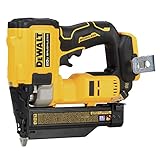


Our Top Picks


Quick Picks
| Product | Best for | Price |
|---|---|---|
| DCN680B 18-Gauge Brad Nailer | Trim and interior millwork | $299.99 |
| 20V 30° Framing Nailer | Heavy framing and sheathing | $358 |
| DWFP12231 Pneumatic Brad Nailer Kit | Budget-conscious finish work | $102.35 |
| 20V 21° Framing Nailer | Subfloor and deck construction | $364.99 |
| 2-in-1 Nail & Staple Gun | Cabinet backing and light assembly | $94.99 |
| ATOMIC 23-Gauge Pin Nailer | Delicate molding and craft work | $236.99 |
| ATOMIC DCN623D1 Pin Nailer Kit | Small-hole fastening with battery included | $274.90 |
| DCN662B 16-Gauge Finish Nailer | Casing, baseboard, and stair treads | $368.99 |
How We Picked
We narrowed this list on four criteria that consistently determine satisfaction: fastener compatibility and gauge range relative to the intended application, driver power delivery and cycle consistency as reported by owners, ergonomic load and vibration over extended use, and total cost of ownership including whether a battery or compressor is required. A tool that looks impressive on paper but frustrates users with frequent jams or shallow drives on dense hardwoods did not make the cut.
The 8 Best Dewalt Nail Gun in 2026
DCN680B 18-Gauge Brad Nailer
This is the go-to cordless brad nailer for finish carpenters who already own 20V MAX batteries and want clean holes in trim without dragging a compressor. Owners praise the depth-of-drive wheel for handling both pine and oak casing without adjustment frustration, and the compact nose fits tight inside window returns. The main complaint centers on occasional dry-fire when the magazine runs low without clearing the nose.
- Strong, consistent drive in dense hardwoods
- Compact head geometry for flush and tight spaces
- Nose-clearing cycle can interrupt rhythm on long runs
Skip it if your work is mostly framing or sheathing—18-gauge won’t hold structural loads, and you’ll be switching tools constantly.
20V 30° Framing Nailer
Framers who need full-power collated drive on T18 and 210-degree offset heads will find this model delivers noticeably higher strike velocity than the 21-degree variant, making it better suited to engineered lumber and dense sheathing. The 30-degree angle means fewer jams with full-round-head collated nails. Battery consumption runs high under continuous fire, so plan on two sticks per shift.
- Handles full collation without misfires on cold mornings
- Clear depth adjustment accessible with a gloved hand
- Heavier than competing 21-degree framing models
Skip it if your framing is mostly dimensional spruce and you want a lighter tool; the 21-degree option is more nimble.
DWFP12231 Pneumatic Brad Nailer Kit
For hobbyists and small-shop owners who already have a compressor, this kit delivers genuine Dewalt brad-nailing performance at a fraction of cordless cost. The 5/8-inch to 2-inch range covers baseboard through casing. Dry-fire prevention is a practical touch for production work. The trade-off is hose drag and noise, which limits where you can comfortably set up.
- Lowest entry price among quality 18-gauge options
- Fast cycle time with adequate compressor output
- Requires a compressor and hose management
Skip it if you do site work away from power or value a quiet job site.
20V 21° Framing Nailer
The 21-degree angle keeps this framing nailer lighter and better balanced than its 30-degree sibling, making it the preferred choice for overhead roof work and subfloor nailing where wrist fatigue accumulates. Owners report smooth sequential drive and reliable flush setting into engineered I-joists. The magazine holds fewer collated strips before reloading than some competitors, which matters on production framing.
- Lightest full-power cordless framing option here
- Reliable drive in engineered lumber and glulam
- Magazine capacity requires frequent reloads
Skip it if you primarily use clipped-head nails or full collation on dense sheathing—the 30-degree model handles those better.
2-in-1 Nail & Staple Gun
This third-party attachment for Dewalt 20V batteries fills a niche: cabinet backing, screening, light upholstery, and decorative trim where a dedicated stapler would be oversized. At under $95 it undercuts any Dewalt-branded brad nailer. Owners note the drive force is adequate for soft woods and 18-gauge brads but struggles in oak or hardwood flooring. Build quality is functional but not rugged.
- Extremely low cost for a battery-compatible nailer
- Switches between brads and staples without tool change
- Underpowered for dense hardwoods and thick materials
Skip it if you need a daily-use tool on a crew; the drive consistency does not match Dewalt’s own line.
ATOMIC 23-Gauge Pin Nailer
The ATOMIC pin nailer leaves a hole so small it often skips putty entirely, making it ideal for shoe molding, quarter-round, and delicate craft assemblies. At tool-only pricing it slots into a Dewalt battery ecosystem without breaking the bank for someone already owning sticks. The drive is adequate for 1/2-inch to 2-inch pins but not for anything thicker. Some owners report a learning curve on flush setting near edges.
- Minimal surface marking on finished moldings
- Lightweight and balanced for overhead detail work
- Pin capacity limits material thickness range
Skip it if your work involves anything structural; 23-gauge pins will not resist shear forces.
ATOMIC DCN623D1 Pin Nailer Kit
The kit version bundles a battery and charger, eliminating the guesswork of whether your existing stick will fit. Performance mirrors the tool-only ATOMIC pin nailer, but the unboxing-to-first-nail experience is smoother for someone without a 20V platform. The included battery is a compact model, not a high-capacity stick, so runtime between charges will be modest on heavy sessions.
- Ready to use out of the box without extra purchases
- Same pin-driven precision as the bare tool
- Included battery limits runtime on high-volume days
Skip it if you already own a Dewalt battery and want to save the bundled cost.
DCN662B 16-Gauge Finish Nailer
Straight 16-gauge finish work—casing, chair rails, stair treads—benefits from this nailer’s larger fastener diameter, which holds better in end grain and prevents split-out at board ends. Owners consistently call out its ability to sink 2.5-inch nails through oak treads without pilot holes. The trade-off is slightly more visible hole marks than 18-gauge, and the tool carries noticeable front-end weight during overhead runs.
- Handles dense hardwood finish work without splitting
- Straight magazine reduces loading friction
- Larger hole requires fill on clear-finish projects
Skip it if your work is primarily trim on painted surfaces where a brad hole is invisible; the lighter 18-gauge tool is easier to live with all day.
Buying Guide
Gauge and Fastener Type Define the Job
Gauge determines holding strength and hole visibility. Twenty-three gauge pins leave near-invisible marks but resist almost no shear force; they are for decorative molding only. Eighteen-gauge brads handle baseboard and casing on softwoods but will pull loose in end-grain joints. Sixteen-gauge finish nails carry enough friction grip to hold treads and rails without adhesive. On framing, 30-degree collation allows full-head penetration into engineered lumber while 21-degree favors lighter, faster cycles. Buy for the densest material you regularly drive into, not the easiest.
Cordless Freedom Comes With Hidden Costs
A battery nailer only makes sense if you already own the platform. A tool-only brad nailer at $299.99 becomes a $450 investment when you add a high-capacity battery and charger you do not have. Pneumatic models like the DWFP12231 deliver faster cycle rates and consistent drive regardless of temperature, but they lock you to a compressor and hose. For production framing crews, cordless wins on mobility. For a single-day trim install at a house with power, compressed air is still more economical per drive.
Ergonomics Matter More Than Weight Ratings
Spec-sheet weight numbers rarely predict fatigue. The 21-degree framing nailer feels lighter than the 30-degree because its balance point sits closer to the trigger. Pin nailers and brad nailers are almost always used one-handed at close range, so grip circumference and exhaust direction matter more than overall mass. Read owner reviews for comments on wrist angle during overhead work, not just the number on the box.
Our Verdict
The DCN662B 16-Gauge Finish Nailer is the top pick for any carpenter who handles casing, treads, and rails as core work. Its fastener versatility and dense-material capability make it the single best all-around dewalt nail gun for finish carpenters in 2026. For budget-minded hobbyists who need clean brad holes without a cordless platform commitment, the DWFP12231 at $102.35 is the clear value. If your framing crew works overhead or values wrist endurance over raw collation strength, the 21-degree framing nailer is the right call over its 30-degree sibling.
FAQ
Can I use any Dewalt battery in these nailers?
All cordless models listed accept Dewalt 20V MAX batteries, including the compact, standard, and high-capacity sticks. Verify your existing battery voltage matches the tool’s requirement—some ATOMIC models work with 12V batteries, but every 20V tool listed here requires the 20V platform specifically.
Is a brad nailer or finish nailer better for baseboard?
For painted baseboard, an 18-gauge brad nailer is sufficient and leaves smaller holes that primer fills easily. If your baseboard sits in a clear-finished wood or you are nailing into end grain, a 16-gauge finish nailer holds more securely and reduces callbacks.
Do these nailers require oil?
Pneumatic models like the DWFP12231 need a few drops of nailer oil at the beginning of each session. Cordless Dewalt models do not require regular lubrication; their internal mechanisms are sealed for the rated lifespan under normal use.
What does “tool only” actually include?
A tool-only listing means you receive the nailer itself with no battery, charger, or case. For the framing and finish models here, you will also need collated nails or strips appropriate to the gauge. Third-party batteries from non-Dewalt manufacturers may fit physically but will void the warranty.

0 Comments