

Our Top Picks
What's inside
As an Amazon Associate I earn from qualifying purchases. This post may contain affiliate links at no extra cost to you.
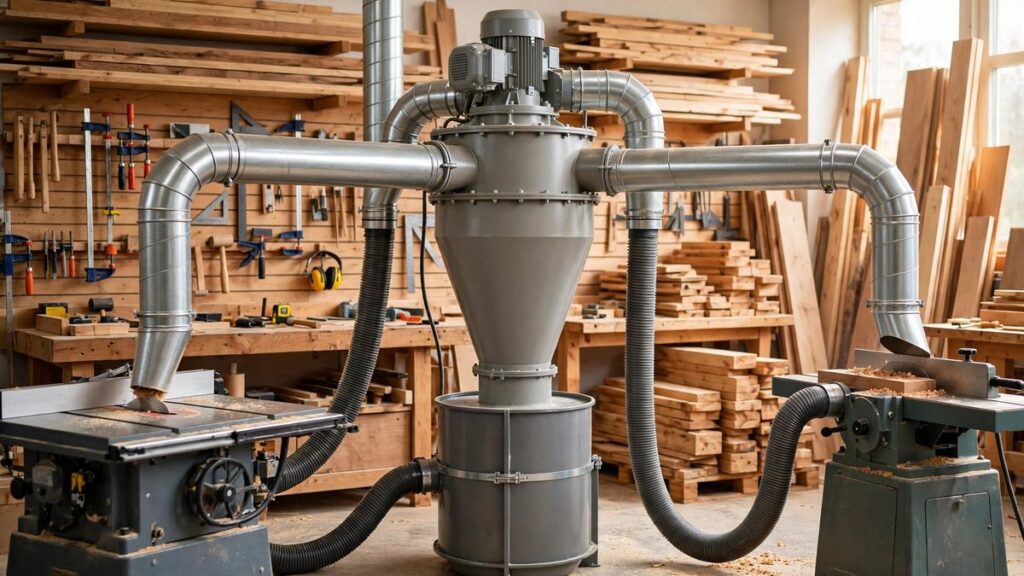
- Top Pick: Shop Fox W1666 2 HP Dust Collector
- Runner-up: JET DC-1100VX-CK Vortex Cone Dust Collector
- Also consider: WEN DC1300 Woodworking Dust Collector
A good dust collection system does more than keep a shop floor tidy. It pulls chips and fine dust away from the tool at the point of cutting, which keeps blades clearer and reduces cleanup between jobs. The right system depends less on a single headline number and more on the tools it will serve, the space it must fit, and how fine the filtration needs to be.
This guide compares five distinct options, from a compact mobile collector that serves one tool at a time to a two-horsepower stationary unit built for larger machines. Each model is described from its published specifications, so you can match airflow, filtration, inlet size, and collection capacity to the machines you own.
As an Amazon Associate, we earn from qualifying purchases.
Quick answer
For most small to mid-size woodworking shops, the WEN DC1300 is the most balanced starting point, with dual inlets and strong airflow for two tools. Choose the Shop Fox W1666 or JET DC-1100VX-CK when finer filtration and larger stationary machines matter more. Pick the compact WEN DC3401 for a single tool in a tight space, and the DEWALT DWV010 for direct tool connection and HEPA filtration.
1. Shop Fox W1666 2 HP Dust Collector

The Shop Fox W1666 is the high-airflow workhorse of this group, built around a two-horsepower motor and a single-stage bag design. It suits shops with larger stationary machines, such as a table saw, jointer, or planer, where a long hose run still needs enough air movement to carry heavy chips. Its published airflow rating is the highest among the bag collectors here. The trade-off is size and power supply: this stationary machine needs a 220-volt circuit and floor space for its tall bag assembly.
Specs:
- Motor: 2 HP, 220 volt, single phase, 12 amp, 3450 RPM
- Airflow: 1550 CFM maximum
- Filtration: 2.5 micron bag
- Inlets: dual 4 inch ports
- Collection capacity: 5.4 cubic feet
- Static pressure: 12.3 inches at zero CFM
- Impeller: steel
- Best for: larger stationary machines and longer duct runs
-
Tier: premium
-
ASIN: B00064NPXO
2. JET DC-1100VX-CK Vortex Cone Dust Collector

The JET DC-1100VX-CK pairs a vortex cone with a pleated canister filter instead of a plain upper bag. The cone separates chips before they reach the filter, which helps the canister stay clearer for longer. The 1-1/2 horsepower motor can run on 115 or 230 volts, so it fits a wider range of shops than a 220-volt-only collector. Airflow is rated at 1100 CFM, and the canister is rated at 2 microns. This is a premium-tier pick for woodworkers who want cleaner filtration without moving to a full cyclone system.
Specs:
- Motor: 1-1/2 HP, 115 or 230 volt, single phase, prewired for 115 volt
- Airflow: 1100 CFM
- Filtration: 2 micron canister filter
- Separation: vortex cone for chip separation ahead of the filter
- Collection capacity: 5.3 cubic feet
- Canister length: 25 inches
- Canister efficiency: 86 percent of 1 micron particles and 98 percent of 2 micron particles
- Stock number: 708659K
- Best for: finer filtration and shops that sand and plane often
-
Tier: premium
-
ASIN: B004T86NAK
3. WEN DC1300 Woodworking Dust Collector

The WEN DC1300 is the most balanced mid-range option in this guide, combining strong airflow with a simple mobile design. Its 14-amp motor drives a 10-inch steel impeller, and the published rating of 1300 CFM gives it enough air movement to serve a table saw or a planer well, or two tools through its dual inlets. The vertical bag holds up to 50 gallons, and the mobile base makes it easy to roll the unit to the machine in use. Filtration is rated at 5 microns, which captures visible chips and coarse dust but allows finer particles to pass. It runs on a standard household circuit.
Specs:
- Motor: 14 amp
- Airflow: 1300 CFM
- Filtration: 5 micron bag
- Inlets: dual 4 inch ports
- Collection capacity: 50 gallons
- Impeller: 10 inch steel, up to 3450 RPM
- Base: mobile base with four swivel casters
- Warranty: two-year manufacturer warranty
- Best for: a general shop serving one or two tools at a time
-
Tier: mid-range
-
ASIN: B09XX61YD6
4. WEN DC3401 Woodworking Dust Collector
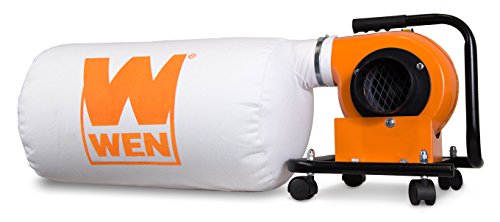
The WEN DC3401 is the compact budget pick in this guide, designed for a single tool in a small shop, a garage corner, or a shared workspace where floor space is limited. Its 5.7-amp brushed motor moves a published 660 CFM through a 6-inch impeller, enough for a table saw, a miter saw, or a small planer through its single 4-inch port. The 12-gallon bag keeps the footprint small, and lockable swivel casters let the unit roll between machines. An optional wall mount is included, so it can hang out of the way in a very tight shop. Filtration is rated at 5 microns, so it handles visible dust well while finer particles remain a limitation.
Specs:
- Motor: 5.7 amp brushed motor
- Airflow: 660 CFM
- Filtration: 5 micron bag
- Inlet: single 4 inch port
- Collection capacity: 12 gallons
- Impeller: 6 inch
- Dimensions: 34.25 by 13 by 14.2 inches
- Weight: 17 pounds
- Mounting: mobile base with lockable swivel casters and optional wall mount
- Warranty: two-year manufacturer warranty
- Best for: a single tool in a small or shared shop
-
Tier: budget
-
ASIN: B09Q7F9NC8
5. DEWALT DWV010 HEPA Dust Extractor
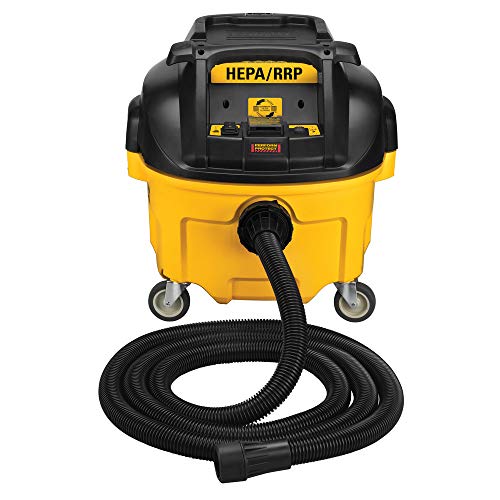
The DEWALT DWV010 is not a stationary chip collector. It is a HEPA dust extractor built for direct connection to a power tool, and it fills a different role from the other four models here. Instead of moving a large volume of air through a 4-inch hose to a table saw or planer, it connects to a sander, a track saw, a grinder, or a router and pulls dust away at the tool while you work. Its 15-amp motor is rated at 150 CFM, lower than the stationary collectors, but it is paired with strong suction through a 1.25-inch hose and a HEPA filter. Automatic filter cleaning pulses every 30 seconds, and Power Tool Actuation starts and stops the extractor with the tool. It meets the EPA lead renovation rule for HEPA vacuums only when DWV9330 filters are used.
Specs:
- Motor: 15 amp
- Airflow: 150 CFM
- Filtration: HEPA filter
- Capacity: 8 gallons
- Filter cleaning: automatic cleaning pulses every 30 seconds
- Tool control: Power Tool Actuation starts and stops the extractor with the tool
- Hose: 15 foot anti-static hose, 1.25 inches in diameter, with a universal swivel connector
- Weight: 22 pounds
- Warranty: one-year manufacturer warranty
- Best for: hand-held tools, sanding, and jobsite dust extraction
-
Tier: premium
-
ASIN: B00OA02TZ0
How to choose
Start with the tools you will connect. A table saw, a jointer, and a planer produce heavy chips and need high airflow through a 4-inch hose or duct, while a sander, a router, and a track saw produce fine dust and work better with a direct extractor connection and finer filtration. Match the inlet size to the dust port on the tool, and remember that every bend, every extra length of hose, and every blast gate reduces the airflow that reaches the tool.
Next, weigh airflow against filtration. A high CFM rating moves more chips, but a coarse bag lets fine dust pass back into the shop air. A canister filter or a HEPA filter captures finer particles, which matters more if you sand often, cut MDF, or work in a small enclosed space. Collection capacity matters too: a larger bag means fewer stops, but also a taller or heavier unit.
Check the electrical supply before you choose. Several strong collectors need a 220-volt circuit, while others run on a standard household outlet. Measure the space for the unit, the hose, and the bag when it is full, and think about whether you need a mobile base, a wall mount, or a fixed ducted layout.
Who should skip
Skip a large stationary collector if you work only with hand-held tools and have no table saw, planer, or jointer to connect. A HEPA extractor such as the DEWALT model here will serve sanders and track saws better, take up less space, and move with you from job to job.
Skip a high-airflow 220-volt model if your shop has only standard household outlets and no practical way to add a dedicated circuit. A mid-range or compact collector that runs on a standard outlet will be far more useful than a powerful unit you cannot plug in safely. Likewise, skip a tall stationary unit if your shop is a shared garage or a basement with low ceilings, since the bag needs room to fill and to be removed.
Skip a basic 5-micron bag collector as your only dust control if you cut MDF every day or sand for hours at a time. In that case, choose a canister or HEPA model first, or budget for a finer filter and a separate air cleaner.
FAQ
What size dust collector do I need for a small shop?
Match the collector to your largest chip-producing tool. A compact 660 CFM unit suits a single table saw or miter saw, while a 1100 to 1300 CFM unit suits a planer or jointer. A 1550 CFM unit suits larger machines and longer duct runs. Hose length and bends reduce the airflow that reaches the tool.
Is a canister filter better than a bag filter?
A canister filter usually captures finer particles than a basic bag and offers more filter surface, which can help airflow stay steadier as dust builds up. A bag filter is simpler to replace, but a 5-micron bag lets finer dust pass. If you sand often or work in a small enclosed shop, the finer filtration of a canister or HEPA model is usually worth it.
Can one dust collector serve two tools at once?
Some collectors have dual inlets and can stay connected to two tools, but they are usually used with one tool at a time, with a blast gate closed on the idle machine. Running two chip-producing tools at once splits the airflow and reduces collection at each tool.
Do I need a 220-volt circuit for a dust collector?
Not always. Compact and mid-range collectors here run on a standard household outlet, including the WEN DC1300 and the WEN DC3401. Larger two-horsepower models, such as the Shop Fox W1666, need a 220-volt circuit. The JET DC-1100VX-CK can run on either 115 or 230 volts.
Final verdict
For most woodworking shops, the WEN DC1300 is the best starting point, combining strong airflow, dual inlets, a large bag, and a mobile base at a mid-range tier. If your shop runs larger stationary machines, the Shop Fox W1666 offers the highest airflow here, while the JET DC-1100VX-CK offers finer canister filtration. For a tight space or a single tool, the WEN DC3401 is the sensible budget pick, and for hand-held tools, the DEWALT DWV010 HEPA extractor fills a role no stationary collector can match.
Related guides
More from Amazon
Programs that pair well with the guide above. Offers and eligibility are set by Amazon and may change.
A free business account with business pricing and bulk-buying tools for work, shop or home office.
Create a business accountFree shipping on eligible items, Prime Video and more. Eligible new members can start with a free trial.
Start a Prime free trialAudiobooks and podcasts to listen to on the go. Eligible new members can start with a free trial.
Try Audible freeAd-free music streaming. Eligible new subscribers can start with a free trial.
Try Music Unlimited freeAs an Amazon Associate we earn from qualifying purchases.


Write Your Review
No reviews yet. Be the first to share your experience!