

Key takeaways
- Compare the best dovetail jigs for drawers, from budget clamp-on templates to a variable-spacing 24-inch machine, with capacities and joint types.
What's inside
- Table of Contents
- How a Dovetail Jig Cuts Drawer Joints
- General Tools 861 EZ Pro Dovetail Jig
- POWERTEC 71529 15-Inch Dovetail Jig System
- Keller Dovetail System 135-1500 Journeyman Dovetail Jig
- PORTER-CABLE 4216 Dovetail Jig with Mini Template Kit
- Leigh D4R Pro Dovetail Jig
- How to Choose a Dovetail Jig for Drawers
- FAQ
- Conclusion
As an Amazon Associate I earn from qualifying purchases. This post may contain affiliate links at no extra cost to you.
- Top Pick: General Tools 861 EZ Pro Dovetail Jig
- Runner-up: POWERTEC 71529 15-Inch Dovetail Jig System
- Also consider: Keller Dovetail System 135-1500 Journeyman Dovetail Jig
If you want strong, professional-looking drawer boxes without hand-cutting every joint, a router dovetail jig is the fastest route. For most drawer work, the PORTER-CABLE 4216 is the most complete choice: its three templates cover half-blind, through, sliding and miniature dovetails on stock up to 12 inches wide. On a tighter budget, the General Tools 861 clamps straight onto the board and includes a dovetail bit, while the Leigh D4R Pro sits at the premium end with variable finger spacing and a 24-inch capacity.
As an Amazon Associate, we earn from qualifying purchases.
Drawer joinery makes specific demands of a jig. Drawer sides are usually 1/2 to 3/4 inch thick, fronts run wider than most other project parts, and the standard joint is the half-blind dovetail because it hides the mechanical lock from the front. A jig that excels at through dovetails for boxes may still disappoint on drawers if it lacks a good half-blind template or cannot handle a wide front in one clamping. The five jigs below each address drawer work differently, from a portable clamp-on template to a full variable-spacing machine.
Table of Contents
- How a Dovetail Jig Cuts Drawer Joints
- General Tools 861 EZ Pro Dovetail Jig
- POWERTEC 71529 15-Inch Dovetail Jig System
- Keller Dovetail System 135-1500 Journeyman Dovetail Jig
- PORTER-CABLE 4216 Dovetail Jig with Mini Template Kit
- Leigh D4R Pro Dovetail Jig
- How to Choose a Dovetail Jig for Drawers
- FAQ
- Conclusion
- Product and ASIN Reference
How a Dovetail Jig Cuts Drawer Joints
Every router dovetail jig works on the same principle: a template with a row of fingers guides the router, and a matched pair of bits cuts the two halves of the joint. A dovetail bit cuts the flared tails, and a straight bit cuts the matching pins. On fixed-template bench jigs, both boards are clamped at once and routed in a single pass for half-blind joints, which is why they are so popular for drawer production. Template-only systems take a different approach: the template clamps to the board itself, the board can be any width, and each half of the joint is routed separately.
For drawers, three specifications matter most: stock thickness range, because sides and fronts differ and both must fit the jig; width capacity, which decides whether a wide front can be jointed in one setup; and the half-blind setup itself, since socket depth is fixed by bit height.
General Tools 861 EZ Pro Dovetail Jig
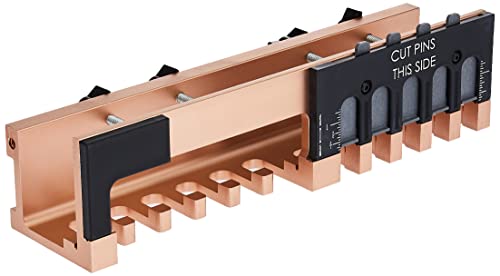
The General Tools 861 is the budget entry point into router-cut dovetails, and its design is unlike the bench jigs that dominate this category. Instead of a base that bolts to the bench, the one-piece aluminum body clamps directly onto the workpiece and works with either a handheld router or a router table. Because the jig attaches to the board rather than the other way around, board width is effectively unlimited, useful for wide drawer fronts.
The self-aligning design registers both ends of the joint so the pins and tails line up, and the kit includes a 14-degree, 1/2-inch dovetail router bit, so the only other tool required is a router with a suitable guide bushing. It cuts half-blind and through dovetails, and box joints are possible with a shop-made shim the manufacturer describes in the instructions. The trade-offs are fixed finger spacing, which gives every drawer the same pattern, and a lighter clamping arrangement than a cam-action bench jig.
Specs:
- Type: Clamp-on portable jig for handheld router or router table
- Construction: One-piece aluminum body
- Template length: 12 inches; board width unlimited, jig clamps to the stock
- Joints: Half-blind, through, box joints with a shop-made shim
- Included: 14-degree, 1/2-inch dovetail router bit
- Weight: 2.94 pounds
- Tier: Budget
POWERTEC 71529 15-Inch Dovetail Jig System
The POWERTEC 71529 follows the Keller pattern: a precision template that mounts to a shop-made backer board and rides on bearing-guided bits rather than guide bushings. The 15-inch phenolic template is milled with the tail pattern on one face and the pin pattern on the other, so flipping the template converts the setup from tails to pins without changing bit height.
The kit includes a straight edge pattern bit, a 7-degree dovetail bit with guide bearing, and mounting screws; the buyer supplies the backer board, which the instructions dimension at roughly 2-1/4 inches wide. With the included bits, the system cuts through dovetails in stock from 1/2 inch to 3/4 inch thick, matching standard drawer side and front thicknesses exactly. The limitation is scope: this is a through-dovetail-only system, so builders who want half-blind drawer joints should look at the bench jigs further down the list.
Specs:
- Type: Template system, mounts to a shop-made backer board
- Template: 15-inch phenolic, back-to-back tail and pin patterns
- Stock thickness: 1/2 inch to 3/4 inch with the included bits
- Joints: Through dovetails
- Included: Straight edge pattern bit, 7-degree dovetail bit with bearing, mounting hardware
- Template dimensions: 15 x 4.88 x 0.47 inches
- Tier: Mid-range
Keller Dovetail System 135-1500 Journeyman Dovetail Jig
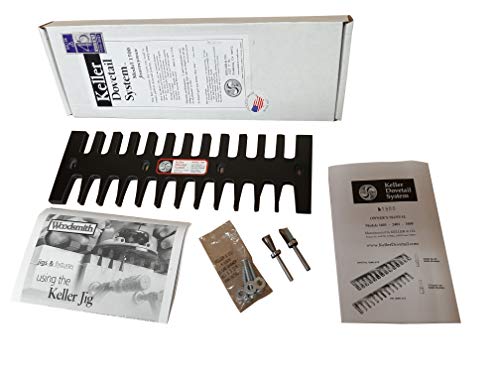
The Keller Journeyman is the original template-style dovetail system, sold since the 1970s. The 15-inch template is precision-milled from phenolic plate and is genuinely back-to-back: one edge guides the dovetail bit for the tails, the other guides the straight bit for the pins. The included bits carry ball-bearing guides the same diameter as the cutters, which makes the pin template a true full-size pattern of the finished joint and removes guide-bushing concentricity from the accuracy equation.
Stock thickness runs from 1/8 inch to 3/4 inch, and because the template clamps directly to the workpiece, there is no width or length limit, so a long drawer side or a wide blanket-chest panel is jointed the same way as a small box side. The kit includes the standard dovetail bit, a straight pattern bit, bearing guides and the phenolic template guide. What it does not include is a clamping base: the template is screwed or clamped to a backer board the user makes. It also cuts through dovetails only.
Specs:
- Type: Template system, clamps to the workpiece, handheld or table-mounted router
- Template: 15-inch precision-milled phenolic, back-to-back design
- Stock thickness: 1/8 inch to 3/4 inch
- Width capacity: Unlimited, set by the workpiece
- Joints: Through dovetails
- Included: Standard dovetail bit, straight bit, ball-bearing guides, phenolic guide
- Warranty: 1 year
- Tier: Mid-range to premium
PORTER-CABLE 4216 Dovetail Jig with Mini Template Kit
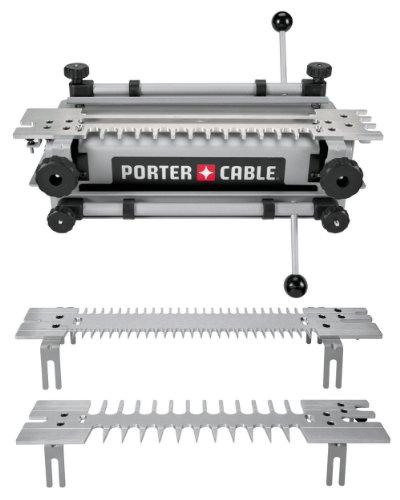
The 4216 is the most versatile fixed-template jig in this group and the natural center of a drawer-making setup. The one-piece steel base arrives assembled and either clamps or bolts to the bench. Three CNC-machined aluminum templates are included: the 4211 cuts half-blind, rabbeted half-blind and sliding dovetails; the 4213 cuts through dovetails and box joints; and the 4215 cuts miniature versions of all three, suiting small drawers and jewelry boxes. Four router bits, four template guides, two lock nuts and a wrench are in the box, so every supported joint can be cut without further purchases.
Capacity is 12 inches wide and 1/4 inch to 1-1/8 inches thick, covering drawer fronts and sides with room to spare. Two setup features matter in daily use: machined template alignment lines for registering the template to the stock, and on-board router bit depth gauges that set bit height for half-blind joints without repeated test cuts. Cam-action clamps with abrasive-backed locking bars hold both boards for the single-pass half-blind routine that makes drawer production fast. The fixed finger spacing is the honest limitation: every joint follows the template pattern, so drawers get uniform tails rather than a hand-cut layout. The three-year limited warranty is the longest in this roundup.
Specs:
- Type: Bench jig, one-piece steel base, no assembly required
- Width capacity: 12 inches
- Stock thickness: 1/4 inch to 1-1/8 inches
- Templates: 4211 half-blind and sliding, 4213 through and box joint, 4215 miniature
- Joints: Half-blind, rabbeted half-blind, sliding, through, box joints, miniature
- Included: 3 templates, 4 router bits, 4 template guides, 2 lock nuts, wrench
- Clamping: Cam-action clamps with abrasive-backed locking bars
- Warranty: 3-year limited
- Tier: Mid-range to premium
Leigh D4R Pro Dovetail Jig

The D4R Pro is the premium option and the only jig here with fully variable spacing. Its guide fingers are individually adjustable along the template bar, so pins and tails can be spaced to suit the drawer front in front of you: narrow pins at the edges, wider tails in the middle, or an asymmetric pattern that looks hand-planned rather than machine-set. The 24-inch capacity swallows wide drawer fronts and casework panels that no 12-inch jig can clamp in one pass.
Out of the box, the Leigh cuts single-pass half-blind dovetails, variably spaced half-blind and through dovetails, sliding dovetails, and box joints in 3/8-inch and 3/4-inch sizes, plus end-on-end and asymmetrical joints that fixed templates cannot attempt. Thickness capacity runs from 1/8 inch to 1-1/2 inches. The extruded aluminum body uses cam clamps and side stops for repeatable registration. The costs are a premium price tier and a longer learning curve: variable spacing means the user designs each layout. For a shop that builds drawers and cases regularly, it is the most capable router joinery system here.
Specs:
- Type: Bench jig with individually adjustable guide fingers
- Width capacity: 24 inches
- Stock thickness: 1/8 inch to 1-1/2 inches
- Spacing: Fully variable pin and tail spacing
- Joints: Through, half-blind, sliding, asymmetrical, end-on-end, box joints
- Construction: Extruded aluminum body, cam clamps, side stops
- Tier: Premium
How to Choose a Dovetail Jig for Drawers
Start with the joint you actually need. Most drawer boxes are built with half-blind dovetails at the front and through dovetails at the back. If that describes your work, a bench jig with a good half-blind template, such as the PORTER-CABLE 4216 or the Leigh D4R Pro, is the direct answer. If your drawers use through dovetails throughout, the template systems from Keller and POWERTEC are simpler and have no width limit.
Match the jig to your widest drawer front. A 12-inch capacity handles most kitchen and dresser drawers, but wide file drawers, blanket chests and case sides quickly exceed it; that is where a 24-inch jig or an unlimited-width template system earns its keep. Check thickness range against your drawer stock as well: sides at 1/2 inch and fronts at 3/4 inch sit comfortably in every jig here.
Consider setup style. Fixed templates are faster: clamp, rout, repeat. Variable spacing looks better and adapts to any board width, but every new layout is a small design exercise. Finally, count the included bits and guides: kits with matched bits and bushings, like the 4216 and the 861, get you cutting sooner.
FAQ
Which joint is best for drawer boxes, half-blind or through dovetails?
Half-blind dovetails are the standard choice for the front corners of a drawer because the socket is hidden inside the drawer front, so the front face shows no end grain or joint lines. Through dovetails are typically used at the back of the drawer box, where the joint is rarely seen and the full strength of the interlocking tails is an advantage.
Do I need a plunge router to use a dovetail jig?
A plunge router is helpful but not required for most jigs in this roundup. Bench jigs are routinely used with fixed-base routers because bit height is set once against the jig’s depth gauge, and template systems such as the Keller and POWERTEC work with handheld routers or router tables. What matters more is that the router accepts the guide bushing or bearing-guided bits the jig specifies.
Can one jig cut both dovetails and box joints?
Yes, several can. The PORTER-CABLE 4216 cuts box joints with its 4213 template and the appropriate straight bit, the Leigh D4R Pro cuts 3/8-inch and 3/4-inch box joints with its finger assembly, and the General Tools 861 can cut box joints using a shop-made shim described by the manufacturer. The Keller and POWERTEC template systems are dedicated to through dovetails.
Why do my dovetails fit too loose or too tight?
Fit problems almost always trace back to bit height or bushing position rather than the template. On fixed-template jigs, raising the dovetail bit makes tails larger and the joint tighter, while lowering it loosens the fit; adjustments of a few thousandths of an inch are the norm. On bearing-guided template systems, the usual culprit is a worn bearing or a bit whose cutting diameter no longer matches its guide. Cutting one test joint in scrap of the same thickness first is the standard safeguard.
Conclusion
For most woodworkers building drawers, the PORTER-CABLE 4216 is the balanced choice: three templates, included bits and guides, a 12-inch capacity, and single-pass half-blind routing that makes drawer production genuinely quick. The General Tools 861 keeps the budget tier honest with a clamp-on design that handles any board width, while the POWERTEC 71529 and Keller 135-1500 serve builders who prefer through dovetails and unlimited width in a simple template format. At the top, the Leigh D4R Pro justifies its premium tier with variable spacing and 24-inch capacity no fixed template can match.
Related guides
More from Amazon
Programs that pair well with the guide above. Offers and eligibility are set by Amazon and may change.
A free business account with business pricing and bulk-buying tools for work, shop or home office.
Create a business accountFree shipping on eligible items, Prime Video and more. Eligible new members can start with a free trial.
Start a Prime free trialAudiobooks and podcasts to listen to on the go. Eligible new members can start with a free trial.
Try Audible freeAd-free music streaming. Eligible new subscribers can start with a free trial.
Try Music Unlimited freeAs an Amazon Associate we earn from qualifying purchases.










Write Your Review
No reviews yet. Be the first to share your experience!