What's inside
As an Amazon Associate I earn from qualifying purchases. This post may contain affiliate links at no extra cost to you.
For a painted interior door, the best material is usually not the prettiest wood. It is the material that stays stable, sands cleanly, accepts primer evenly, and does not telegraph knots or open grain through the finish. For most projects, that means poplar, maple, or a paint-grade hardwood with a flat, uniform surface. MDF is also an excellent option for slab doors and routed panels, provided it will not be exposed to moisture.
As an Amazon Associate we earn from qualifying purchases at no extra cost to you.


Our Top Picks
 Rust-Oleum 369384 Advanced Dry Door & Trim Paint32 Fl Oz (Pack of 1)4.25 x 4.25 x 4.9 Inches2.9 poundsCheck on Amazon
 JUBEST 32"x80" Raised 2-Panel Square Smooth White Primed32x80 Inch1.38 x 32 x 80 inchesCheck on Amazon
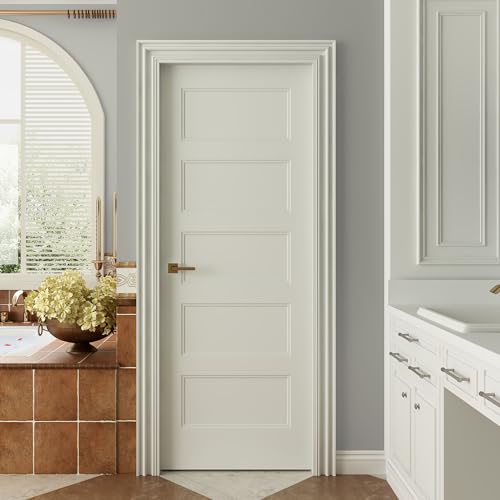 JUBEST 32"x80" 5-Panel White Primed Hollow Core Interior32x80 Inch1.38 x 32 x 80 inchesCheck on Amazon

Best overall: poplar
Poplar is the practical default for painted interior doors. It is affordable, widely available, relatively stable, and easy to machine. Its fine, closed grain needs less filling than oak, ash, or walnut, so it is easier to produce sharp-looking stiles, rails, and panel edges.
Poplar’s main drawback is softness. A fingernail or careless clamp can dent it, and raised grain can appear around routed profiles if the cutters are dull. It also varies from pale green to gray, but that color variation does not matter under a properly applied primer and two finish coats.
For new solid-wood doors, choose stock with a moisture content around 6% to 8% if possible. Let the lumber acclimate indoors for at least several days before milling. Poorly acclimated boards can move after assembly, opening joints or making a once-crisp edge look uneven.
Other good choices for painted doors
| Material | Advantages | Limitations | Best use |
|---|---|---|---|
| Poplar | Affordable, fine grain, easy to machine | Soft; can dent and show color variation | Most stile-and-rail painted doors |
| Hard maple | Very smooth, hard, clean edges | More expensive; difficult to sand and machine | High-wear doors and sharp routed profiles |
| Birch | Uniform appearance and moderate cost | Can blotch or show glue contamination under paint | Flat panels and paint-grade components |
| MDF | Extremely smooth faces; no natural grain | Heavy, moisture-sensitive, weak at unsupported edges | Interior slab doors and routed door faces |
| Oak or ash | Strong and readily available | Open pores require filling for a flat painted finish | Only when strength or existing trim requires it |
When maple is worth the extra cost
Hard maple produces the cleanest solid-wood edges among common domestic species. It resists dents better than poplar, and its tight grain makes it a good choice for narrow sticking profiles, hinge edges, and doors likely to receive hard use. It also takes a uniform paint finish when sanded correctly.
The trade-off is labor. Maple burns easily with dull router bits, and its hardness makes hand-sanding slower. Use sharp cutters, make light passes, and sand through 120, 150, and 180 grit. Do not jump directly from 80 to 220 grit; the coarse scratches may remain under paint, while overly polished areas can reduce primer adhesion.
When MDF is the cheaper, better option
MDF is often the best choice for a flat painted interior door. Its face is already smooth and grain-free, so it does not need pore filling. It is also less likely than solid wood to show seasonal grain movement across a broad painted surface.
A standard 3/4-inch MDF slab is heavy and can sag or stress lightweight hinges. Use a properly supported door design, install three hinges on a full-height door, and seal every cut edge. MDF edges absorb primer aggressively and can swell if exposed to water. A dedicated MDF edge sealer or thinned water-based wood filler can reduce this problem.
MDF is a poor choice for bathrooms, laundry rooms with frequent condensation, or any opening where water can reach the bottom edge. Moisture-resistant MDF improves the odds but is not waterproof. For those locations, a stable hardwood or a factory-finished composite door is safer.
How to keep edges crisp
Crisp painted edges start with accurate joinery, not paint. Keep the door parts square and make sure rails meet stiles without gaps. A small joint gap may disappear under primer, but a misaligned profile will remain visible. Use a sharp block plane or sanding block to remove machining marks without rounding the edge.
Break exposed sharp corners very slightly—about 1/32 inch to 1/16 inch. A perfectly knife-sharp corner chips easily and is difficult to cover with paint. Do not heavily ease the edges, because a rounded profile catches light and makes the door look soft.
For solid wood, fill dents and small voids with a paintable paintable wood filler. Avoid silicone or flexible caulk in wood defects; paint often crawls away from it. Sand filler flush after it dries, then inspect the surface under raking light.
Primer and paint selection
Use a high-build bonding or wood primer rather than relying on finish paint to hide defects. On poplar and maple, one coat is often enough after good sanding. MDF edges may need two coats, with a light sanding between them. Sand primer with 220 grit or a fine sanding sponge, using a flat block on broad surfaces.
For the finish, a waterborne trim enamel is convenient and dries quickly, while an alkyd-modified or hybrid enamel typically levels better and resists blocking when the door closes against its stop. Apply two thin coats instead of one heavy coat. Heavy paint rounds profiles, sags on vertical faces, and can glue the door shut against the jamb.
A high-density foam trim roller can leave a smoother coat than a cheap brush on flat areas, but back-brush or tip off the paint while it is wet. Between coats, follow the product’s recoat time; sanding or closing the door too soon can damage the soft film.
What to buy
Choose poplar for the best balance of cost, workability, and finish quality. Choose hard maple when dent resistance and very clean edges justify the added expense. Choose MDF for a flat slab or routed painted design in a dry room. Use oak or ash only if you are willing to fill the open grain, typically with two applications of grain filler and additional sanding.
The cheapest acceptable option is often poplar with careful primer work. Spending more on maple will not compensate for dull tools, poor sanding, glue squeeze-out, or a thick finish coat. The surface preparation determines whether the final edges look crisp.
0 Comments