What's inside
As an Amazon Associate I earn from qualifying purchases. This post may contain affiliate links at no extra cost to you.
For a painted built-in desk and shelves, the best material is usually not one wood species. A practical build often combines plywood for the structural boxes, MDF for smooth painted faces, and solid wood only where it adds strength or protects an exposed edge. The right choice depends on span, moisture, edge treatment, and how much time you want to spend filling and sanding.
As an Amazon Associate we earn from qualifying purchases at no extra cost to you.

Best overall material: paint-grade plywood with MDF face parts
For most built-ins, use 3/4-inch cabinet-grade plywood for the desk top, shelving boxes, vertical dividers, and cabinet sides. Add 1/2-inch or 3/4-inch plywood backs as needed. Plywood holds screws well, resists sag better than MDF at the same thickness, and is lighter than particleboard.
For doors, drawer fronts, end panels, and other broad surfaces that must look perfectly smooth, 3/4-inch MDF is often easier to paint. Its face has no open grain, so it needs less filling than oak, ash, or even many plywood veneers. MDF is also less expensive than high-quality plywood.
A good combination is plywood for the load-bearing carcass, MDF for painted trim and flat panels, and poplar for narrow solid-wood edging. This controls cost without forcing you to finish every surface with the same material.
How the common choices compare
| Material | Advantages | Drawbacks | Best use |
|---|---|---|---|
| Cabinet-grade plywood | Strong, lighter, good screw holding, better moisture tolerance | More expensive; veneer edges need banding or filling | Desk tops, shelves, sides, and cabinet boxes |
| MDF | Very smooth faces, inexpensive, easy to paint | Heavy, weak screw holding near edges, swells badly when wet | Doors, drawer fronts, trim, and end panels |
| Poplar | Easy to machine, stable, affordable, paints well | Soft; dents and may show green or gray tones under light paint | Face frames, edge strips, and solid trim |
| Birch or maple plywood | Hard, clean veneer, durable edges | Costs more; veneer can telegraph through a thin finish | Visible shelves and high-wear desk surfaces |
| Particleboard | Cheapest option, flat and consistent | Heavy, poor moisture resistance, weak after repeated screw removal | Budget shelves or hidden cabinet parts |
Choosing plywood for shelves and the desktop
Buy plywood labeled cabinet grade, rather than construction sheathing. Construction plywood may have voids, rough faces, and thin surface veneers that become obvious after painting. Birch plywood is a useful middle ground: its face is smooth, it machines cleanly, and it accepts primer reliably. A higher-grade maple or hardwood plywood gives a more uniform surface but may not be worth the added cost under opaque paint.
For shelves wider than about 30 inches, do not rely on a flat 3/4-inch sheet without support. Books and office equipment can make a shelf sag permanently. Add a front edge band, a center divider, or a fixed support. A 1-1/2-inch-wide solid-wood or plywood nosing on the front edge makes a noticeable difference. For long shelves, a face frame or vertical support is usually more effective than buying thicker material.
Inspect sheets before buying. Reject panels with bowed faces, open voids at the edges, damaged corners, or veneer bubbles. Let the wood acclimate indoors for several days, supported flat, before cutting.
When MDF is the cheaper and better option
MDF is a sensible choice for painted parts that do not carry heavy loads. It is particularly good for wide end panels, simple slab doors, drawer fronts, and crown or base trim. The surface is smooth enough that a properly applied primer can produce a sprayed-looking finish with a roller and brush.
Its weaknesses matter in a desk. MDF is heavy, so a large desktop made entirely from 3/4-inch MDF may need more support than plywood. Its edges are porous and can swell from water-based products or spilled drinks. It also does not hold ordinary wood screws well near an edge. Use glue, confirmat screws, pocket screws in suitable locations, or threaded inserts where parts must be disassembled.
Seal every exposed MDF edge. Apply a thin coat of primer or diluted wood glue, let it dry, and sand with 180-grit paper. For the smoothest result, use a dedicated MDF edge sealer or primer, then apply a second coat if the edge still absorbs finish.
The best solid wood for painted trim
Poplar is the usual choice for paint-grade face frames, edge banding, and trim. It is stable, easy to cut, and usually cheaper than clear maple. Poplar can have green, purple, or gray streaks, but these disappear under a good primer and two finish coats.
Soft maple is harder and more dent-resistant, making it worthwhile for a desktop front edge or a heavily used shelf nosing. It costs more and can be less forgiving to machine. Pine is acceptable for inexpensive trim, but knots, resin, and seasonal movement can cause paint failures. If you use pine, seal knots with a shellac-based primer rather than assuming ordinary latex primer will block them.
Avoid using wide solid-wood boards for an entire built-in desktop unless you plan for movement. Wood expands across its grain as humidity changes. Fastening a solid panel rigidly between two fixed walls can cause cracks or buckling. Plywood or MDF is more predictable for this application.
Preparation and paint that hold up
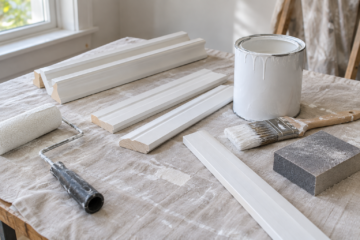
Start with clean, sharp cuts. Break exposed edges with a light 120-grit sanding pass, then sand broad faces with 150- or 180-grit paper. Do not aggressively sand plywood veneer; it is easy to cut through the top layer. Fill nail holes, screw recesses, and plywood voids with a paintable filler, let it dry fully, and sand flush.
Use a bonding primer on smooth plywood veneer and a high-build or MDF-friendly primer on porous edges. Sand the primer with 220 grit after it dries. Vacuum thoroughly and wipe with a slightly damp microfiber cloth. Dust left in corners will become visible under a satin finish.
For a durable built-in, apply two thin finish coats rather than one heavy coat. A waterborne cabinet or trim enamel is convenient and has low odor; an oil-modified or solvent-based enamel can level well but dries more slowly and may yellow. A waterborne cabinet and trim enamel is a sensible default for most home offices. Allow the stated recoat time, and avoid loading the desk heavily for several days.
A practical material list
For a typical painted built-in, buy 3/4-inch cabinet-grade plywood for the carcasses and desktop, 3/4-inch MDF for flat panels and trim, and poplar boards for exposed edge strips. Use wood glue suited to indoor furniture, such as a standard PVA adhesive, on clean, close-fitting joints. Glue does not compensate for gaps or poorly supported shelves.
If the budget is tight, use MDF for fixed shelves and panels while reserving plywood for the desktop and screw-bearing sides. That is a reasonable compromise when the room is dry and the built-in will not be moved. Spend extra on good primer and careful edge preparation; a cheap board with properly sealed edges usually looks better than expensive wood covered with rushed paint.
0 Comments