As an Amazon Associate I earn from qualifying purchases. This post may contain affiliate links at no extra cost to you.
The dust that hurts you is the dust you cannot see. A pile of shavings on the floor is harmless. The haze that hangs in the air two hours after you shut off the planer is the problem, and that haze is exactly what a dust mask from the paint aisle was never designed to stop. Choosing the best respirator for woodworking comes down to understanding one thing most people get backwards: the filter is rarely the weak link. The seal against your face is.
Here is the mechanism, because it makes every buying decision afterward obvious. Air is lazy. It takes the path of least resistance. A filter media is a maze of fibers that air has to weave through, and that maze costs effort. A gap along your cheekbone costs nothing. So if there is a gap, air goes around the filter, not through it, and the rating printed on the box becomes decoration. This is why a properly fitted N95 outperforms a top-tier cartridge respirator worn loose over a beard.
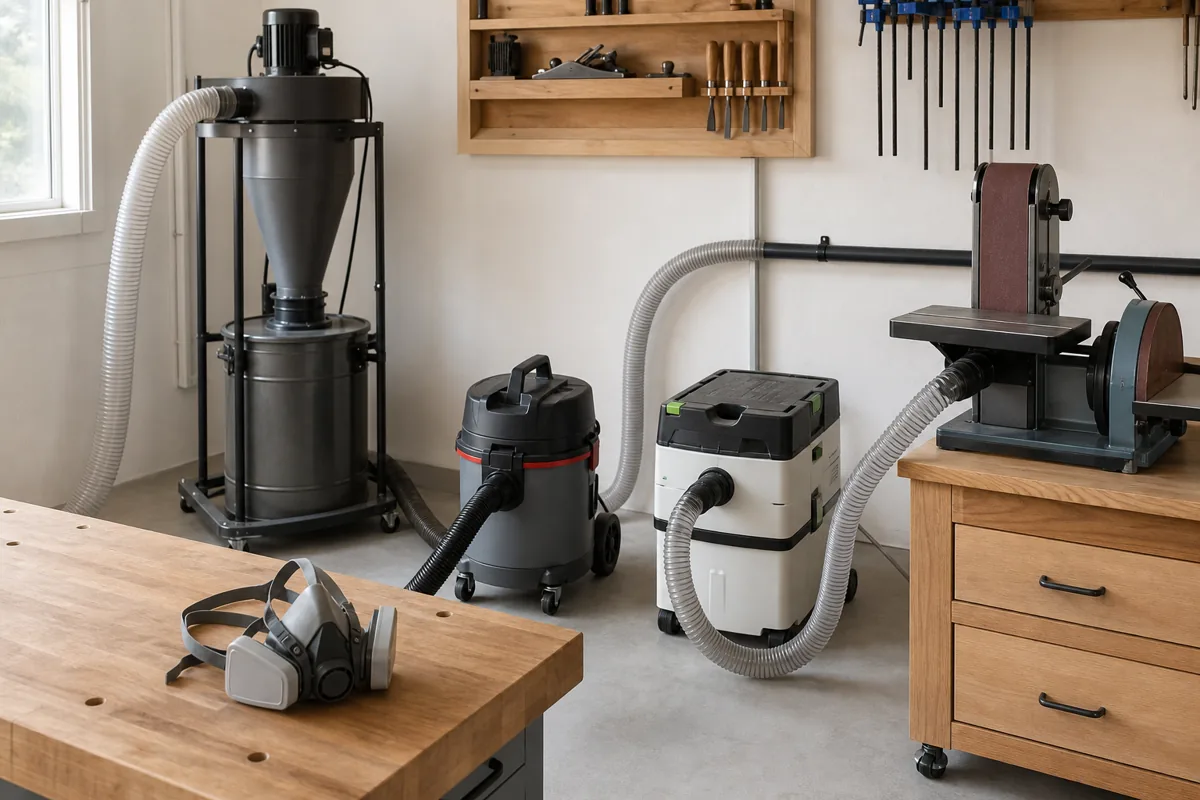
The Misconception: “Wood Dust Is Just Sawdust”
Almost everyone starts here. Sawdust looks like a solid, chunky nuisance, so it feels like something a paper mask should easily catch. The reality is that a single pass through a table saw or a router produces particles across an enormous size range, and the smallest fraction behaves less like sand and more like smoke. Those particles stay airborne for hours, and they are small enough to travel past the nose and throat and reach the deepest part of the lungs.
Two more corrections worth naming. First, hardwood dust is classified as a carcinogen by international health agencies, and species like walnut, cocobolo and western red cedar are also notorious sensitizers, meaning repeated exposure can create a reaction where none existed before. Second, a dust collector and an air filter reduce exposure but do not replace a respirator. Collection at the tool catches the coarse stuff and a share of the fines. An ambient air cleaner slowly scrubs the room. Neither one protects the eighteen inches of air directly in front of your face while you are actively cutting, which is the only air you are breathing.
Decoding Filter Ratings Without the Jargon
The US rating system is NIOSH’s, and it is simpler than it looks. The letter describes oil resistance and the number describes efficiency. N means not oil resistant, which is fine for woodworking. R and P handle oil aerosols, which matters for spray finishing. The number 95 or 100 is the percentage of 0.3 micron particles the media captures, tested at that size specifically because it is the hardest size to catch. Particles both larger and smaller are captured more easily. P100 filters are often labeled HEPA-equivalent and are the ones tinted magenta on cartridge respirators.
An important distinction: particulate filters trap solids. They do nothing for vapors. Finish fumes, lacquer thinner, contact cement and spray solvents require an activated carbon organic vapor cartridge, which works by adsorption rather than straining. Carbon has a service life that starts the moment you unseal it, whether you are wearing it or not, so store cartridges in a sealed bag between uses.
| Style | Best For | Filter Level | Trade-off |
|---|---|---|---|
| Disposable N95/N99 | Quick cuts, occasional sanding | N95 to N99 | No reuse, fit varies by face |
| Elastomeric half mask | Daily shop work, sanding, sawing | P100 particulate | Blocks some face shield fits |
| Half mask with combo cartridges | Finishing and glue-up fumes | P100 plus organic vapor | Heavier, higher breathing effort |
| Powered air respirator (PAPR) helmet | Beards, long sessions, lathe work | HEPA-class | Highest cost, battery upkeep |
The Best Respirator for Woodworking by Style
There is no single winner because faces and jobs differ. What follows is how each style behaves in a real shop.
Disposable N95 and N99 masks are the honest entry point. They are cheap, they weigh nothing, and a good one with dual head straps and a molded nose bridge seals better than most people expect. Skip anything with a single ear-loop band, since ear loops cannot generate enough tension to hold a seal. Look for the NIOSH approval number printed on the mask itself. An exhalation valve reduces heat and fogging considerably, which matters more than it sounds when you are wearing safety glasses.
Elastomeric half masks are the sweet spot for anyone in the shop weekly. The silicone or rubber face piece conforms to your face instead of relying on a folded shell, the head harness pulls with real tension, and P100 cartridges last months of hobby use. Filters twist off and get replaced for a fraction of the mask cost. The two known irritations are that some models crowd a face shield and that the front-mounted cartridges can bump your workpiece when you lean in close. Low-profile designs with slim filters solve most of that.
Powered air respirators blow filtered air into a helmet or hood, so they do not depend on a face seal at all. That single fact makes them the practical answer for anyone with a beard, and turners love them because the helmet includes face protection. They cost several times what a half mask does, the belt-mounted or helmet-mounted battery needs charging, and the fan is audible. In exchange you get cool, clean, low-effort air for hours.
Reusable Half Mask Respirator with P100 Filters
If you buy one respirator and keep it for years, buy this category. Search for a silicone face piece in your size, then add a pair of P100 cartridges. Expect to spend more up front than a box of disposables and less than half of that per year afterward on filters.
Fit Beats Filter Class Every Time
Industrial workplaces run quantitative fit testing with particle counters. At home you can get most of the way there with a user seal check, and you should do one every single time you put the mask on. It takes five seconds.
On a cartridge respirator, cover the filter inlets with your palms and inhale gently. The face piece should collapse slightly toward your face and hold. On a disposable, cover the whole front with both hands and exhale sharply. Feel for air escaping along the nose, cheeks or jaw. Any leak means you adjust the straps, reseat the nose bridge, and check again.
Three things break seals. Facial hair is the big one, since even a few days of stubble along the sealing surface creates channels air will happily use. Wrong size is the second, and manufacturers do offer small, medium and large for a reason. Eyeglass temples running under the seal are the third. Also worth knowing: half masks come in different face piece geometries, and a model that leaks badly on a narrow face may seal perfectly on a broad one. If a mask will not pass a seal check after honest adjustment, that mask is wrong for your face and no amount of persistence changes it.
- ✔ P100 cartridges cost a fraction of the mask and last months
- ✔ Silicone seals conform better than folded paper shells
- ✔ Combination cartridges add solvent vapor protection for finishing
- ✔ Seal check takes seconds and confirms protection every time
- ✘ Useless over a beard or stubble along the seal
- ✘ Front cartridges can interfere with face shields and close work
- ✘ Breathing effort rises as filters load with dust
- ✘ Carbon vapor cartridges expire once opened, even unused
Building a Habit That Actually Sticks
The best respirator is the one hanging where you reach for it. Keep it on a hook next to the light switch, not in a drawer under the bench. Put it on before you make the first cut, because the fine fraction goes airborne instantly and lingers, so a mask donned after sanding is closing the barn door late.
Replace particulate filters when breathing gets noticeably harder or when they get wet. Replace vapor cartridges on schedule, or immediately if you smell finish through them, since smell means breakthrough. Store the mask in a sealed bag or lidded container so the face piece does not collect the very dust you are trying to avoid. Wipe the silicone with mild soap and water, let it dry fully, and inspect straps and valves for cracks every few months.
NIOSH N95 Disposable Masks, Dual Strap
Buy a box and stash them in the shop, the garage and the truck. Dual head straps and an exhaust valve are the two features worth insisting on. These are for the ten-minute job where a cartridge mask feels like too much friction, and friction is what keeps masks off faces.
Powered Air Respirator Helmet for Woodturning
If you have a beard you will not shave, or you spend hours at the lathe, this is the honest recommendation. No face seal to compromise, integrated face protection, and comfortable enough that you forget it is on. Budget for it as a tool purchase, not an accessory.
Frequently Asked Questions
Will an N95 work for spray finishing? No. An N95 captures particles, and spray produces both particles and solvent vapor. Vapor passes straight through particulate media. For any solvent-based finish you need a combination cartridge with activated carbon for organic vapors plus a particulate pre-filter, along with real ventilation.
Can I wear a respirator with a beard? Not a sealing one, and this is not a matter of trying harder. Hair crossing the sealing surface prevents contact with skin, and air takes the gap. Options are shaving the seal area, or moving to a powered air respirator that supplies positive-pressure filtered air into a hood or helmet where no seal is needed.
How long do P100 filters last in a home shop? There is no hour rating, because loading depends on how dusty your air is. Judge by breathing resistance: when inhaling takes noticeably more effort than a fresh pair, swap them. Most hobby woodworkers get months from a set. Replace immediately if a filter gets soaked or physically damaged, and always store the mask sealed so filters are not loading while parked on the bench.
Protecting your lungs is the cheapest insurance in the shop, and unlike a bandsaw upgrade you will never see the payoff, which is exactly the point. Pick the style that matches your face and your work, confirm the seal every time you put it on, and treat filter replacement as routine maintenance rather than an emergency.
Check prices on Amazon →
0 Comments