What's inside
As an Amazon Associate I earn from qualifying purchases. This post may contain affiliate links at no extra cost to you.
The best benchtop woodworking lathe for most small shops is the Jet JWL-1221VS, while the RIKON 70-105 is the better compact choice, the WEN 3424T is the budget pick, and the NOVA Comet II suits turners who value portability and accessories.
A benchtop lathe is a practical choice for pens, bowls, tool handles, spindles, and small decorative work, but “benchtop” does not automatically mean light, quiet, or ready to use without preparation. Compare the distance between centers, swing over the bed, speed-control range, motor behavior, total weight, and how securely the machine can be mounted.
As an Amazon Associate we earn from qualifying purchases at no extra cost to you.

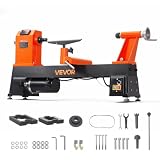


Best benchtop woodworking lathes by situation
| Shop situation | Best fit | Why it fits | Watch out for |
|---|---|---|---|
| Frequent bowl and spindle turning | Jet JWL-1221VS | 12-inch swing, 21-inch capacity, strong variable-speed drive, substantial cast-iron construction | Heavy for a portable bench and commonly costs more than entry-level models |
| Limited bench space | RIKON 70-105 | 10-inch swing, 18-inch capacity, compact footprint, approximately 75 lb | Less room for large bowls and larger blanks |
| Lowest reasonable entry cost | WEN 3424T | 12-inch swing, 18-inch capacity, 5-speed pulley system, approximately 70 lb | Changing speeds requires stopping and moving the belt |
| Portable workbench or shared workspace | NOVA Comet II | Compact 12-inch swing, approximately 16.5-inch capacity, lighter overall format | Shorter capacity and less mass can make large blanks feel less stable |
| Need electronic variable speed at a midrange price | Delta 46-460 | 12.5-inch swing, 20-inch capacity, three-pulley-range variable-speed design | Its relatively compact frame still benefits from a rigid stand or bench mounting |
Specifications can vary by production version and market, so verify the current manufacturer listing before ordering. The useful comparison is not the maximum number alone: a 12-inch swing is only helpful if your bench, chuck, tools, and dust-control setup can support the work that goes with it.
Head-to-head: the important differences
Jet JWL-1221VS: the strongest all-around choice
The Jet JWL-1221VS combines a 12-inch swing with a 21-inch distance between centers and electronic variable speed, typically adjustable from about 60 to 3,600 rpm. That range covers slow startup for an imperfect bowl blank, moderate speeds for general turning, and faster spindle work after the piece is balanced.
Its approximately 130-pound cast-iron body is an advantage when cutting aggressively: more mass means less tendency for the machine to walk or vibrate. The trade-off is ownership convenience. It usually needs a permanent location, a sturdy stand, or a reinforced bench rather than a shelf that must be cleared after every project. Expect a mid-to-upper market price, often roughly $900 to $1,200 depending on configuration and promotions.
RIKON 70-105: compact without being toy-like
The RIKON 70-105 provides a 10-inch swing and 18-inch distance between centers in a smaller package. Its approximately 75-pound weight is easier to move than the Jet’s, but still more stable than very light hobby machines. Electronic variable speed is useful when moving between pens, handles, and small bowls.
This is a good match for a first serious lathe user who has limited floor space and does not expect to turn large salad bowls. Its main limitation is capacity rather than control. A bowl that technically fits within the swing may still be uncomfortable if the blank is heavy, out of balance, or mounted on a large chuck. Typical pricing falls in the midrange, commonly around $600 to $850.
WEN 3424T: budget capacity with manual speed changes
The WEN 3424T offers a 12-inch swing and 18-inch distance between centers, with a 5-speed belt-and-pulley system and a motor commonly listed at 4.5 amps. It is attractive when the budget is closer to $300 to $450 and the work will be occasional spindle turning, pens, handles, and modest bowls.
The manual speed system is not merely a minor inconvenience. You must stop the lathe, open the cover, reposition the belt, and close the cover before restarting. That makes it less convenient for a workpiece that needs several speed changes during shaping. It also means you should select a conservative starting speed for an unbalanced blank instead of relying on a dial to slow it instantly.
NOVA Comet II: portability and ecosystem
The NOVA Comet II is aimed at small projects and flexible shop arrangements. Its 12-inch swing and roughly 16.5-inch distance between centers are enough for many pens, bowls, goblets, and tool handles, while its compact design is easier to store than a full-size benchtop machine.
NOVA’s chuck and accessory ecosystem can be a deciding factor if you already own compatible equipment. The shorter center capacity becomes important when turning long candlesticks or chair parts. A small lathe also has less momentum, so very hard cuts or badly balanced blanks can produce more vibration than they would on a heavier machine. Budget roughly $500 to $750 for the lathe, with accessories potentially adding substantially to the total.
Delta 46-460: useful middle ground
The Delta 46-460 offers approximately 12.5 inches of swing and 20 inches between centers. Its variable-speed arrangement uses a motor and pulley ranges rather than a single simple dial, giving useful control across different work sizes. It is well suited to a hobbyist who wants more capacity than a compact model but does not want the weight and price of a heavier professional machine.
Because the machine can accept larger blanks, bench rigidity becomes more important. A 12.5-inch swing does not turn a light folding table into a safe turning station. Allow approximately $700 to $1,000 for the lathe, before adding a chuck, faceplates, turning tools, sharpening equipment, and a stand.
How to choose capacity without overbuying
Use swing for maximum diameter and distance between centers for maximum length. A lathe with a 12-inch swing can theoretically rotate a 12-inch-diameter piece over the bed, but the practical limit is lower when the blank is rough, irregular, or mounted on a large chuck. Leave clearance for tool access and verify the actual clearance over the tool rest and banjo.
For a first machine, these are useful targets:
- Pens, small handles, and ornaments: 8-10-inch swing and 12-18-inch capacity.
- Small bowls and goblets: 10-12-inch swing, variable speed, and at least 16 inches between centers.
- Medium bowls and repeated production: 12-inch or larger swing, substantial cast-iron mass, and a rigid stand.
- Long spindles: prioritize distance between centers, tailstock alignment, and extension options over maximum swing.
Variable speed is especially valuable for bowl turning. A rough blank may need to begin around 300-500 rpm, while a balanced small spindle may be comfortable at 1,500-3,000 rpm. The correct speed depends on diameter, balance, wood, mounting, and the cutter, so the machine’s maximum rpm is less important than smooth low-speed control.
Bench mounting, noise, and vibration
Plan the mounting surface before buying the lathe. A bench should be rigid enough that pressing a tool into the rest does not make the top flex. Through-bolting the lathe to a thick hardwood or plywood top is preferable to relying on short screws in a thin worktop. Use washers and locknuts where accessible, and check alignment after tightening.
For a portable setup, mount the lathe to a removable board that can be clamped to a heavy bench. This spreads the load and makes storage easier, but clamps must not interfere with the banjo, tailstock, or belt cover. Rubber feet can reduce high-frequency vibration, but they cannot compensate for a weak bench or an unbalanced blank.
Noise comes from several sources: motor whine, belt vibration, bearings, loose covers, and the workpiece itself. A heavy machine often sounds less harsh because it moves less, even if its motor is more powerful. Hearing protection remains sensible, particularly in a small room where sound reflects from walls.
What ownership really involves
The first components likely to need attention are belts, drive-center points, tool-rest surfaces, and chuck jaws—not necessarily the motor. Belts can glaze or stretch, especially when the lathe is run too slowly under heavy load. Keep the belt correctly tensioned rather than overtightening it, which can shorten bearing life.
- Remove shavings from the motor vents, belt housing, and tailstock threads after each session.
- Clean rust-prone bare metal and apply a light protective film, keeping lubricant away from grip surfaces.
- Inspect the drive center and live center for damage before mounting a new blank.
- Keep chuck jaws, screws, and threads free of packed dust; wood debris can prevent accurate seating.
- Recheck tool-rest and tailstock alignment after moving the machine.
- Do not exceed the chuck, faceplate, or lathe’s stated workpiece limits.
A common mistake is buying the lathe and postponing the stand. If a $750 machine requires a $250 reinforced stand, a $150 chuck, and $200 of basic tools and sharpening equipment, the initial setup is about $1,350 before wood or dust collection. That calculation is more useful than comparing lathe prices alone.
Final buying recommendation
Choose the Jet JWL-1221VS if you turn regularly and want the best combination of capacity, low-speed control, and stability. Choose the RIKON 70-105 when bench space and portability matter more than bowl diameter. Choose the WEN 3424T for occasional turning at the lowest entry cost, accepting manual speed changes. Choose the NOVA Comet II for compact projects and accessory compatibility, or the Delta 46-460 for a middle path with useful capacity and variable-speed control.
Whichever model you select, budget for a rigid mounting solution and safe workholding before chasing the largest swing or highest motor rating. In a small shop, stability and controllable speed usually improve results more than a few extra inches of theoretical capacity.
0 Comments