What's inside
As an Amazon Associate I earn from qualifying purchases. This post may contain affiliate links at no extra cost to you.
Every spring I end up with the same mess: a flower bed whose grass border has crawled six inches into the mulch, a patch of lawn that died after a fuel spill, or a section of yard that needs to be stripped before laying new turf. In each case, a machete or flat spade gives you ragged, uneven cuts that leave the replacement looking sloppy. A proper sod cutter slices through the root mat at a consistent depth, producing clean rectangles or edges that lay flush without guesswork.
The category has split into distinct types over the years, and choosing the right tool means matching the format to the job. Folding knives excel at precision cuts in tight spaces. Half-moon edgers handle long linear borders with minimal wrist strain. Plugger-style tools remove exact squares for transplanting without disturbing surrounding roots. What separates a good one from a bad one is blade geometry, handle leverage, and whether the steel holds its edge through a full Saturday of digging without needing a file every ten cuts.
As an Amazon Associate we earn from qualifying purchases at no extra cost to you.




Our Top Picks
 CKLT Edger Lawn Tool 41in Border Edger with41" Assembly Required40 x 10 x 1.3 inches5.9 poundsCheck on Amazon
 Colwelt Saw-Tooth Edger Lawn Tool38-Inch Saw-Tooth Border Edger8.7 x 1.7 x 38 inches3.7 poundsCheck on Amazon

Quick Picks
| Product | Best for | Price |
|---|---|---|
| 4.75″ Folding Sod Knife | Precision trimming and patches | n/a |
| 41in Half Moon Edger | Long clean borders along driveways | n/a |
| Colwelt Saw-Tooth Edger | Budget edging with aggressive grip | $30 |
| 11″ Stainless Sod Cutter Knife | Insulation cutting and sod repair | n/a |
| Garden Weasel Edger Chopper | Garden beds and patio edges | n/a |
| 52″ Heavy Duty Sod Lifter | Large-area removal with less bending | n/a |
| Dolibest Sod Plugger | Bulb planting and round patch repair | n/a |
| Colwelt Square Sod Plugger | Exact square plugs for seeding | n/a |
How We Picked
We evaluated each tool on three criteria: cutting efficiency through thick root mats, ergonomic design that reduces strain during extended use, and material durability under repeated soil contact. Blade hardness, handle geometry, and whether the tool demands a hammer blow or a clean push-through mattered more than brand name or price. We also considered storage footprint, since many buyers keep these tools in sheds where space is limited.
The 8 Best Sod Cutters in 2026
4.75″ Folding Stainless Steel Sod Knife
This is the tool I reach for when I need to trim around a sprinkler head or slice a patch that a dog dug up. The 4 3/4-inch folding blade gives you knife-level control in spaces where nothing else fits, and stainless steel resists the rust that kills cheaper alternatives after one wet season.
- Pro: Folds to pocket size, making it genuinely portable for spot repairs across a large yard.
- Pro: Stainless steel edge holds sharpness well through dense thatch.
- Con: Short blade means multiple passes through thick sod, which tires your hand over larger jobs.
Skip this if your primary task is edging long stretches of lawn. It is a precision instrument, not a production tool.
41in Border Edger with Tempered Spring Steel Blade
The half-moon profile on this 41-inch edger does most of the work through gravity. You step down on the wide footplate, and the tempered spring steel blade bites into compacted soil without requiring a hammer. The long rubber handle gives excellent leverage, reducing the shoulder strain that plagues shorter alternatives.
- Pro: Footplate is genuinely wide, distributing pressure so you do not sink into soft ground while stepping.
- Pro: Manganese steel construction resists rust without needing constant oiling.
- Con: The overall length makes it awkward to store in small sheds or carry to a neighbor’s yard.
Pass on this if you work in areas with heavy tree root systems, where a chopper-style blade breaks through where a half-moon stalls.
Colwelt Saw-Tooth Edger Lawn Tool
At $30, this saw-tooth edger is the best value entry point in the category. The 38-inch handle with T-grip puts enough weight behind each step for most suburban lawns, and the serrated cutting edge grips sod rather than sliding across it. For someone maintaining clean sidewalk edges twice a season, it handles the job without demanding a premium budget.
- Pro: Aggressive saw-tooth design cuts through wet, slippery sod where smooth blades skate.
- Pro: T-grip handle rotates comfortably, reducing wrist fatigue during long runs.
- Con: At this price, the steel does not match the hardened edges found on premium half-moon tools.
If your soil is heavy clay or you have tree roots, you will likely outgrow this within two seasons.
Insulation Knife Sod Cutter Knife
This hybrid tool straddles categories: its 11.14-inch blade is sharp enough to slice through thin sod, and it doubles as a utility knife for cutting landscape fabric or foam insulation on jobs around the house. The double-sided edge and nylon sheath make it a versatile companion for anyone who moves between garden beds and workshop tasks.
- Pro: Long blade handles thicker sod mats in fewer strokes than folding knives.
- Pro: Nylon sheath protects the edge and your hand during storage.
- Con: No footplate or handle leverage means all cutting force comes from your arm.
Not the tool for large-area sod removal, but excellent when you need one knife that covers multiple job-site needs.
Garden Weasel Edger Chopper
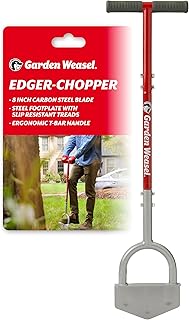
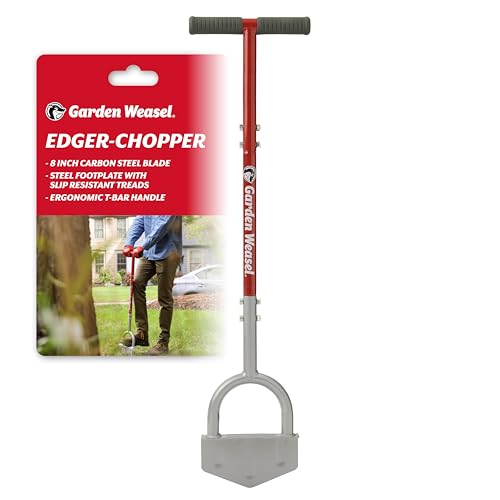
Garden Weasel’s name comes from how the tool behaves: you swing the half-moon chopper blade down like a hatchet, and it severs roots that a stepping edger would merely bend around. The T-grip keeps your hands above the cutting line, and the steel blade handles garden beds, sidewalks, and patio borders without complaint.
- Pro: Chopping action conquers root-heavy soil and established perennial borders.
- Pro: Creates clean edges on multiple surfaces without changing tools.
- Con: Repeated overhead swinging is harder on your back and shoulders than step-down designs.
If you have a large, flat lawn edge with no roots, a step edger will be faster and less tiring.
52″ Heavy Duty Sod Lifter
At 52 inches with a D-grip handle, this is the longest-reach option here and the one that spares your back the most. The steel shaft and wide blade let you slice under sod, then lever it up in sections. Including gloves in the package is a small touch that signals the manufacturer understands the grip-heavy nature of this task.
- Pro: Extra length means you stand more upright, reducing lower back strain during extended sessions.
- Pro: The D-grip provides a secure purchase even with gloved, sweaty hands.
- Con: Heavier than shorter models, which adds fatigue during repetitive lifting motions.
Overkill for a quick patch repair or edging a single garden bed.
Dolibest Sod Plugger Tool
This tool solves a problem I had not considered until I planted daffodil bulbs last fall: cutting perfect round plugs for transplanting without disturbing root systems. Dual pedals let you drive the serrated cylinder into the ground with body weight, and the foot ejector releases the plug cleanly. The soft grip handle stays comfortable even after thirty or forty insertions.
- Pro: Foot ejector mechanism saves your knees from repeated bending to pry plugs loose.
- Pro: Sharp serrations cut through dense Bermuda or fescue mats without twisting.
- Con: Assembly is required before first use, which adds a minor inconvenience on a busy weekend.
If you only need straight edges rather than plugs, a half-moon edger will serve better.
Colwelt Sod Plugger Tool Square
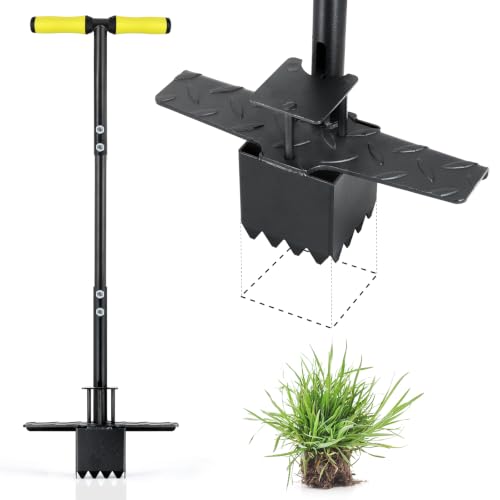
Where the round plugger suits bulbs, this 3×3 square version is designed for grass repair and seeding. The 36-inch handle with dual pedals gives you body-weight leverage, and the T-grip keeps your hands in a natural position during repeated cuts. Square plugs fit together with minimal gaps, which matters when you are patching bare areas in visible lawn sections.
- Pro: Square geometry means patches tile cleanly with no dead space between sections.
- Pro: 36-inch handle length provides solid leverage without excessive weight.
- Con: Square corners are stress points; in rocky soil, they can catch and require prying.
For planting round bulbs, the cylindrical version cuts faster and causes less root damage.
Buying Guide
Blade Geometry and Material
Half-moon blades slice cleanly through grass roots and thatch, while saw-tooth edges grip wet or slippery sod better. Stainless steel resists rust with minimal maintenance, but hardened spring steel holds a sharper edge longer before needing a file. Match the geometry to your dominant task: linear edges favor smooth curves, root-heavy beds favor serrations or chopping profiles.
Handle Length and Ergonomics
Tools over 36 inches let you apply body weight instead of arm strength, which is the difference between one pleasant Saturday and three sore ones. T-grips suit edging where your hands stay fixed, while D-grips allow repositioning for prying or lifting. If you have knee or hip issues, longer handles reduce how far you must bend with every cut.
Storage and Portability
A folding knife disappears into a jacket pocket or tackle box. A 52-inch sod lifter demands a wall hook or shed corner. If you move between job sites or store tools in a vehicle, weight and foldability matter as much as cutting performance. Consider how often you will reach for the tool versus how many times it will trip you in the garage.
Our Verdict
The 41in Half Moon Edger wins as the top pick for most homeowners because it balances cutting efficiency, ergonomic comfort, and durability without the price premium of specialty tools. For the budget pick, the Colwelt Saw-Tooth Edger at $30 covers standard sidewalk and bed edging with genuine competence. If your primary task is transplanting bulbs or repairing small bare patches without disturbing surrounding roots, the Dolibest Sod Plugger outperforms every other option here simply because it solves a problem the edgers and knives cannot.
FAQ
What is the difference between a sod cutter and a regular spade?
A sod cutter slices horizontally through the root mat at a consistent depth, producing a uniform sheet you can roll or lift. A spade cuts vertically and leaves an uneven root network, making replacement pieces fit poorly.
Can I use a half-moon edger to remove large areas of sod?
You can, but it is slow and tiring on your knees and lower back. For areas larger than a few square feet, a dedicated sod lifter or manual rotary cutter saves substantial time and physical effort.
How deep should I set my blade when cutting sod?
Most lawns have root zones between two and four inches. Setting your blade just below that depth captures roots without dragging heavy clay soil up with the sod mat, which makes the piece harder to handle.
Do stainless steel blades rust?
They resist rust far better than carbon steel, but they are not immune, especially in acidic soils or if left outdoors between uses. A quick rinse and dry after heavy use extends the edge life noticeably.

0 Comments