What's inside
As an Amazon Associate I earn from qualifying purchases. This post may contain affiliate links at no extra cost to you.
Pale woods such as maple, birch, ash, and white oak can shift noticeably under a clear finish. Some turn amber; others look slightly darker or more saturated. The right choice depends on whether you want the wood to stay close to its freshly sanded color, how much wear the surface will take, and whether you can test samples before finishing the whole piece.
Start with the wood, not the label
“Clear” describes transparency, not color neutrality. Oil-based varnish and many oil-based polyurethanes add a warm amber cast. Water-based finishes usually change pale wood less, though they can still deepen its color and make grain contrast stronger. Even finishes sold as “natural” or “crystal clear” may look different on maple than on oak.
Wood species matters. Maple’s fine, even grain can show blotchy patches if the surface is uneven or the finish wets it inconsistently. White oak has open pores that absorb finish and emphasize its grain. Birch can also turn unevenly colored, especially if stain is involved. If preserving a light, uniform appearance is the goal, skip stain unless you have a specific reason to use it.
Compare finish types
This is a starting point, not a guarantee: product formulas vary, and the wood itself affects the result. Test the exact finish system on offcuts from the project.
| Finish category | Effect on pale wood | Practical trade-off | Good fit |
|---|---|---|---|
| Water-based polyurethane | Usually the least ambering of these options | Can raise grain; thin coats and careful application help | Indoor furniture, cabinets, and floors where color matters |
| Oil-based polyurethane | Adds a warm, amber tone that often increases with time | Durable and widely available, but the color shift may be unwanted | Projects where a warmer look is acceptable |
| Hardwax oil or penetrating oil | Often makes wood look wet or more saturated; some formulas amber | Easy to repair locally, but may need more upkeep than a film finish | Low-gloss furniture and surfaces where repairability matters |
| Clear shellac | Typically adds warmth; “blonde” is lighter than amber shellac | Fast drying and useful as a sealer, but less resistant to heat and alcohol | Interior pieces with modest exposure or as a compatible barrier coat |
Choose for the way the surface will be used
For a desk, dining table, or kitchen cabinet, a water-based polyurethane is often the practical choice when you want to limit yellowing without giving up a durable film. Compare products by the stated use and application instructions, not just the words “clear” or “non-yellowing.” A water-based polyurethane for wood is a reasonable category to consider for indoor furniture.
For a shelf or decorative object that sees little handling, a lower-cost clear water-based finish may be sufficient. Paying more for a floor-rated coating is unnecessary if the piece will not face abrasion, spills, or frequent cleaning. Conversely, a soft oil finish may be a poor bargain on a busy tabletop if it needs regular maintenance and you want a tough, washable surface.
For outdoor pale wood, first choose a finish rated for exterior exposure. Clear coatings outdoors need maintenance because sunlight and moisture can degrade the coating and discolor the wood. A clear finish cannot keep wood looking freshly cut indefinitely in full sun. If stable color matters more than seeing the grain, an opaque exterior paint generally offers better UV protection.
Test before coating the project
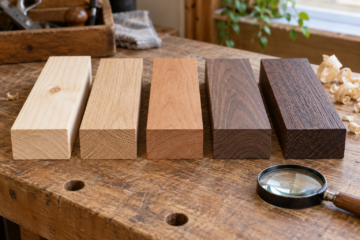
Make at least two test boards from offcuts, sanded with the same grit sequence as the workpiece. Apply the full planned finish schedule to one; leave the other unfinished as a reference. Check the samples after the finish has dried fully, because wet wood and wet finish can look darker than the cured surface. View them in daylight and in the room where the piece will live.
Use the manufacturer’s recommended sanding range. Many water-based film finishes work well over wood sanded to about 150–220 grit, but sanding finer can reduce adhesion or make absorption less even, depending on the product. Follow the label rather than assuming that a finer surface is always better. Remove dust thoroughly, and do not use a tack cloth containing wax or silicone unless the finish maker approves it.
Water-based finishes can raise the grain, leaving a rough feel after the first coat. One option is to dampen the bare wood lightly with clean water, let it dry, and sand gently with the final grit before finishing. Another is to apply the first coat, let it dry, then sand the raised fibers lightly without cutting through the coating. Do not press hard: exposed patches may absorb later coats differently.
Avoid common color problems
Do not judge color from a small dab on the surface. A larger sample reveals both the overall cast and the way grain, glue lines, and sanding marks show through. Inspect end grain too: it can absorb more finish and appear darker. On glued panels, wipe away squeeze-out before it hardens. Dried glue can block finish and leave pale, shiny patches that are difficult to fix after assembly.
If you want the least change in color, try a water-based “natural” or “raw” look product, but verify that it is a clear coating rather than a tinted finish. Some products use white pigment to counter ambering; too much can leave a cloudy or chalky appearance, especially in pores and corners. A water-based natural-look wood finish can be worth testing, but the sample is more reliable than the name.
For a subtle warm tone, oil-based polyurethane is not automatically a mistake. It is commonly available and can suit pale oak or a piece designed to age warmly. The important point is to choose that color deliberately. If the sample is already too yellow, do not expect extra coats to make it clearer; they usually build the same cast.
Apply and maintain the finish
Apply thin coats at the temperature and humidity range stated on the container. Thick coats can sag, stay tacky, or cure unevenly. Respect the listed recoat time; a surface that feels dry may not be ready for sanding or another coat. For many water-based finishes, light sanding between coats with 220–320 grit is common, but follow the product directions and avoid sanding through edges.
Keep leftover finish sealed and store it as directed. For future repairs, record the product, sheen, number of coats, and sanding grit. Gloss tends to show scratches and surface defects more clearly than satin, while a matte finish can make a pale surface look slightly less bright. Choose sheen as part of the sample test, not as a last-minute decision.
0 Comments