RP Woodworks

  • Home
  • Reviews
  • Projects
  • Tools
  • Woodworking Techniques
  • About

Wood Species & Lumber

Choosing wood: species comparisons, lumber grades, plywood, MDF and sheet goods for each kind of project.

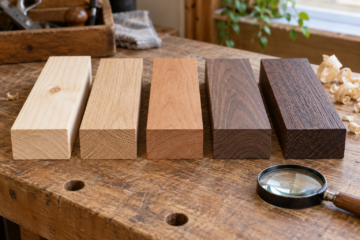
AI-generated editorial illustration: five wooden board samples showing different grain textures and colors.
Wood Species & Lumber

Hemlock vs Douglas Fir for Painted Interior Trim

Both hemlock and Douglas fir can work for painted interior trim, but neither is automatically ready for a smooth finish. Hemlock is often the easier choice for profiles with visible grain or knots; Douglas fir can be a sound, economical option when the stock is straight, dry, and carefully prepared. Read more

By , 2 weeksSeptember 25, 2026 ago
AI-generated editorial illustration: five wooden board samples showing different grain textures and colors.
Wood Species & Lumber

Alder vs Cherry for Natural Oil-Finished Furniture

Alder and cherry are both workable hardwoods that can produce attractive furniture with a natural oil finish. They are not interchangeable, though. Alder is softer, lighter, and usually less expensive. Cherry is denser, more durable, and develops a deeper red-brown color as it ages. Your choice affects dent resistance, color Read more

By , 2 weeksSeptember 25, 2026 ago
AI-generated editorial illustration: five wooden board samples showing different grain textures and colors.
Wood Species & Lumber

Birch vs Poplar for Water-Based Cabinet Paint

Birch and poplar are both common choices for painted cabinet doors and face frames. Either can produce a smooth result under water-based paint, but neither is ready for paint straight off the saw. The practical difference is that birch is harder and usually more dent-resistant, while poplar is often cheaper Read more

By , 2 weeksSeptember 25, 2026 ago
AI-generated editorial illustration: five wooden board samples showing different grain textures and colors.
Wood Species & Lumber

White Oak vs Chestnut for Fumed Wood Finishes

What Fuming Does to Wood Fuming is a chemical coloring process, not a stain. Wood is placed in a sealed enclosure with household ammonia, and ammonia vapor reacts with tannins in the wood. The result is color that penetrates farther than a typical stain and does not sit as a Read more

By , 2 weeksSeptember 25, 2026 ago
AI-generated editorial illustration: five wooden board samples showing different grain textures and colors.
Wood Species & Lumber

Hard Maple vs Hickory for a Durable Clear-Coated Countertop

Hard maple and hickory are both dense hardwoods that can make a durable countertop under a clear finish. Hard maple is usually the easier choice to buy, machine and keep looking even. Hickory is tougher in some respects, but its strong color variation, harder machining and movement across the grain Read more

By , 2 weeksSeptember 25, 2026 ago
AI-generated editorial illustration: five wooden board samples showing different grain textures and colors.
Wood Species & Lumber

Redwood vs Western Red Cedar for Semi-Transparent Exterior Stain

The short answer For a semi-transparent exterior stain, both redwood and western red cedar are good choices. Western red cedar is usually the better all-around siding and trim material because it is stable, widely available, and takes stain predictably. Redwood can produce a richer-looking finish and is often a strong Read more

By , 2 weeksSeptember 25, 2026 ago
AI-generated editorial illustration: five wooden board samples showing different grain textures and colors.
Wood Species & Lumber

Elm vs Ash for Clear-Coated Furniture with Visible Grain

Elm and ash can both make excellent clear-coated furniture, but they produce different-looking surfaces and behave differently during preparation. Ash is the easier, more predictable choice when you want a crisp open grain and a light, even appearance. Elm is the better choice when you want movement: interlocked grain, cathedral Read more

By , 2 weeksSeptember 25, 2026 ago
AI-generated editorial illustration: five wooden board samples showing different grain textures and colors.
Wood Species & Lumber

Sycamore vs Soft Maple for a Clear, Light-Colored Finish

Sycamore and soft maple can both produce a pale, clean-looking finish, but they do not look or behave exactly alike. Sycamore usually has a more noticeable flecked figure, especially when quartersawn. Soft maple is often more uniform, though its color and grain vary by species and board. For a clear Read more

By , 2 weeksSeptember 25, 2026 ago
AI-generated editorial illustration: five wooden board samples showing different grain textures and colors.
Wood Species & Lumber

White Oak vs Black Locust for Exterior Stain Performance

White oak and black locust can both work outdoors, but they behave differently under stain. White oak is usually easier to source, machine and finish consistently. Black locust is naturally durable and often needs no film-forming finish for rot protection, but its color, density and extractives can make staining less Read more

By , 2 weeksSeptember 25, 2026 ago
AI-generated editorial illustration: five wooden board samples showing different grain textures and colors.
Wood Species & Lumber

How to Compare End-Grain Absorption Across Common Wood Species

End grain absorbs liquid differently from the long-grain face of a board. Cut across a board’s fibers and you expose open vessels and capillaries that can draw in water, glue, stain, or finish quickly. How much it absorbs depends on the species, the cut, the condition of the surface, and Read more

By , 2 weeksSeptember 25, 2026 ago

Posts pagination

Previous 1 … 9 10 11 … 19 Next
Recent Posts
  • Best Woodworking Clamps: Which Types to Buy and How Many You Need
  • Best Pocket Hole Jigs in 2026: Kreg, Massca and Milescraft Compared
  • Best Dovetail Jigs: Fixed, Multi-Template and Variable-Spacing Options Explained
  • Best Compact Wood Routers: Corded vs Cordless Picks for Edge Work and Trimming
  • How to Repair a Wood Split Caused by a Screw (Even in Thin Teak)
Recent Comments
No comments to show.
Archives
  • October 2026
  • September 2026
Categories
  • Clear Coats & Topcoats
  • Finish Problems & Fixes
  • Gift Guides
  • Grain Filling & Sealing
  • Guides
  • Oils & Waxes
  • Painting & Priming
  • Sanding & Surface Prep
  • Shop Setup & Safety
  • Staining & Dyes
  • Tool Troubleshooting
  • Tools
  • Wood Finishing
  • Wood Species & Lumber
  • Woodworking Techniques
Hestia | Developed by ThemeIsle