RP Woodworks

  • Home
  • Reviews
  • Projects
  • Tools
  • Woodworking Techniques
  • About

Staining & Dyes

Choosing and applying wood stains, dyes, toners and color washes for even, predictable color.

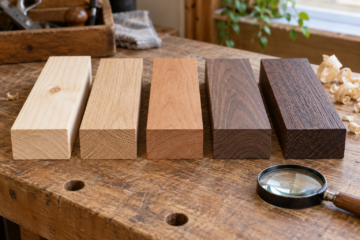
AI-generated editorial illustration: five wooden board samples showing different grain textures and colors.
Staining & Dyes

Best Wood for Stained Interior Stair Risers

For stained interior stair risers, the best wood is usually the one that matches the surrounding trim, takes stain evenly, and stays flat after installation. Clear poplar is a practical choice when you want a smooth painted-grade surface but plan to stain; red oak is easier to match to common Read more

By , 2 weeksSeptember 25, 2026 ago
AI-generated editorial illustration: five wooden board samples showing different grain textures and colors.
Staining & Dyes

Best Wood for Stained Closet Shelving

For stained closet shelving, the best wood is usually poplar, maple, or red oak—not the cheapest construction lumber. The right choice depends on whether you want a smooth, furniture-like finish, a visible grain pattern, or the lowest practical cost. Shelves also need enough thickness and support to avoid sagging under Read more

By , 2 weeksSeptember 25, 2026 ago
AI-generated editorial illustration: five wooden board samples showing different grain textures and colors.
Staining & Dyes

Best Wood for Stained Interior Door Jambs

The best wood for a stained interior door jamb is usually red oak, white oak, or clear pine, depending on the look and budget. Oak gives the most predictable stained finish, while pine costs less but needs more preparation. Poplar is a good paint-grade wood, but it is a poor Read more

By , 2 weeksSeptember 25, 2026 ago
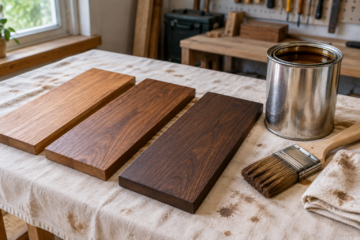
AI-generated editorial illustration of wood stain
Staining & Dyes

How to Test Stain Color on Scrap from the Same Board

A stain test is useful only if the sample represents the surface you’ll actually finish. Wood can vary in color and grain from one edge of a board to another, and sanding, glue, conditioner, and topcoat all change the result. Testing on scrap cut from the same board is the Read more

By , 2 weeksSeptember 25, 2026 ago
AI-generated editorial illustration: five wooden board samples showing different grain textures and colors.
Staining & Dyes

Best Wood for a Stained Exterior Door Under a Covered Porch

For a stained exterior door beneath a covered porch, mahogany is usually the best balance of appearance, stability, and durability. Sapele is a practical close alternative; white oak is a good choice when you want a more pronounced grain and can accept extra weight. The porch roof helps, but it Read more

By , 2 weeksSeptember 25, 2026 ago
AI-generated editorial illustration: five wooden board samples showing different grain textures and colors.
Staining & Dyes

Best Wood Species for a Two-Step Dye-and-Topcoat Finish

A two-step dye-and-topcoat finish uses a water- or solvent-based dye to color bare wood, then a clear finish to protect it. The dye adds color without hiding grain; the topcoat supplies wear and moisture resistance. The wood species matters because its grain, pores, and natural color affect how evenly dye Read more

By , 2 weeksSeptember 25, 2026 ago
AI-generated editorial illustration: five wooden board samples showing different grain textures and colors.
Staining & Dyes

Best Wood Species for a Translucent Color Wash

A translucent color wash lets the grain show through while shifting the wood’s overall color. The species matters as much as the stain: open pores, strong grain contrast, resin, and uneven absorption can all change the result. For a first project, choose a light-colored wood with a fairly even surface, Read more

By , 2 weeksSeptember 25, 2026 ago
AI-generated editorial illustration: five wooden board samples showing different grain textures and colors.
Staining & Dyes

Best Wood Species for a Smooth, Dark Dye Finish

A smooth, dark dye finish depends more on the wood species than many finishers expect. Dye colors the wood fibers instead of forming an opaque film, so grain, pores, earlywood, and end grain all remain visible. That is what gives dye its depth, but it also means an uneven species Read more

By , 2 weeksSeptember 25, 2026 ago
AI-generated editorial illustration: five wooden board samples showing different grain textures and colors.
Staining & Dyes

How to Prepare Wood for a Limed Oak Finish

A limed oak finish fills oak’s open pores with a pale pigment while leaving the grain visible. The result can look chalky and whitewashed, but it depends more on surface preparation than on the lime product itself. Dust, old finish, uneven sanding, or closed pores can leave the color blotchy Read more

By , 2 weeksSeptember 25, 2026 ago
AI-generated editorial illustration of wood fillers and finishing prep
Staining & Dyes

How to Choose a Wood Filler That Accepts Stain

“Stainable” on a filler label does not mean the patch will disappear. Wood absorbs stain through its pores; most fillers absorb it differently, so a filled nail hole or gouge can turn into a pale, dark, or oddly colored spot. The best choice depends on the damage, the wood, the Read more

By , 2 weeksSeptember 25, 2026 ago

Posts pagination

Previous 1 … 12 13 14 … 16 Next
Recent Posts
  • Best Woodworking Clamps: Which Types to Buy and How Many You Need
  • Best Pocket Hole Jigs in 2026: Kreg, Massca and Milescraft Compared
  • Best Dovetail Jigs: Fixed, Multi-Template and Variable-Spacing Options Explained
  • Best Compact Wood Routers: Corded vs Cordless Picks for Edge Work and Trimming
  • How to Repair a Wood Split Caused by a Screw (Even in Thin Teak)
Recent Comments
No comments to show.
Archives
  • October 2026
  • September 2026
Categories
  • Clear Coats & Topcoats
  • Finish Problems & Fixes
  • Gift Guides
  • Grain Filling & Sealing
  • Guides
  • Oils & Waxes
  • Painting & Priming
  • Sanding & Surface Prep
  • Shop Setup & Safety
  • Staining & Dyes
  • Tool Troubleshooting
  • Tools
  • Wood Finishing
  • Wood Species & Lumber
  • Woodworking Techniques
Hestia | Developed by ThemeIsle