RP Woodworks

  • Home
  • Reviews
  • Projects
  • Tools
  • Woodworking Techniques
  • About

Wood Finishing

Staining, sealing, oiling and clear-coating wood: product choice, application and fixes for common finish problems.

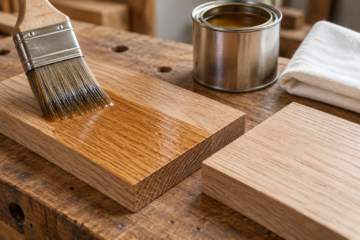
AI-generated editorial illustration: brush applying a clear wood finish to a board beside an unfinished offcut.
Clear Coats & Topcoats

Lacquer vs Water-Based Polyurethane for Cabinet Finishing

Choosing between lacquer and water-based polyurethane comes down to how the cabinets will be used, what equipment you have, and how much time you can spend on application. Lacquer is fast, easy to repair, and common in cabinet shops. Water-based polyurethane is slower to build and slightly less forgiving during Read more

By , 1 weekSeptember 25, 2026 ago
AI-generated editorial illustration: brush applying a clear wood finish to a board beside an unfinished offcut.
Oils & Waxes

Oil-Based Polyurethane vs Water-Based Polyurethane for Stair Treads

Choosing a Finish for Stair Treads Stair treads need a finish that handles repeated foot traffic, grit, cleaning, and occasional moisture. Both oil-based and water-based polyurethane can work, but they behave differently during application and aging. The better choice depends on the wood species, the look you want, how quickly Read more

By , 1 weekSeptember 25, 2026 ago
AI-generated editorial illustration: brush applying a clear wood finish to a board beside an unfinished offcut.
Oils & Waxes

Hardwax Oil vs Penetrating Oil for Dining Tables

Choosing a finish for a dining table is a choice between surface protection, appearance, and ease of repair. Hardwax oil and penetrating oil both leave wood looking natural, but they do not protect it in the same way. For most dining tables, hardwax oil is the safer choice when you Read more

By , 1 weekSeptember 25, 2026 ago
AI-generated editorial illustration of wood paint
Painting & Priming

Oil-Based Paint vs Water-Based Enamel on Interior Woodwork

Choosing between oil-based paint and water-based enamel for interior woodwork comes down to the finish you need, the condition of the surface, and how much drying time you can tolerate. Oil-based paint still has advantages on trim and doors, but modern water-based enamels are easier to use and perform well Read more

By , 1 weekSeptember 25, 2026 ago
AI-generated editorial illustration of wood stain
Staining & Dyes

Gel Stain vs Penetrating Stain for Vertical Wood Panels

Vertical wood panels are a difficult surface to stain evenly. Gravity pulls liquid downward, the wood may have inconsistent porosity, and large uninterrupted boards make lap marks easy to see. Gel stain and penetrating stain can both work, but they behave differently enough that choosing the wrong one can create Read more

By , 1 weekSeptember 25, 2026 ago
AI-generated editorial illustration of wood stain
Staining & Dyes

Water-Based Stain vs Oil-Based Stain on Open-Grain Hardwood

Open-grain hardwoods such as oak, ash, walnut, and mahogany absorb stain unevenly because their earlywood and open pores take up more color than the denser surrounding grain. The choice between water-based and oil-based stain affects more than drying time. It changes color, grain definition, working time, odor, cleanup, and how Read more

By , 1 weekSeptember 25, 2026 ago
AI-generated editorial illustration of wood epoxy
Grain Filling & Sealing

Epoxy vs Wood Filler for Filling Deep Knots

Deep knots are attractive until they loosen, shed bark, or leave a crater in a finished board. Filling one successfully depends less on the brand of filler than on choosing a material that can handle the hole’s depth, movement, and final appearance. For most deep knots, two-part epoxy is the Read more

By , 1 weekSeptember 25, 2026 ago
AI-generated editorial illustration of wood epoxy
Grain Filling & Sealing

Epoxy vs CA Glue for Filling Small Wood Voids

Small knots, pinholes, worm tracks, cracks, and chipped edges are common in otherwise useful boards. Two practical fillers are epoxy and cyanoacrylate (CA) glue. Both can produce a clean repair, but they behave very differently once you sand, stain, and finish the wood. For a pinhole or hairline crack, CA Read more

By , 1 weekSeptember 25, 2026 ago
AI-generated editorial illustration of wood epoxy
Clear Coats & Topcoats

PVA Glue vs Epoxy for End-Grain Repairs

Choosing Glue for End-Grain Repairs End grain is the exposed end of wood fibers, where the straws of the grain point directly at the repair. That structure makes it unusually absorbent and often weaker than long-grain wood. A split cutting board, chipped table leg, cracked stair tread, or missing corner Read more

By , 1 weekSeptember 25, 2026 ago
AI-generated editorial illustration: wood glue bottle beside an edge-glued board assembly and spreader.
Clear Coats & Topcoats

PVA Glue vs Polyurethane Glue for Indoor Wood Joints

For most indoor wood joints, PVA glue is the sensible default. It is inexpensive, easy to apply, cleans up with water, and makes strong joints when the mating surfaces fit properly. Polyurethane glue earns its place when you need longer open time, some moisture resistance, or a glue that will Read more

By , 1 weekSeptember 25, 2026 ago

Posts pagination

Previous 1 … 8 9 10 … 63 Next
Recent Posts
  • Best Woodworking Clamps: Which Types to Buy and How Many You Need
  • Best Pocket Hole Jigs in 2026: Kreg, Massca and Milescraft Compared
  • Best Dovetail Jigs: Fixed, Multi-Template and Variable-Spacing Options Explained
  • Best Compact Wood Routers: Corded vs Cordless Picks for Edge Work and Trimming
  • How to Repair a Wood Split Caused by a Screw (Even in Thin Teak)
Recent Comments
No comments to show.
Archives
  • October 2026
  • September 2026
Categories
  • Clear Coats & Topcoats
  • Finish Problems & Fixes
  • Gift Guides
  • Grain Filling & Sealing
  • Guides
  • Oils & Waxes
  • Painting & Priming
  • Sanding & Surface Prep
  • Shop Setup & Safety
  • Staining & Dyes
  • Tool Troubleshooting
  • Tools
  • Wood Finishing
  • Wood Species & Lumber
  • Woodworking Techniques
Hestia | Developed by ThemeIsle