RP Woodworks

  • Home
  • Reviews
  • Projects
  • Tools
  • Woodworking Techniques
  • About

Wood Finishing

Staining, sealing, oiling and clear-coating wood: product choice, application and fixes for common finish problems.

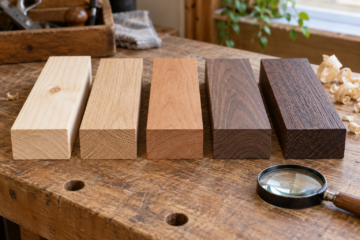
AI-generated editorial illustration: five wooden board samples showing different grain textures and colors.
Painting & Priming

Best Wood for a Painted Mudroom Bench That Resists Scuffs

Best all-around: paint-grade maple plywood with a hardwood edge For a mudroom bench that will take backpacks, shoes, and repeated knocks, use 3/4-inch paint-grade maple plywood for the seat and face it with a solid hardwood strip. Maple plywood gives you a stable, flat top; the hardwood edge protects the Read more

By , 2 weeksSeptember 25, 2026 ago
AI-generated editorial illustration: five wooden board samples showing different grain textures and colors.
Clear Coats & Topcoats

Best Wood Species for a Clear-Finished Bathroom Vanity Door

What matters in a bathroom A clear finish shows the wood’s natural color and grain, so species choice matters more than it would under paint. But a vanity door also sees humid air, splashes, and repeated wiping. No wood species is waterproof: sound joinery, sealed end grain, and a finish Read more

By , 2 weeksSeptember 25, 2026 ago
AI-generated editorial illustration: five wooden board samples showing different grain textures and colors.
Clear Coats & Topcoats

Best Wood Species for a Blonde Finish on a Dining Table

A blonde dining table can look light and natural without looking yellow, but the result depends more on the wood’s starting color and finish than on a stain labeled “natural.” For a clear, pale finish, choose a species with a light base color, modest color variation, and grain you like. Read more

By , 2 weeksSeptember 25, 2026 ago
AI-generated editorial illustration: five wooden board samples showing different grain textures and colors.
Painting & Priming

Best Wood for a Painted Built-In Bookcase in a Humid Room

For a painted built-in in a humid room, the best all-around choice is usually a good-quality plywood carcass with solid wood used only where it helps: face frames, edging, and trim. Paint hides grain, so paying extra for attractive solid lumber rarely makes sense. Stability, flatness, and a surface that Read more

By , 2 weeksSeptember 25, 2026 ago
AI-generated editorial illustration: five wooden board samples showing different grain textures and colors.
Staining & Dyes

Best Wood for Stained Interior Door Jambs

The best wood for a stained interior door jamb is usually red oak, white oak, or clear pine, depending on the look and budget. Oak gives the most predictable stained finish, while pine costs less but needs more preparation. Poplar is a good paint-grade wood, but it is a poor Read more

By , 2 weeksSeptember 25, 2026 ago
AI-generated editorial illustration of wood paint
Painting & Priming

How to Fill Nail Holes in Painted Wood Trim

Small nail holes stand out on painted trim because paint does not hide a dent or a dark opening. A neat repair takes more than pushing filler into the hole: the right material depends on the hole’s size, the trim’s condition, and whether the paint is flat or glossy. For Read more

By , 2 weeksSeptember 25, 2026 ago
AI-generated editorial illustration of wood paint
Finish Problems & Fixes

How to Make a Painted Wood Surface Smooth Without Brush Strokes

Brush marks usually come from paint that is too thick, a brush that is dragging, or paint that starts to set before you finish a section. The fix is not simply to sand harder. Prepare the wood, use a finish suited to the surface, apply thin coats, and let each Read more

By , 2 weeksSeptember 25, 2026 ago
AI-generated editorial illustration of wood epoxy
Clear Coats & Topcoats

How to Compare PVA, polyurethane, and epoxy wood glues

Choosing between PVA, polyurethane, and epoxy comes down to the joint, the wood, and the conditions it must survive. For most clean, close-fitting indoor joints, ordinary PVA wood glue is the inexpensive, reliable choice. Polyurethane handles moisture better and can bond some less-porous materials, while epoxy is useful for gaps Read more

By , 2 weeksSeptember 25, 2026 ago
AI-generated editorial illustration of wood stain
Staining & Dyes

How to Test Stain Color on Scrap from the Same Board

A stain test is useful only if the sample represents the surface you’ll actually finish. Wood can vary in color and grain from one edge of a board to another, and sanding, glue, conditioner, and topcoat all change the result. Testing on scrap cut from the same board is the Read more

By , 2 weeksSeptember 25, 2026 ago
AI-generated editorial illustration: brush applying a clear wood finish to a board beside an unfinished offcut.
Grain Filling & Sealing

How to Fill Open Grain Before Lacquering Walnut

Why fill walnut before lacquering Walnut is a ring-porous hardwood with open pores that can show as small pits and dark lines beneath a clear finish. Lacquer builds a film on the surface; it does not reliably fill those pores. If you want a smooth, level top, fill them first. Read more

By , 2 weeksSeptember 25, 2026 ago

Posts pagination

Previous 1 … 51 52 53 … 63 Next
Recent Posts
  • Best Woodworking Clamps: Which Types to Buy and How Many You Need
  • Best Pocket Hole Jigs in 2026: Kreg, Massca and Milescraft Compared
  • Best Dovetail Jigs: Fixed, Multi-Template and Variable-Spacing Options Explained
  • Best Compact Wood Routers: Corded vs Cordless Picks for Edge Work and Trimming
  • How to Repair a Wood Split Caused by a Screw (Even in Thin Teak)
Recent Comments
No comments to show.
Archives
  • October 2026
  • September 2026
Categories
  • Clear Coats & Topcoats
  • Finish Problems & Fixes
  • Gift Guides
  • Grain Filling & Sealing
  • Guides
  • Oils & Waxes
  • Painting & Priming
  • Sanding & Surface Prep
  • Shop Setup & Safety
  • Staining & Dyes
  • Tool Troubleshooting
  • Tools
  • Wood Finishing
  • Wood Species & Lumber
  • Woodworking Techniques
Hestia | Developed by ThemeIsle