What's inside
As an Amazon Associate I earn from qualifying purchases. This post may contain affiliate links at no extra cost to you.
For a wooden tool handle with a clear finish, the best species balances grip, impact resistance, availability, and appearance. Ash is a dependable all-around choice; hickory is better for handles that take repeated blows; maple suits smaller tools and a fine, light-colored finish. The right pick depends on what the handle must endure—not just how attractive the grain looks.
Choose for the job, not just the finish
A clear coating does not make weak wood durable. Before choosing a species, consider whether the handle will be struck, twisted, or used in wet conditions. A hammer handle needs toughness and shock resistance. A file handle or small carving-tool handle sees far less impact, so a readily available hardwood may be entirely adequate.
Look for straight, continuous grain running along the handle. Avoid knots, checks, and grain that sweeps sharply across a narrow section. A pretty board with short grain at the neck can split where the handle is thinnest. For striking tools, grain direction and sound stock matter more than a dramatic figure.
How common handle woods compare
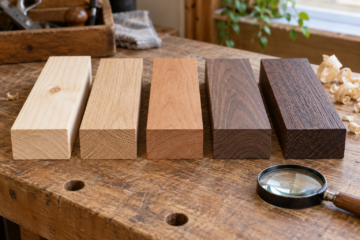
| Species | Good for | Clear-finish look | Main trade-off |
|---|---|---|---|
| Ash | General-purpose handles, mallets, and many striking tools | Light cream to tan, with pronounced open grain | Open pores need filling for a glass-smooth finish |
| Hickory | Axes, sledgehammers, and other high-impact tools | Light to medium brown, often with strong grain | Hard to shape by hand; grain quality is critical |
| Hard maple | Small handles, files, and precision tools | Pale, fine, and relatively even | Less forgiving under heavy shock than hickory |
| Beech | Small shop tools and inexpensive replacement handles | Light, subtle, and fairly uniform | Can move or wear if exposed to damp conditions |
| Birch | Light-duty handles and budget projects | Pale with restrained grain | Not the first choice for repeated heavy impacts |
Ash: the balanced choice
Ash combines useful toughness with a clear, attractive grain, which is why it has long been used for tool handles. It is easier to shape than hickory and is a sensible choice for a general-purpose handle when the tool is not taking extreme abuse. The open grain gives it character, but it also means a film finish may look textured unless you fill the pores.
Choose a blank with straight grain and no visible defects near the head or narrow neck. Ash is not a shortcut around bad grain selection: a handle with grain running out through the neck can still break. For a good-quality replacement or custom blank, compare ash tool-handle blanks by dimensions and grain before buying.
Hickory: for repeated impact
When a handle will regularly absorb hard blows, hickory is often the stronger choice. It is tough and commonly used for axes and striking tools. That toughness comes with a cost: hickory is dense and can take more effort to rasp, carve, and sand. It may also be harder to find in a straight-grained blank than an ordinary piece of hardwood lumber.
Inspect the full length, especially the section that fits into the tool head. Reject stock with a check, knot, or abrupt grain deviation there. A clear finish will not hide those defects or prevent a split. If you are replacing a handle on an impact tool, pay for suitable handle stock rather than choosing a cheap decorative board.
Maple, beech, and birch: when they make sense
Hard maple has a fine, even texture that takes a clear finish neatly. It works well on smaller handles that are not subjected to heavy repeated blows. Beech is another practical option for shop tools, and birch can be fine for light-duty use. These are not automatically poor choices; they are simply less compelling than hickory for a heavy striking handle.
Price and availability can make beech or birch the sensible choice for a file handle or a low-cost replacement. If a tool is used occasionally and kept dry, spending extra on premium impact-grade stock may not improve the result enough to justify the cost.
Sand carefully before coating
Shape the handle until it feels comfortable before applying finish. Sand along the grain, working through roughly 80 or 100, 120, and 150 or 180 grit. For a handle, going much finer is often unnecessary: very smooth wood can feel slippery, and polishing the surface can make a film finish adhere less reliably. Remove sanding dust with a vacuum or clean cloth.
Check the grip with dry hands before coating. A clear finish makes the grain visible but can also make the handle slick, particularly when polished glossy. Ease sharp edges and leave the grip comfortable rather than turning it into a perfect cylinder. On open-grained ash, decide whether you want visible pores or a smoother surface; filling them adds work and can make the handle feel more like furniture than a tool.
Pick a finish that suits the grip
For a working handle, a thin oil finish is easy to renew and usually preserves a natural feel. Apply it according to the product directions, wipe off excess, and allow it to cure fully before use. A hardwax oil wood finish is one category to consider, though the specific formula and cure time vary. Oil provides limited protection against water and abrasion compared with a robust film coating.
Polyurethane or another film finish offers more moisture and dirt resistance, but a thick, glossy coat can reduce grip and may chip under hard use. If using a film finish, apply thin coats and let each dry as directed; test the feel after the first coat rather than building up a glassy surface by habit. For an easy-to-refresh traditional option, boiled linseed oil is widely available. Follow the label, and handle oil-soaked rags safely: they can heat up and ignite if left bunched together.
What to check before buying
Buy a blank sized to leave enough material for shaping, and inspect photos or the stock in person for straight grain, checks, and knots. If the seller cannot show the grain clearly, ask before ordering. Match the species to the task: ash for a capable general-purpose handle, hickory for heavy impact, and maple, beech, or birch for lighter tools where cost and a clean finish matter more than maximum shock resistance.
0 Comments