As an Amazon Associate I earn from qualifying purchases. This post may contain affiliate links at no extra cost to you.
Hearing damage does not announce itself. No bruise, no splinter, no burned bearing smell. The first real sign is usually that you start asking people to repeat themselves in a noisy restaurant, and by then the hair cells that quit have been gone for years. Choosing the best hearing protection for woodworkers is therefore less about chasing the biggest number on the package and more about understanding what noise does to an ear, and what a foam plug or a set of muffs can actually do about it.
Mechanism first, shopping list second. Once you understand why an NRR 33 plug does not hand you 33 dB of protection, the buying decision gets simple.

Why Shop Noise Is Sneakier Than It Sounds
Two ideas carry most of the weight here.
Decibels are not inches. The scale is logarithmic, closer to earthquake magnitude than to a tape measure. Going from 90 to 100 dB is not eleven percent worse, it is roughly ten times the sound energy arriving at your eardrum. A machine that sounds only a little louder can be dramatically more damaging.
Damage is a dose, not an event. Treat it like a sunburn budget. NIOSH uses 85 dBA over eight hours as one full day, and every 3 dB doubles the rate at which you spend that budget. At 88 dBA you have four hours. At 100 dBA, about fifteen minutes. At 106 dBA, roughly where a loaded planer or a big table-mounted router lives, you are done in under four minutes.
The misconception: if it does not hurt, it is not hurting me. Pain arrives somewhere around 120 dB. Permanent damage starts a good 30 dB below that with no sensation at all. Noise loss also does not shave volume off evenly. It carves a notch around 3 to 6 kHz first, which is exactly where consonants live. That is why the complaint is never that everything got too quiet, it is that you can hear someone fine and still not make out what they said.
Field test with no meter: if you have to raise your voice to be understood at arm’s length, you are probably at or above 85 dBA.
Noise Levels by Tool: What Actually Puts You Over
The figures below are published industry and manufacturer ranges, not readings I took in my own shop. Real numbers move with blade choice, stock, feed rate and room acoustics, so use this to rank your risks rather than as gospel.
| Tool | Typical range (dBA) | Full daily dose in about | What to wear |
|---|---|---|---|
| Thickness planer or jointer | 100-110 | 2 to 15 minutes | Plugs plus muffs |
| Table saw or miter saw | 95-105 | 5 to 45 minutes | Well-seated plugs or muffs |
| Router in a table | 95-110 | 2 to 45 minutes | Plugs plus muffs on long passes |
| Circular saw or brad nailer | 95-105 | Impulse peaks count instantly | Something you can put on fast |
| Random orbit sander | 80-92 | 2 hours to all day | Muffs you will actually keep on |
| Dust collector or shop vac | 80-95 | 45 minutes to all day | Protection for the whole session |
The bottom two rows are the ones everyone ignores. Twelve seconds of cutting is rarely your biggest problem. A dust collector howling at 88 dBA for three straight hours is. Dust collection is what turns an occasional-noise shop into an all-day-noise shop, and it stacks on top of everything else you run.
How Hearing Protection Works, and Why NRR Lies a Little
Earmuffs are mass plus a seal. A heavy cup forces sound to shove something substantial, the foam inside kills resonance in the trapped air, and the gasket keeps the whole assembly airtight against your skull. Airtight is the operative word. A leaking muff is a soundproof room with a cracked window, and the mass stops mattering the moment air has a path in. Eyeglass temples, hat brims, hoods, thick hair and a beard along the jawline all break that seal.
Earplugs seal the canal itself, so there is nothing to leak across your face, and they generally handle low-frequency rumble better than muffs do. Their weakness is depth. A foam plug parked in the doorway of the canal is doing maybe half of its rated job.
The misconception: NRR 33 means you hear 33 dB less. NRR is a laboratory number, produced with trained fitters under ideal conditions, and it needs correcting before it maps onto real shop noise. The field rule of thumb safety pros use is to subtract 7 from the NRR, then halve what is left to account for everyday fit. That NRR 33 plug becomes roughly 13 dB of real-world protection. It takes a 106 dBA planer down to about 93 dBA, which is a large win, but note that 93 is still above 85, and it is nowhere near 33.
Electronic level-dependent earmuffs
The best default for most woodworkers, mostly because you can hold a conversation without breaking the seal. Prioritize a passive rating in the mid to high 20s NRR, an output limit around 82 dB, and slim cups if you wear a hat. Skip the very cheapest units, which tend to hiss and pump against steady machine noise.
Choosing the Best Hearing Protection for Woodworkers
Here is the part that surprises people: maximum attenuation is not the goal. You want to land somewhere in the mid 70s to low 80s dBA at the eardrum. Over-protect and you cannot hear the saw bog down, the router pitch change that means you are feeding too fast, the vac hose starting to clog, or someone walking up behind you. Over-protected woodworkers also do the single most dangerous thing available to them: they lift the muffs off for just this one cut.
The misconception: more NRR is always safer. Protection you keep on for a whole session beats protection you keep taking off.
Electronic level-dependent muffs
Microphone outside, small amplifier inside, and a limiter that clamps output at roughly 82 dB. Quiet sounds pass through, loud sounds get squashed, much like an auto-dimming rearview mirror. Be clear on what is doing the work: the passive shell protects you, and the electronics only give back situational awareness. If the batteries die mid-project, you still have a working muff.
- ✔ You hear speech, phones and the machine changing pitch
- ✔ The passive shell keeps protecting when batteries die
- ✔ The limiter tames impulse noise from nailers and dropped stock
- ✘ Bulkier and hotter than plugs in a summer shop
- ✘ One more thing in the shop that needs batteries
- ✘ Budget units hiss or pump against steady machine noise
Plugs, foam or flanged
The best ratings per dollar, and the only option that plays nicely with safety glasses, a face shield and respirator straps all at once. Foam is cheapest and seals best when rolled properly. Reusable flanged plugs on a cord suit the in-and-out days better, since they seat in one push and hang around your neck between cuts.
Foam and reusable flanged earplugs
Buy foam in bulk boxes rather than single pairs so a clean pair is always within reach and nothing gets reused past its life. Add one corded flanged set for days you are in and out of the shop. Together this is the cheapest large upgrade in hearing protection available to you.
Low-profile passive muffs
Slim cups matter more than you would expect if you wear a hat or work close to a wall, and thin gaskets seal more easily over glasses. Ratings run lower than on a bulky cup, but there are no batteries to fail and they are quick to grab off the bench.
Low-profile passive earmuffs
Look for a thin soft gasket, replaceable cushions, and a headband that stays where you set it. Comfort decides whether protection stays on your head, so buy for the seal and the fit rather than for the biggest number on the box.
Fit Mistakes That Quietly Cost You 10 dB
Roll foam plugs down to about the diameter of a toothpick before they go anywhere. Then reach over your head with the opposite hand, pull the ear up and back to straighten the canal, insert, and hold for ten seconds while the foam expands. Squeezing a plug like a wad of gum and pressing it into the entrance is the most common mistake in any home shop.
Quick check with plugs in: cup your hands tightly over your ears while a machine runs. If it gets noticeably quieter, your plugs are not seated and there is protection left on the table.
For muffs, sweep hair out from under the cushions, wear thin wire temples on your safety glasses instead of thick plastic ones, and replace cushions once they go stiff and shiny. A hardened gasket does not seal, and that is a real loss you cannot see or hear happening.
Double up on the planer, the jointer and long router sessions. The misconception: plugs plus muffs add their two NRR numbers together. They do not. Plan on roughly 5 dB better than the higher-rated of the two, which happens to be exactly the margin you need on the loudest machines in the shop.
Hearing Protection FAQ
Is NRR 33 overkill for a hobby shop? Not for a planer, but it can work against you elsewhere. After field derating, an NRR 33 plug gives you around 13 dB, which is about right on the loudest machines. On an 85 dBA sander you would rather hear the tool, so a lower-rated muff you leave on all afternoon protects you better than a high-rated plug you keep pulling out.
Can I just wear Bluetooth muffs and listen to music? Yes, with one catch: whatever plays under the cup counts toward your dose too. If you are cranking volume to hear over a router, you can be sitting at 90 dB inside a muff rated 27. Look for volume-limited models and treat the passive rating as the part that matters.
Do earplugs still work with a beard or a respirator? Better than muffs do. Beard hair under a gasket breaks the seal, and respirator and face shield straps do the same. Plugs seal inside the canal, so nothing on your face interferes. That is why a lot of sanding and finishing work goes plugs plus respirator rather than muffs.
Your ears are the one shop tool with no replacement part and no rebuild kit. Buy protection you will genuinely leave on, learn to seat it properly, and double up for the loudest ten minutes of the day.
Check prices on Amazon →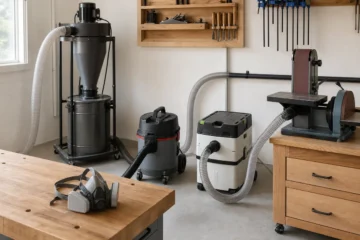

0 Comments