As an Amazon Associate I earn from qualifying purchases. This post may contain affiliate links at no extra cost to you.
Most people blame the saw when a cut goes badly. The saw is almost never the problem. If your reciprocating saw is bouncing, smoking, or taking four minutes to get through a 2×4 with a nail in it, you are running the wrong blade, and the best reciprocating saw blades for your job are usually a dollar or two away from the one that failed you. A reciprocating saw is a dumb machine. It pushes a piece of steel back and forth about an inch and lets the teeth do all the thinking.
So before any recommendation, here is the mechanism. Each tooth is a tiny chisel. It has to bite into the material, lift a chip out, and carry that chip up the gullet (the valley between teeth) and out of the cut. Everything about blade selection comes down to one tradeoff: bigger teeth with deep gullets remove material fast but need thick material to bite into, while small teeth with shallow gullets cut slowly and cleanly and can ride on something as thin as sheet metal without snagging. Get that one idea and the packaging wall at the store stops being confusing.
The Misconception That Wrecks the Most Blades
The misconception: more teeth means a better blade. People see 18 TPI next to 6 TPI, assume more is more, and buy the fine-tooth blade for framing lumber. Then the blade overheats, the teeth glaze over, and the cut stalls.
Here is why that fails. TPI means teeth per inch. At 18 TPI the teeth are tiny and the gullets are shallow, so they hold almost no sawdust. Push that into a 1.5-inch-thick stud and each tooth fills with chips in the first quarter inch of travel and then just rubs. Rubbing makes heat, heat kills the temper in the steel, and a dull blade needs more pressure, which makes more heat. That death spiral takes about fifteen seconds.
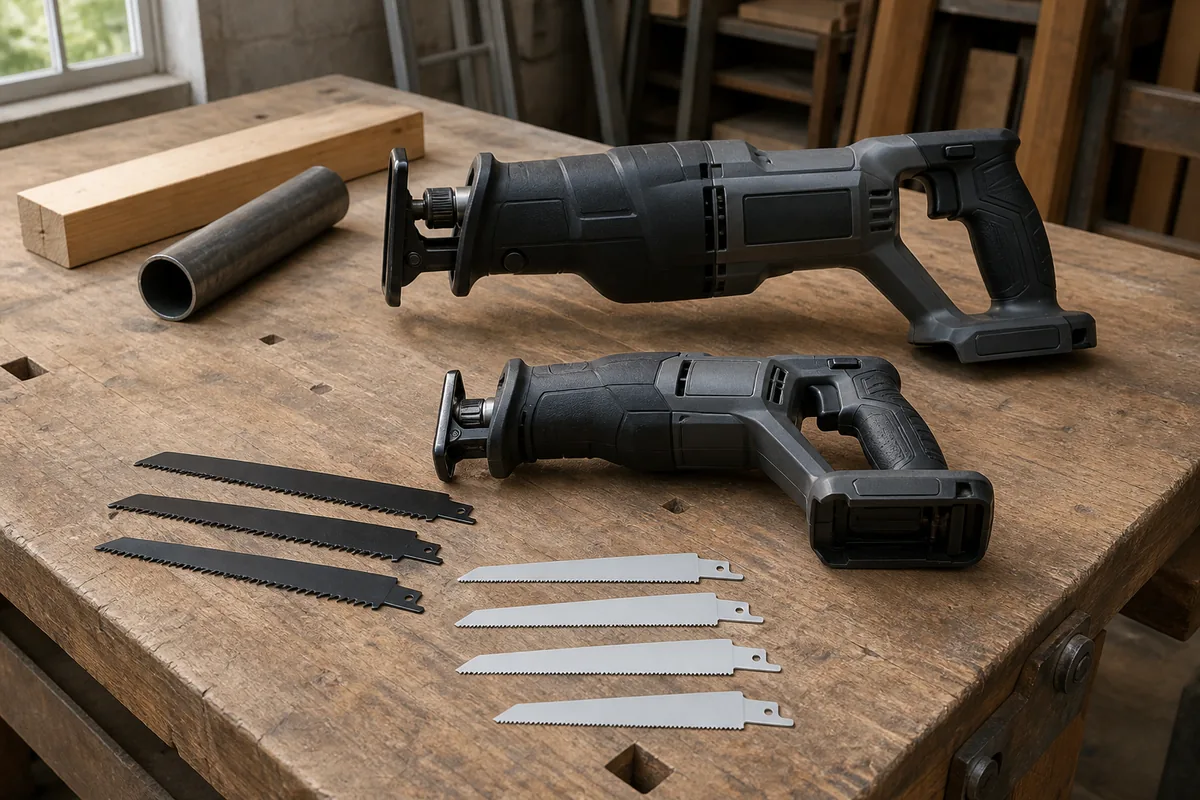
The working rule is the three-tooth rule: you want at least three teeth in contact with the material at all times, but not many more than you need. Thick, soft material like framing lumber wants coarse teeth, 5 to 8 TPI. Thin, hard material like conduit or angle iron wants fine teeth, 18 to 24 TPI, because a coarse tooth would hook the wall of the pipe and either tear it or snap the blade. Everything else lands in between, which is why 10 to 14 TPI blades are the ones that seem to work “okay” at everything and excellently at nothing.
Blade Types At A Glance
Match the row to the job rather than buying whatever is on the endcap.
| Job | TPI range | Tooth material | What to expect |
|---|---|---|---|
| Framing lumber, fast rough cuts | 5-6 TPI | Bi-metal or carbon steel | Very fast, rough edge, will wander |
| Nail-embedded lumber, demo, pallets | 8-10 TPI | Bi-metal, thick body | Survives hidden fasteners, moderate speed |
| General purpose wood and plastic | 10-14 TPI | Bi-metal | Decent speed, cleaner edge, safe default |
| Thin metal, EMT conduit, sheet | 18-24 TPI | Bi-metal | Slow, controlled, no snagging |
| Thick metal, cast iron, rebar | 8-10 TPI | Carbide-tipped | Expensive but lasts many times longer |
| Tree limbs, wet green wood | 3-5 TPI pruning | Carbon steel or bi-metal | Aggressive, clears wet chips |
| Tile, fiber cement, masonry | Gritted or carbide grit | Carbide grit edge | No teeth, abrades instead of cuts |
Tooth Material Matters More Than Tooth Count
Three families are worth knowing, and the difference is genuinely mechanical rather than marketing.
Carbon steel is one alloy all the way through. It is flexible and cheap, which makes it fine for clean wood and pruning, but the teeth soften at fairly low temperatures. Hit a nail and you will typically strip several teeth in one pass.
Bi-metal is two steels electron-beam welded together: a hard high-speed steel strip carrying the teeth, bonded to a spring steel body. Think of it as a hard cutting edge on a flexible spine. The hard edge holds up to heat and fasteners, the flexible body bends instead of snapping when you flex the blade in a tight spot. This is the workhorse and it should be most of what is in your case.
Carbide-tipped blades braze tungsten carbide teeth onto a steel body. Carbide stays hard at temperatures that would ruin high-speed steel, so these are what you use on cast iron pipe, rebar, hardened fasteners, and long stretches of nail-embedded lumber. They cost several times more per blade and they are brittle: a hard twist or a pinched cut can chip teeth off. Used correctly, one can outlast a whole pack of bi-metal.
Bi-metal demolition blade multi-pack (8-10 TPI)
If you buy one thing, buy a multi-pack of thick-body bi-metal demo blades in the 8-10 TPI range, 9 or 12 inches long. They handle framing lumber, nails, plaster and lath, and light metal without complaint, and buying in bulk means you stop being precious about retiring a dull blade. Look for a thicker body, roughly 0.05 inch or more, if you do overhead or plunge work.
Thickness, Length And Why Your Blade Keeps Bending
Blade body thickness is the spec nobody reads and it explains most bent blades. A thin body, around 0.035 inch, flexes easily, which is handy for flush cuts where you want to bow the blade against a surface. A thick body, 0.05 to 0.062 inch, resists buckling when you lean into a cut or work overhead. If your blades keep coming out with a permanent banana curve, you are probably running thin blades with heavy feed pressure.
Length is a similar tradeoff. A short 6-inch blade is stiffer and easier to control in tight spots. A 9 or 12-inch blade reaches through a wall cavity or a thick log but whips around and wanders. Rule of thumb: pick a blade long enough that it fully clears the material on the push stroke, plus about an inch, and no longer. A blade that never fully exits the cut cannot dump its chips, and you are back to the rubbing problem.
One more mechanical note. Most modern saws use orbital action, which swings the blade tip in a slight ellipse so the teeth dig in on the pull and lift away on the return. That is a big speed gain in wood and it is actively harmful in metal, where it hammers the teeth. If your saw has an orbital switch, turn it off before every metal cut.
Carbide-tipped metal and nail-embedded blades
Buy these for a reason, not as a default. Cast iron drain pipe, rebar, thick angle iron, or a full day of tearing out nailed subfloor are exactly where the higher price pays back, because you are not stopping every few minutes to change a burned blade. Keep the feed pressure steady and let the carbide work; forcing or twisting it is what chips teeth.
What Makes The Best Reciprocating Saw Blades Actually Last
Blade choice is half of it. Technique is the other half, and most of it is about managing heat and chip clearance.
- ✔ Let the saw’s shoe rest firmly against the work so the blade cannot bounce
- ✔ Use the full stroke length so chips clear the cut
- ✔ Moderate steady pressure; the blade should cut, not be pushed
- ✔ Turn orbital action off for any metal cut
- ✔ Slow the speed setting down for metal, run it up for wood
- ✔ Rotate blade position slightly in the clamp so wear spreads across the teeth
- ✘ Leaning hard on the saw to go faster, which just generates heat
- ✘ Fine-tooth blades in thick lumber
- ✘ Coarse blades on thin-wall pipe, where teeth snag and snap the blade
- ✘ Letting the blade tip hammer against a stud or floor joist behind the cut
- ✘ Cutting metal dry at full speed with no cutting fluid
- ✘ Keeping a glazed, shiny-toothed blade in service because it “still looks fine”
On metal specifically, a dab of cutting oil or even a bar of wax on the teeth makes a genuinely large difference in blade life. It carries heat out of the cut and keeps chips from welding into the gullets.
How To Stock A Practical Blade Kit
You do not need twenty varieties. A realistic kit for a home shop or a remodel truck is four categories deep.
First, a bulk pack of 9-inch bi-metal demo blades around 8-10 TPI. That covers walls, studs, pallets, and general destruction. Second, a small set of 18-24 TPI bi-metal for conduit, bolts, brackets and sheet metal. Third, one or two carbide-tipped blades held in reserve for cast iron, rebar or anything hardened. Fourth, if you own trees, a coarse pruning blade in the 3-5 TPI range with wide-set teeth that shed wet sap and green chips.
Add a carbide-grit blade only if you actually cut tile, fiber cement or plaster, since it has no teeth at all and works by abrasion, the same way sandpaper does.
Frequently Asked Questions
Are expensive blades really worth the money? For bi-metal, mostly yes, but with a limit. Better weld quality and better heat treatment mean the teeth stay sharp several times longer, which usually beats buying twice as many cheap blades. For carbide, worth it only when the job justifies it, meaning metal, hardened fasteners, or long demo runs. For a weekend cutting clean pine, a mid-priced bi-metal blade is plenty.
Why does my blade smoke and stop cutting? That is almost always heat plus packed gullets. Either the TPI is too fine for the thickness, you are pushing too hard, or the blade is not clearing the material on each stroke so chips have nowhere to go. Back off the pressure, check that the blade fully exits the cut, and drop to a coarser tooth count.
Do blades fit every saw brand? Yes, in practical terms. Reciprocating saw blades use a universal half-inch tang, so a Milwaukee FUEL, DeWalt XR, Makita LXT, or a corded Sawzall all take the same blades. Blade brand and saw brand do not need to match. What varies is the stroke length and orbital action of the saw, which affects how fast a given blade cuts.
Pick the blade for the material and thickness first, tooth material second, and body thickness third. Get those three right and a mid-range saw will feel like it doubled in power.
Check prices on Amazon →
0 Comments