What's inside
- Best outdoor cushions by patio situation
- What to look for before buying
- Fade resistance, water repellency, and drying speed compared
- Head-to-head: common outdoor cushion designs
- A practical decision matrix
- Maintenance that extends cushion life
- How much cushion thickness do you need?
- Bottom line
- Related Guides
- Best outdoor cushions by patio situation
- What to look for before buying
- Fade resistance, water repellency, and drying speed compared
- Head-to-head: common outdoor cushion designs
- A practical decision matrix
- Maintenance that extends cushion life
- How much cushion thickness do you need?
- Bottom line
- Related Guides
As an Amazon Associate I earn from qualifying purchases. This post may contain affiliate links at no extra cost to you.
The best outdoor cushions for patio furniture are the ones that match your seat dimensions closely, use quick-drying foam or resilient polyester fill, and have solution-dyed, water-repellent covers that can be removed for cleaning.
A cushion that looks attractive in a product photo can still be a poor choice if it is too deep for the chair, holds water in its filling, or lacks a replacement cover. For most patios, prioritize fit and drying speed first, then compare fade resistance, tie placement, comfort, and long-term cover availability.
As an Amazon Associate we earn from qualifying purchases at no extra cost to you.

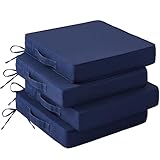


Best outdoor cushions by patio situation
| Patio situation | Best cushion type | Useful dimensions or specification | Why it fits the situation | Typical price range |
|---|---|---|---|---|
| Standard dining chair | Two-piece seat and back set | Seat: 18–20 in wide × 17–19 in deep; 2–3 in thick | Easy to tie down and less bulky at a dining table | $25–$70 per set |
| Deep lounge chair | Thick seat-and-back cushion | Seat: 24–26 in wide × 22–26 in deep; 4–6 in thick | Provides enough support without leaving a hard frame exposed | $70–$180 |
| Outdoor bench | Single bench cushion | Common lengths: 42, 48, 60, or 72 in; 18–20 in deep | Fewer seams and ties than several individual seat pads | $60–$180 |
| Small balcony | Thin, removable seat pad | 1.5–2.5 in thick; under 20 in deep | Preserves legroom and is easier to store indoors | $20–$60 |
| Rain-exposed seating | Reticulated quick-dry foam cushion | 3–5 in thick; open-cell foam with mesh-like drainage | Water passes through instead of remaining trapped in the core | $100–$300 |
What to look for before buying
Measure the furniture, not the old cushion
Measure the usable frame from inside edge to inside edge, then measure the available seat depth from the front edge to the back rail. Also measure the back height if you are buying a combined cushion. A replacement cushion normally needs to be about 0.5 to 1 inch narrower than the opening so it can be inserted without crushing the fabric.
For example, if a chair opening is 19.5 inches wide and 19 inches deep, a cushion around 19 inches wide by 18 inches deep is a safer fit than a 20-by-20-inch pad. A cushion that is too large will bow upward, stress its seams, and make the chair difficult to use. A cushion that is too small can slide and expose the frame.
Check the shape as well as the measurements. Rounded front corners, a tapered back, and a notch for armrests can matter more than an extra half-inch of thickness. For built-in benches, measure the entire usable length and look for a cushion with boxed corners rather than a loose tufted pad.
Choose the fill according to drying needs
- Polyester fiberfill: Usually the least expensive and softest option. It compresses more quickly and can remain damp in its center after rain.
- Standard polyurethane foam: Supportive and comfortable, but its closed or semi-closed structure can hold water. It is better for covered patios than for fully exposed seating.
- Reticulated quick-dry foam: The strongest choice for frequent rain. Its open structure allows air and water to move through the cushion, although it costs more and may feel firmer.
- Foam wrapped in polyester batting: A useful compromise for comfort and shape retention. It still needs a cover with drainage and should not be treated as completely waterproof.
Do not judge water performance from the cover alone. A water-repellent fabric can shed a shower while the filling remains saturated underneath. Ask whether the interior has a drainage layer, mesh panels, or quick-dry foam.
Fade resistance, water repellency, and drying speed compared
| Feature | What to prefer | What it actually improves | Limits to understand |
|---|---|---|---|
| Solution-dyed acrylic | Solution-dyed fibers with a stated outdoor-use rating | Better color retention in strong sunlight | Can still fade over years, especially in dark colors |
| Olefin or polyester outdoor fabric | UV-treated woven fabric with a tight weave | Often lowers cost while providing useful sun resistance | Performance varies widely by coating and yarn quality |
| Water-repellent finish | Removable cover with a coated or tightly woven face | Slows water absorption and helps with light spills | Does not make seams or zippers waterproof |
| Mesh or vented underside | Breathable bottom panel and drainage opening | Shortens drying time after rain | Cannot compensate for a water-holding foam core |
| Quick-dry foam | Open-cell reticulated foam | Moves water through the entire cushion | Usually firmer and more expensive than fiberfill |
For a sunny, uncovered patio, a light or medium fabric color is often more forgiving than black or dark navy. Dark colors absorb more heat and can show uneven fading sooner. If you want a dark cushion, a fitted cover or shade structure is a sensible addition.
Head-to-head: common outdoor cushion designs
One-piece cushion versus separate seat and back cushions
A one-piece cushion gives a clean appearance and can be comfortable on a deep lounge chair, but it is harder to fold and store. Water also has fewer escape paths if the back and seat are joined closely. Separate cushions are easier to replace individually, wash, and rearrange. For dining chairs, separate seat and back cushions are usually the more practical design.
Ties versus no ties
Ties are worthwhile on upright chairs, windy balconies, and seats with smooth metal or plastic frames. Look for two pairs of durable fabric ties rather than thin cord attached to a single weak seam. Ties can become a nuisance when cushions are frequently removed, so a heavy lounge cushion on a sheltered deck may not need them.
Check tie placement before ordering. A tie at the rear center may not reach around a wide chair rail, while side ties may interfere with armrests. A non-slip bottom panel can help, but it is not a substitute for ties in a windy location.
Attached cover versus removable cover
An attached cover is often cheaper and has fewer zipper points for water to enter, but cleaning is limited to spot treatment. A removable cover with a corrosion-resistant zipper is far easier to maintain. The most useful replacement-cover option is one where the manufacturer sells the cover separately and continues the same dimensions across multiple seasons.
Before buying an expensive cushion, check whether the cover can be replaced without buying a new insert. A cover may cost roughly 40–70% of a complete cushion, but replacing only the fabric is still less wasteful when the foam remains supportive.
A practical decision matrix
| Your priority | Choose | Avoid |
|---|---|---|
| Lowest upfront cost | Polyester fiberfill with a removable polyester cover | Custom-size quick-dry foam |
| Daily use | High-density foam or quick-dry foam with boxed seams | Very soft, loosely filled pads |
| Frequent rain | Open-cell foam, mesh underside, and breathable construction | Thick fiberfill or waterproof plastic-like covers |
| Maximum sun exposure | Solution-dyed acrylic in a medium or light color | Unrated cotton and dark untreated fabric |
| Rental or short-term setup | Standard sizes with widely available replacement covers | Rare custom dimensions |
| Windy location | Two-point ties plus a non-slip underside | Loose, lightweight seat pads |
Maintenance that extends cushion life
- Dry cushions vertically after rain. Stand them on edge with space around both sides. This exposes more surface area to air than laying them flat.
- Remove debris before washing. Brush off leaves and grit so particles do not work into the weave or zipper.
- Follow the care label. Many outdoor covers can be cleaned with mild soap and cool water, but aggressive bleach can weaken stitching and strip water-repellent finishes.
- Do not store damp cushions. A sealed storage box can trap moisture and create mildew odors. Wait until the insert and cover are fully dry.
- Rotate reversible cushions. Swap the front and back or turn the cushion end-for-end when the design allows. This reduces a permanent sitting hollow.
- Use covers during long periods of non-use. A breathable cover is preferable to tightly wrapping damp cushions in plastic.
The parts that usually wear first are the top fabric on sun-facing edges, zipper sliders, tie attachments, and the front lip where people sit down. Inspect those areas at the end of each season. If the insert is still springy but the fabric is worn, a replacement cover is the economical repair. If the foam stays flattened after being unoccupied, replacement of the insert is usually more effective than adding extra batting.
How much cushion thickness do you need?
Thickness is not a direct measure of comfort. A dense 3-inch cushion can support better than a loosely packed 5-inch pad. For dining chairs, 2–3 inches is normally sufficient. Lounge chairs and sofas commonly use 4–6 inches, while benches may need 3–5 inches depending on the frame.
Consider the finished seat height. If the bare chair seat is already 18 inches high, adding a cushion that compresses only 1 inch may produce a seat that feels too tall at a dining table. Conversely, a soft 4-inch fiberfill pad may compress enough that the frame becomes noticeable. Measure the uncompressed and expected compressed thickness when the specification provides both.
Bottom line
For most uncovered patios, choose a correctly measured cushion with solution-dyed outdoor fabric, a removable cover, secure ties where needed, and a vented or quick-drying interior. Select polyester fiberfill when price and occasional use matter most, standard foam for sheltered everyday seating, and reticulated quick-dry foam when rain and rapid turnaround are the deciding factors. The best value is not necessarily the thickest cushion: it is the one whose dimensions, fill, drying design, and replacement-cover options suit the way your furniture is actually used.

0 Comments