What's inside
As an Amazon Associate I earn from qualifying purchases. This post may contain affiliate links at no extra cost to you.
The DeWalt cordless paint sprayer is worth buying if you already own 20V MAX batteries and spray doors, trim, cabinets, or fences a few times a month — expect roughly 6–10 interior doors per 5Ah charge depending on tip size and material, and a cleanup routine that takes about 10 minutes once you learn it.
As an Amazon Associate we earn from qualifying purchases at no extra cost to you.



What the Cordless Format Actually Changes
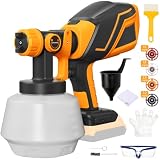
Cordless paint sprayers trade raw output for freedom from extension cords and compressors. The DeWalt unit is an HVLP-style handheld: a turbine and pump sit in the body, paint lives in an onboard cup (roughly 1 quart capacity on this class of tool), and the battery does all the work. Compared to a corded HVLP like a Wagner FLEXiO, you lose continuous-duty capability but gain the ability to spray a door in a garage, a fence panel at the back of a lot, or a ceiling corner on a ladder without managing a cord.
The honest framing: this is a finishing tool, not a whole-house tool. If your project is more than ~1.5 gallons of material in a session, a corded or airless rig wins on refill interruptions alone.
Runtime: Doors per Charge
Runtime is the spec buyers ask about and listings rarely answer concretely. Based on typical draws for this tool class with latex thinned per the manual:
| Battery | Material throughput | Cup refills | Real-world coverage |
|---|---|---|---|
| 2Ah compact | ~0.7–0.9 gal | 3–4 | 4–5 doors or ~200 sq ft of fence |
| 5Ah XR | ~1.5–1.8 gal | 6–7 | 6–10 doors or ~400 sq ft of fence |
| 8Ah / FlexVolt-adjacent packs | ~2.2+ gal | 8–9 | Small room’s trim + doors in one charge |
Two caveats that affect these numbers more than battery size: thicker material (unthinned latex) draws more current and can cut runtime by 20–30%, and cold batteries (below ~50°F) lose effective capacity fast. Worked example for a typical DIYer: a 6-panel door takes about 3–4 oz of material per coat per side when sprayed correctly. A 5Ah pack handles roughly 50–60 oz of spraying, so a door-and-both-sides-two-coats job (24–32 oz) uses just over half a charge.
Arm Fatigue and Overhead Work
This is where cordless earns its keep and where it hurts. A full cup plus a 5Ah battery puts the working weight around 8–9 lbs, and unlike a corded unit where the turbine can sit on the floor, all of that is in your hand. For horizontal surfaces — doors laid flat, deck boards, furniture — it’s comfortable for full sessions. Overhead is different: wrist flexion under a full hopper becomes noticeable after about 10–15 minutes of ceiling or soffit work.
Practical mitigations:
- Spray ceilings with a half-full cup; refills are cheap compared to wrist strain.
- Use a compact 2Ah battery for overhead stretches — you lose runtime but drop nearly a pound.
- Rotate grip between coats; the tool’s balance point shifts forward as the cup empties, which subtly changes wrist loading.
Overspray: Cordless vs. the Alternatives
| Tool type | Overspray level | Masking needed | Finish quality on trim/doors |
|---|---|---|---|
| DeWalt cordless HVLP | Moderate — visible mist within 2–3 ft | Mask adjacent walls/floors; drop cloths below | Very good with proper thinning |
| Corded HVLP (Wagner FLEXiO style) | Moderate, similar pattern | Same | Comparable |
| Airless (Graco-style) | High — fine mist travels 6+ ft | Heavy masking required | Good, less control on detail |
| Brush/roller | None | Minimal | Visible texture on doors |
The DeWalt’s overspray is manageable indoors with standard masking, but “cordless” tempts people into spraying outdoors where wind becomes the real problem — anything above a light breeze carries the fine mist farther than you’d expect. Plan to spray fences early morning or evening.
Cleanup: The 10-Minute Routine
Cleanup speed is a genuine advantage of this design. The hopper and tip disassemble without tools, and the narrow passages are easier to flush than an airless hose-and-gun system:
- Empty remaining material back into the can (2 min).
- Fill the cup with warm water (latex) or the correct solvent, spray until clear into a waste bucket (3 min).
- Pull the tip and needle, brush the air cap holes — this is where dried material builds up first and causes spitting (3 min).
- Wipe the cup gasket; a dried gasket causes air leaks and inconsistent spray next session (2 min).
Skipping step 3 is the most common mistake — the sprayer works fine that day and then spits and patterns poorly the next because of residue in the air cap.
Decision Matrix: Who Should Buy It
| Your situation | Verdict |
|---|---|
| Already on DeWalt 20V MAX, spray doors/trim monthly | Buy — batteries are the hidden cost, and you’ve paid it |
| No DeWalt batteries, small occasional projects | A corded HVLP at a lower price point makes more sense |
| Whole-house repaint or exterior siding | Get an airless; this tool can’t keep up with volume |
| Cabinets and furniture, finish quality is the priority | Good fit — thin material properly and practice on cardboard |
| Mostly overhead (ceilings, soffits) | Workable but fatiguing; corded with floor turbine is kinder |
Ownership Realities
- What wears first: the needle seal and cup gasket, typically after 15–25 gallons of material. Replacements are inexpensive; keep spares.
- Consumables: tips/needles for different material viscosities, strainers (always strain — a single clump clogs the tip mid-pass).
- Common mistake: spraying unthinned latex because the spec sheet says it can. It can, but the finish is noticeably rougher and runtime drops. Thin 10–15% with water for a furniture-grade result.
- Battery math: two 5Ah packs cover a full day of intermittent spraying; plan on one if you only do a few doors.
FAQ
Can it spray unthinned latex?
Yes, but expect reduced runtime, more tip clogging, and a slightly orange-peel texture. Thinning 10–15% gives a meaningfully better finish.
Is one battery enough?
For a single-room door-and-trim job, yes. For anything bigger, a second 5Ah pack eliminates mid-job downtime since charge time exceeds drain time.
Cordless DeWalt vs. corded HVLP — which for cabinets?
Finish quality is comparable. Choose cordless for mobility and fast setup; choose corded if you’ll spray for an hour straight without wanting to think about charge.
0 Comments