What's inside
As an Amazon Associate I earn from qualifying purchases. This post may contain affiliate links at no extra cost to you.
The best paint sprayer for walls depends mainly on how much you need to paint: choose an airless sprayer for a whole room, ceilings, or a house, and a handheld HVLP sprayer for small rooms, accent walls, and occasional projects where easier control matters more than speed.
For most interior wall painting, an airless sprayer is the practical choice—but only when you can mask thoroughly and manage overspray. HVLP is easier to control in tight spaces, but many handheld models need frequent refills and are slower on large, flat walls. The coverage estimates below are planning figures, not guaranteed output: paint thickness, surface texture, tip or nozzle size, and operator speed all affect results.
As an Amazon Associate we earn from qualifying purchases at no extra cost to you.


Choose by project size and working conditions
| Situation | Best fit | Typical planning rate | What to consider |
|---|---|---|---|
| One accent wall or a few doors and trim pieces | Handheld HVLP | About 100–200 sq. ft. per gallon per coat | Fine control, but small cups mean pauses to refill |
| One small room with furniture removed | Airless for walls; HVLP if overspray control is the priority | About 150–250 sq. ft. per gallon per coat | Allow time for masking, setup, and cleanup |
| Several rooms or a large open-plan area | Airless | About 150–250 sq. ft. per gallon per coat | Faster application; extensive masking is usually worthwhile |
| Ceilings or a whole house | Airless with an appropriate tip and extension | About 150–250 sq. ft. per gallon per coat | Plan for ladder or extension work, fatigue, and careful protection |
These rates are conservative budgeting ranges for spraying wall paint. Check the paint label for its stated coverage, and buy enough for the required number of coats. A textured or porous surface can use more paint; a smooth, previously painted wall may use less. Spraying alone does not guarantee one-coat coverage.
Airless versus handheld HVLP
Airless: the faster choice for large surfaces
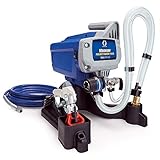
An airless pump pushes paint through a small tip at high pressure, producing a broad fan that covers walls quickly. Examples of established product lines include the Graco Magnum X5 and X7 and the Wagner Control Pro series. Models vary in hose length, supported tip sizes, and maximum pressure, so check the specific model’s manual before choosing paint or accessories.
Airless equipment is usually the better match for multiple rooms, ceilings, and exterior-scale workloads. Its trade-off is a wider spray cloud and more demanding setup. The fine mist can travel beyond the wall, so an airless sprayer is not automatically a time-saver in a furnished or occupied home.
Handheld HVLP: better for small, controlled jobs
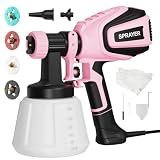
HVLP (high volume, low pressure) sprayers use an air-driven spray pattern and are commonly sold as handheld units. Wagner Flexio models are one example. They can be manageable for an accent wall, a small room, or a mix of walls and trim, but cup capacity and refill frequency limit their pace. Viscous wall paint may require thinning or a suitable nozzle setup; follow the sprayer and paint manufacturers’ instructions rather than thinning by guesswork.
HVLP generally offers more control at close range, but it is not overspray-free. It can also leave a different texture from a roller, so practice first and check the wall under the room’s normal lighting.
Calculate paint and masking time before buying
For a quick estimate, use this formula:
Gallons per coat = paintable wall area ÷ coverage per gallon.
For example, a room with 500 square feet of paintable wall area needs about 2 to 3.3 gallons per coat at a planning rate of 150–250 square feet per gallon. Two coats could therefore require roughly 4 to 6.6 gallons. Deduct large doors and windows, then add a sensible allowance for texture, touch-ups, and paint left in the equipment. If the paint label gives a lower coverage figure, use that instead.
Masking can take longer than spraying. For a cleared, simple room, allow roughly 1–3 hours to protect floors, windows, doors, outlets, and adjoining surfaces; detailed rooms, furniture, and occupied spaces can take several hours or more. These are planning estimates, not fixed rates. Include setup and cleanup when comparing a sprayer with a roller: a small job may be quicker overall to roll, even if spraying the wall itself takes less time.
Decision matrix: match the tool to your home
| Your situation | Recommended choice | Why |
|---|---|---|
| Tight budget, one small project | Roller, or a basic handheld HVLP if spraying is essential | Buying or renting an airless system may not pay off for a single wall |
| New to spraying, limited practice space | Handheld HVLP for a small project; practice on cardboard first | Its smaller pattern can be easier to manage, though technique still matters |
| Furnished home that must stay in use | Roller for occupied rooms; sprayer only if the area can be fully isolated | Fine mist can settle on furniture, floors, and nearby rooms |
| Several rooms, an empty house, or frequent projects | Airless | Higher output makes its setup and cleaning effort easier to justify |
| Walls plus trim or small pieces, with controlled work areas | Handheld HVLP or separate tools for each task | One sprayer may not be equally efficient for broad walls and detailed work |
How to spray in an occupied home without coating everything
- Clear or isolate the room. Move furniture out when possible. If it must stay, cover it completely and keep it away from the wall. Close doors to adjoining rooms and protect HVAC returns so mist does not circulate through the house.
- Mask beyond the obvious. Cover floors, windows, door openings, fixtures, outlets, and nearby surfaces. Tape down drop cloths so they do not shift. Overspray can travel farther than the visible spray fan, especially with airless equipment.
- Check ventilation and product instructions. Follow the paint label and sprayer manual for ventilation and respiratory protection. Keep children, pets, and other occupants out of the work area until spraying is complete and the space is ready for re-entry according to the product directions.
- Test the pattern. Spray scrap cardboard first. Hold the gun perpendicular to the wall and keep it moving before pulling the trigger; release the trigger at the end of each pass. Overlap each pass consistently—often around half the fan width, adjusted to the product instructions and test results.
- Watch for runs and dry spray. Keep a steady distance and travel speed. Runs often mean the gun moved too slowly or paint was applied too heavily. A rough, dusty finish can result from spraying too far away or from conditions that cause paint to dry before reaching the wall.
Ownership costs: cleaning and wear
Budget for masking materials, compatible tips or filters, and cleaning supplies—not only the sprayer. With airless equipment, the tip and filters are wear items; a worn or clogged tip can distort the fan and make it harder to apply an even coat. Handheld HVLP units also depend on clean air passages and an unobstructed nozzle. Dried paint is a common cause of poor performance in both types.
Clean the system immediately after use using the method specified for the coating—water for many water-based paints, or the compatible solvent specified for other coatings. Relieve pressure before servicing an airless sprayer, and never put a hand or finger near a pressurized spray tip. Follow the manufacturer’s storage instructions; leaving paint in the passages can turn a straightforward cleanup into a repair.
Bottom line
Choose an airless sprayer when you have several rooms, ceilings, or a whole house to coat and can devote time to masking. Choose handheld HVLP for smaller, more controlled projects where refill time is acceptable. If the home is furnished and needs to remain occupied, compare the total masking and ventilation burden with rolling before buying: the fastest sprayer is not always the fastest way to finish the room.
0 Comments