

Key takeaways
- Compare the best variable speed wood lathes with digital speed displays for home woodworking shops, with RPM readouts, swing, and motor power explained.
What's inside
As an Amazon Associate I earn from qualifying purchases. This post may contain affiliate links at no extra cost to you.
A digital speed display solves a small problem that ruins more turning sessions than most buyers expect: guessing the spindle speed. Without a readout, you set a dial by feel, and the same mark can mean a different speed after a belt change or a motor warm-up. With a readout, you return to the exact RPM that worked last time, slow down confidently for an unbalanced blank, and speed up for a clean finishing pass without stopping to check a chart on the wall.
This guide is written for home-shop woodworkers who want electronic variable speed plus a visible RPM number, and for buyers comparing midi lathes that look alike on paper. Each lathe below was picked from the names and specifications shown on its Amazon page, with the digital display, speed range, swing, and motor checked against the listing.
Quick Picks
As an Amazon Associate we earn from qualifying purchases
| Product | Best for | Key spec from title |
|---|---|---|
| JET JWL-1221VS 12 x 21 | All-round home-shop turning | Digital RPM readout, 60 to 3600 RPM |
| RIKON 70-220VSR 12.5 x 20 | Bowls and heavier blanks | LED speed display, 250 to 3850 RPM |
| Laguna Revo 12 | 16 | Low-speed bowl work |
How to Choose
Read the display, not the dial
A digital readout shows the actual spindle speed, which matters because a dial position means little once belts wear or voltage sags. Look for a display that is large enough to read from your normal stance and placed where shavings do not cover it. A readout that only shows the selected range instead of the live RPM is less useful, so confirm the listing describes a live RPM number before you buy. A display that updates live is worth more than a large dial, because it shows the speed dropping under load instead of hiding it.
Low-speed range decides roughing comfort
The bottom of the speed range is where a digital display earns its keep, because roughing a wet or uneven blank at the wrong speed shakes the bench and tears the surface. A lathe that drops to 50 or 60 RPM lets you round a blank gently, while one that bottoms out near 400 RPM forces you to take tiny cuts on anything out of balance. Compare the minimum speed first, then the maximum. Roughing a blank that is still wet from the log is the hardest test of low-speed control, and a 50 RPM floor makes that job far safer.
Motor power keeps the displayed speed honest
A display can show 800 RPM while the motor bogs down under a heavy cut, so match the readout with enough horsepower for your work. A 1 HP motor holds speed far better than a 3/4 HP motor on a wide bowl blank, and pulse-width modulation on some models keeps torque steadier at low RPM. If the speed sags every time the tool bites, the number on the screen is decoration rather than control. Listen for the motor note as well as watching the display, because a falling pitch tells you the cut is too heavy before the number changes.
Swing and bed length still set the project limits
A display does not add capacity, so check swing and distance between centers against the pieces you plan to turn. A 12-inch swing with 16 to 21 inches between centers covers pens, bowls, and chair spindles, while longer furniture legs need a longer bed or an extension. Buy the display on a lathe that already fits your work, not the other way around. A midi lathe with a good display still cannot turn a bowl wider than its swing, so capacity comes before electronics in the decision.
The 3 Best Options
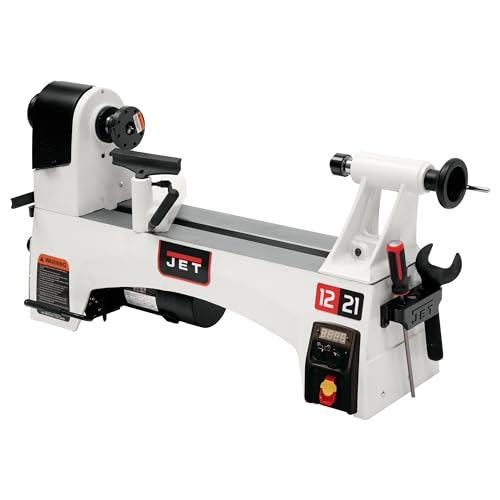
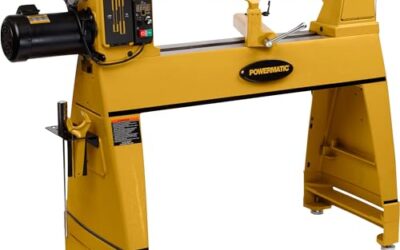
JET JWL-1221VS 12 x 21 Variable Speed Wood Lathe

The JET JWL-1221VS suits a home-shop turner who wants one dependable midi lathe with a clear RPM readout and a wide speed range. Its 1 HP motor and 60 to 3600 RPM range cover everything from slow roughing to fast finishing, and its 21 inches between centers handle longer spindles than most midi lathes. The digital readout sits on the headstock where it stays visible while you work, and the three speed ranges keep torque useful across the whole dial. It is a machine that rewards a careful setup with years of steady service.
Specs
- 12-inch swing over bed; 21 inches between centers
- 1 HP motor; 115V single phase
- Electronic variable speed from 60 to 3600 RPM in three ranges
- Digital RPM readout on the headstock
- Forward and reverse rotation; cast iron construction
- 121 pounds; 5-year warranty
- Includes tool rest, faceplate, spur center, and live center
Best for: Mixed home-shop work where one midi lathe must handle bowls, spindles, and pens.
Watch out for: At 121 pounds it needs a sturdy bench and two hands to lift safely into place.
RIKON 70-220VSR 12.5 x 20 Midi VSR Lathe
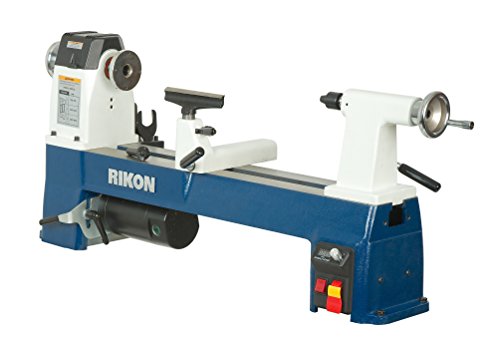
The RIKON 70-220VSR suits a turner who works heavier blanks and wants the readout to confirm a low, safe roughing speed. Its 1 HP motor, 250 to 3850 RPM range, and LED speed display make it easy to hold a steady pace on bowls up to 12 inches, and its 24-position indexing head adds layout options for fluting and drilling. The cast iron build and 115-pound mass keep vibration in check, and the reverse function helps with sanding and finishing. The LED display stays readable in a dim shop, which is a small detail that matters on evening sessions.
Specs
- 12.5-inch swing over bed; 20 inches between centers
- 1 HP motor; 120V single phase
- Electronic variable speed from 250 to 3850 RPM
- LED digital speed display; 24-position indexing head
- Forward and reverse rotation; cast iron construction
- 115 pounds; 5-year warranty
- Includes faceplate, spur center, live center, tool rest, and knockout bar
Best for: Bowl turning and heavier blanks where a confirmed low speed matters most.
Watch out for: Speed changes across three belt ranges, so check the belt position when the display reads higher than expected.
Laguna Revo 12|16 Midi Lathe EVS

The Laguna Revo 12|16 suits a home-shop turner who prizes low-speed control above all else. Its pulse-width modulation motor holds torque down to 50 RPM, and its digital readout lets you confirm that slow speed before the tool touches the wood. The 12-inch swing and 16-inch bed cover bowls and spindles, and the optional bed extension and outboard turning open up wider work later. The cast iron headstock, tailstock, and stand keep the machine steady on demanding cuts. The optional extension keeps the machine useful as projects grow longer.
Specs
- 12-inch swing over bed; 16 inches between centers
- 1 HP DC motor with pulse-width modulation; 110V
- Electronic variable speed from 50 to 3500 RPM in three ranges
- Digital readout; 24-position indexing; forward and reverse
- Outboard turning up to 16 inches with extension
- 118 pounds; cast iron headstock, tailstock, and stand
- Includes 3-inch faceplate and tool rest
Best for: Low-speed bowl work and turners who want torque that holds at very low RPM.
Watch out for: The 16-inch bed is short for long spindles unless you add the optional bed extension.
Which One Fits Your Situation
One lathe for everything in a home shop
Choose the JET JWL-1221VS, because its 21-inch bed, 1 HP motor, and 60 RPM low end cover the widest mix of bowls, spindles, and pens, and its readout stays easy to read from the operator position. The 60 RPM low end is the detail that sets it apart, because it lets you round a wet blank gently before moving up to shaping speeds.
Bowls and heavy blanks dominate your work
Choose the RIKON 70-220VSR, because its LED display, 24-position indexing, and heavier build suit steady bowl work. The Laguna is the alternative when very low speeds matter more than bed length. The 24-position indexing head also supports fluted patterns and drilled layouts, which adds variety to bowl work without extra jigs.
Very low speeds for roughing wet blanks
Choose the Laguna Revo 12|16, because its pulse-width modulation holds torque down to 50 RPM and its display confirms the setting. Add the bed extension when longer spindles enter the picture. Pulse-width modulation keeps torque steady at very low speeds, which is the feature that matters most when a blank is heavy and unbalanced.
A compact bench with limited depth
Choose the JET JWL-1221VS, because its footprint fits a standard workbench while still giving 21 inches between centers. The RIKON is the pick when a shorter bed is acceptable and mass matters more. A shorter bed also means a smaller footprint, which leaves bench space for a sharpening station and a rack of turning tools.
Common Mistakes
- Assuming every variable speed lathe has a live RPM readout, when some only show a dial mark.
- Buying for the highest maximum RPM instead of the lowest speed you will actually use.
- Mounting a midi lathe on a light bench and blaming the display when vibration shakes the cut.
- Ignoring the belt range, then wondering why the readout and the cutting feel do not match.
- Forgetting a chuck in the budget, which leaves bowl work impossible on a spindle-only setup.
Frequently Asked Questions
What is a digital speed display on a wood lathe?
It is a small screen on the headstock or control box that shows the live spindle speed in RPM. It lets you return to a speed that worked before, slow down for unbalanced blanks, and avoid guessing from a dial position. The display usually sits on the headstock or the control box, and it updates continuously while the lathe runs, unlike a fixed dial mark.
Do I need a digital readout to turn wood well?
No, but it removes guesswork. Experienced turners manage with dial marks and belt charts, yet a readout speeds up repeat work and helps newer turners learn which speeds suit roughing, shaping, and finishing. A readout shortens the learning curve, because you can note the speed that gave a clean cut and return to it on the next piece.
Which speed range matters most on a midi lathe?
The low end matters most. A minimum near 50 to 60 RPM lets you round wet or uneven blanks safely, while a high top speed mainly helps with fine finishing and small-diameter work such as pens. The high end of the range matters for pens and small work, where a faster spin gives a cleaner surface with a sharp tool.
Can a midi lathe with a digital display turn large bowls?
It can turn bowls up to its swing, usually about 12 inches, but mass and motor power limit how aggressively you can rough a heavy blank. For bowls above 12 inches, a full size lathe with more weight is the safer choice. Outboard turning on some models extends the effective swing, but it needs extra floor space and a sturdy stand to stay safe.
Related guides
More from Amazon
Programs that pair well with the guide above. Offers and eligibility are set by Amazon and may change.
A free business account with business pricing and bulk-buying tools for work, shop or home office.
Create a business accountFree shipping on eligible items, Prime Video and more. Eligible new members can start with a free trial.
Start a Prime free trialAudiobooks and podcasts to listen to on the go. Eligible new members can start with a free trial.
Try Audible freeAd-free music streaming. Eligible new subscribers can start with a free trial.
Try Music Unlimited freeAs an Amazon Associate we earn from qualifying purchases.
Write Your Review
No reviews yet. Be the first to share your experience!