

Key takeaways
- Compare the best wheel marking gauges for woodworking, from solid brass fence models to budget sets with spare cutters for crisp layout lines.
What's inside
- Table of Contents
- Clarke Brothers Wheel Marking Gauge — Best Overall
- Taytools 467603 Wheel Marking Gauge — Best for Fine Joinery
- VISLONE Wheel Marking Gauge Set 180mm — Best for Lines and Arcs
- Red Oak Tools Wheel Marking Gauge Set — Best Spare-Cutter Value
- KAKURI Japanese Wood Marking Gauge — Traditional Blade Alternative
- How to Choose a Wheel Marking Gauge
- FAQ
- Conclusion
As an Amazon Associate I earn from qualifying purchases. This post may contain affiliate links at no extra cost to you.
A wheel marking gauge replaces the dragging pin of a traditional marking gauge with a small rolling disc cutter, and that single change is why it has become the layout tool most often recommended for joinery work. The wheel severs wood fibers instead of tearing them, so the line stays crisp with the grain, across the grain, and on end grain, and a saw blade or chisel edge can register directly in the cut. For most benches, the Clarke Brothers Wheel Marking Gauge is the best all-round choice: it pairs a graduated solid metal bar with a roll-stop fence and ships with spare cutters included. The Taytools 467603 suits woodworkers who want a heavier solid brass head and a longer beam, while the VISLONE and Red Oak Tools sets cover the budget tier. This guide also includes one traditional alternative, the KAKURI Japanese knife gauge, for woodworkers who prefer a fixed blade to a wheel. Each pick below is compared on published specifications only: beam length, graduations, fence design, cutter supply, and adjustment style.
As an Amazon Associate, we earn from qualifying purchases.
Table of Contents
- Clarke Brothers Wheel Marking Gauge — Best Overall
- Taytools 467603 Wheel Marking Gauge — Best for Fine Joinery
- VISLONE Wheel Marking Gauge Set 180mm — Best for Lines and Arcs
- Red Oak Tools Wheel Marking Gauge Set — Best Spare-Cutter Value
- KAKURI Japanese Wood Marking Gauge — Traditional Blade Alternative
- How to Choose a Wheel Marking Gauge
- FAQ
- Conclusion
- Product and ASIN Reference
Clarke Brothers Wheel Marking Gauge — Best Overall

The Clarke Brothers gauge is the pick that fits the widest range of benches. Its fence has flat spots machined into the rim, so the tool sits still on the bench instead of rolling away between cuts, and the same flats give a stable register against the edge of a board. The solid metal bar is graduated in both inches and millimeters out to 6 inches (150 mm), which covers the shoulder lines, tenon cheeks, and hinge gains marked out in everyday furniture work.
The hardened steel wheel cutter arrives fitted, and two spare cutters are included in the box, so a dull or nicked wheel does not stop a project while a replacement is sourced. As a mid-range tool it skips micro-adjustment, but the fence slides smoothly along the bar and locks with a knurled screw, and the dual-unit graduations make repeat settings straightforward to return to. Woodworkers who want one wheel gauge for general joinery layout, without paying premium-tier money for features they will rarely use, are the natural audience for this model.
Specs:
- Cutter: hardened steel wheel
- Spare cutters: 2 included
- Beam: solid metal bar
- Scale: inches and millimeters to 6 in / 150 mm
- Fence: roll-stop design with flat spots
- Tier: mid-range
Taytools 467603 Wheel Marking Gauge — Best for Fine Joinery
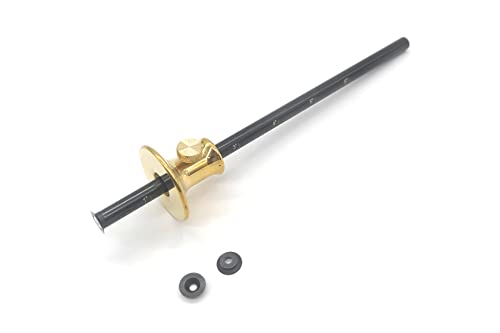
The Taytools 467603 is built around a head machined from solid brass, 1-9/16 inches in diameter, which gives the fence enough mass to stay planted against a reference edge under light hand pressure. The beam is hardened steel, .310 inch in diameter and 8 inches long, with graduations in millimeters and SAE units out to 150 mm (6 inches) and a usable cutting depth of up to 7 inches, the longest reach in this roundup. A knurled thumb screw locks the head anywhere along the beam.
The cutting wheel measures 7/16 inch and can be resharpened by rubbing its flat face on flat sharpening media, which extends its working life well beyond a disposable cutter. Two extra cutters are included alongside the fitted one, so the box holds three wheels in total. At about 6 ounces, this is a mid-range gauge with a premium feel, aimed at woodworkers who mark out fine joinery often and want a beam that reads in both unit systems without swapping tools.
Specs:
- Head: solid brass, 1-9/16 in diameter
- Lock: knurled thumb screw
- Beam: hardened steel, .310 in diameter × 8 in long
- Graduations: millimeters and SAE to 150 mm / 6 in
- Cutting depth: up to 7 in
- Cutters: 1 fitted plus 2 extra, 7/16 in wheel, resharpenable
- Weight: about 6 oz
- Tier: mid-range
VISLONE Wheel Marking Gauge Set 180mm — Best for Lines and Arcs

The VISLONE set takes a different approach: it is a dual-purpose scriber built for both straight layout lines and arcs. The sliding scale runs to 180 mm, the longest metric reach in this group, and the stainless steel roller wheel handles parallel lines along a reference edge, while the tool’s second mode draws arcs and circles for curved work such as tabletops, templates, and rounded aprons.
The listing gives the model number as VISLONE-E5190 and lists aluminum, stainless steel, and wood among its materials. As a budget-tier tool it does not have the brass mass of the Taytools or the roll-stop fence design of the Clarke Brothers, and its graduations are metric-led rather than dual-unit. For woodworkers who split their layout time between straight joinery lines and curved templates, though, it covers both jobs with a single inexpensive tool, which is exactly the gap the other four picks leave open.
Specs:
- Model: VISLONE-E5190
- Range: 180 mm sliding scale
- Cutter: stainless steel roller wheel
- Modes: linear and arc scribing
- Materials (per listing): aluminum, stainless steel, wood
- Tier: budget
Red Oak Tools Wheel Marking Gauge Set — Best Spare-Cutter Value

The Red Oak Tools set, model ROT-105, is the straightforward budget option in this group. It is a conventional wheel marking gauge sized at 6 inches (150 mm), and the set includes two spare steel cutters alongside the fitted wheel, matching the spare supply of the Clarke Brothers at a budget tier. For a first wheel gauge, that spare supply matters: a beginner can nick a cutter on a staple or a gritty board surface and keep working the same day.
Published data for this model is thinner than for the other picks. The manufacturer’s record lists the model number, the 6 inch / 150 mm size, and the spare cutters, without detailed fence or beam specifications, so buyers who care about fence diameter or beam graduations should look at the Clarke Brothers or Taytools instead. Woodworkers who want a simple second gauge for a toolbox, or an entry point into wheel gauges for occasional layout, get the essentials here: a rolling cutter, a sliding fence, and spares in the box.
Specs:
- Model: ROT-105
- Size: 6 in / 150 mm
- Spare cutters: 2 steel cutters included
- Tier: budget
KAKURI Japanese Wood Marking Gauge — Traditional Blade Alternative

The KAKURI is included as the traditional alternative rather than as a wheel gauge: it is a Japanese suji kebiki, a knife-blade marking gauge with a bamboo body. Instead of a rolling disc, a small fixed blade severs the fibers, which many woodworkers prefer for deep, definite lines on softwoods and for layout lines that will guide a saw directly. Because the blade is fixed, it also tracks a straight line without the slight wandering a free-rolling wheel can show in very soft, uneven grain.
This model measures 3.5 inches (90 mm), is made in Japan, and the listing gives a line size of 0.9 mm and model number 40947. There are no beam graduations and no spare cutters, and the setting is held by the traditional sliding fence arrangement, so it asks for a slower, more deliberate setup than the wheel gauges above. In return it offers the direct, tactile feedback of a knife edge, a very light tool that disappears into an apron pocket, and a marking style that pairs naturally with Japanese saws and chisels.
Specs:
- Type: knife-blade marking gauge (suji kebiki)
- Body: bamboo
- Size: 3.5 in / 90 mm
- Model: 40947
- Line size: 0.9 mm
- Origin: made in Japan
- Tier: mid-range
How to Choose a Wheel Marking Gauge
Start with the cutter. A wheel gauge is only as good as its disc: hardened steel wheels hold an edge longest, and a wheel that can be resharpened on flat media, like the Taytools, lowers long-term upkeep. Spare cutters in the box are worth real weight in the decision, because a nicked wheel leaves a fuzzy line until it is replaced or honed. Three of the five picks here include two spares.
Next, look at the fence. The fence is the part that registers against the board edge, so its size, mass, and shape decide how steadily the gauge tracks. A larger, heavier brass fence, as on the Taytools, stays planted with light pressure. Flat spots on the fence rim, as on the Clarke Brothers, stop the tool rolling off the bench and give a stable rest position. Round, light fences are cheaper but demand a firmer grip to keep the line true.
Beam length and graduations come third. Most joinery layout happens within 6 inches of an edge, so a 6 inch (150 mm) graduated beam covers the majority of work; the Taytools reaches 7 inches of cutting depth for wider panels, and the VISLONE runs to 180 mm for metric layout. Dual-unit graduations save time in shops that mix plans from both systems. If a beam has no graduations at all, settings must be transferred with a ruler or calipers every time, which is slower but can be more accurate for one-off work.
Adjustment style is the last divider. Standard slide-and-lock fences are fast and simple. Micro-adjust heads, common at the premium tier, let the fence creep to a setting in fine increments, which helps when fitting tenons to an existing mortise. None of the picks here is a micro-adjust model, so woodworkers who know they need that feature should treat this roundup as the value end of the market. Finally, consider whether a wheel is right at all: for deep lines in softwood, or for a line a saw will follow directly, the fixed blade of a kebiki-style gauge such as the KAKURI remains a legitimate alternative.
FAQ
What is a wheel marking gauge used for?
A wheel marking gauge scribes a line parallel to the edge of a board at a set distance. Woodworkers use it to lay out tenon shoulders and cheeks, mortise positions, hinge gains, dovetail baselines, and panel thicknesses. The rolling wheel cuts the fibers rather than scratching them, leaving a groove that a chisel or saw edge can drop into for accurate cuts.
Is a wheel marking gauge better than a pin marking gauge?
For most joinery work, yes. A pin drags and can tear fibers or follow the grain, especially across the grain or on end grain. A wheel rolls and severs the fibers, so the line stays where it was set. Pin gauges remain serviceable for rough carpentry layout in softwood, where line precision matters less, but a wheel gauge is the better default for furniture work.
How do you sharpen the cutter on a wheel marking gauge?
On models with a resharpenable wheel, such as the Taytools 467603, the wheel is rubbed flat-side down on fine sharpening media in small circles, which restores the bevel edge without changing its shape. Wheels that are not designed for resharpening are simply replaced, which is why gauges that include spare cutters are easier to keep in service.
Can a wheel marking gauge mark curved lines?
A standard wheel gauge is built for straight lines parallel to an edge, because the fence must stay registered against that edge. For arcs and circles, a dual-purpose scriber such as the VISLONE, which adds an arc mode, is the suitable tool. Freehand curves are normally marked with a compass, a trammel, or a flexible curve instead.
Conclusion
The Clarke Brothers Wheel Marking Gauge is the safest single recommendation: a roll-stop fence, dual-unit graduations to 6 inches, and two spare cutters cover the layout work most benches see. The Taytools 467603 is the step up for frequent joinery, with its solid brass head, 8 inch beam, and resharpenable wheel. On a budget, the Red Oak Tools set delivers the essentials with spares included, while the VISLONE adds arc scribing that no conventional wheel gauge offers. Woodworkers who prefer a fixed blade to a rolling wheel should look at the KAKURI kebiki, the traditional Japanese answer to the same layout problem. Whichever style fits the work, a cutting gauge of any kind will mark cleaner, more useful lines than a pencil or a pin for joinery layout.
Related guides
More from Amazon
Programs that pair well with the guide above. Offers and eligibility are set by Amazon and may change.
A free business account with business pricing and bulk-buying tools for work, shop or home office.
Create a business accountFree shipping on eligible items, Prime Video and more. Eligible new members can start with a free trial.
Start a Prime free trialAudiobooks and podcasts to listen to on the go. Eligible new members can start with a free trial.
Try Audible freeAd-free music streaming. Eligible new subscribers can start with a free trial.
Try Music Unlimited freeAs an Amazon Associate we earn from qualifying purchases.




Write Your Review
No reviews yet. Be the first to share your experience!