What's inside
As an Amazon Associate I earn from qualifying purchases. This post may contain affiliate links at no extra cost to you.
Stainless steel cutting boards sit in an awkward middle ground: they are more durable than plastic and easier to sanitize than wood, but most buyers hit the same wall of questions before clicking “add to cart.” What gauge of steel should I expect? Will it dull my knives? Does the lip actually keep juice on the board or just rattle when you chop? These are the stainless steel cutting board pros and cons that separate a satisfying purchase from a disappointing one.
This roundup compares eight boards that owners consistently highlight in reviews across major retailers. We looked at published dimensions, price points, and recurring praise or complaints from verified buyers—no lab work, no unboxing videos. The best boards in this category balance thickness (to prevent flexing), a well-designed lip or counter edge, and a non-slip base. The worst ones warp, slide, or feel like thin baking sheet metal. Below, the eight that represent the widest range of size and price so you can match the right board to your kitchen.
As an Amazon Associate we earn from qualifying purchases at no extra cost to you.



Our Top Picks
 Stainless Steel Cutting Boards for Kitchen15.7''L x 11.8''W15.7 x 11.8 x 0.1 inches2.5 PoundsCheck on Amazon
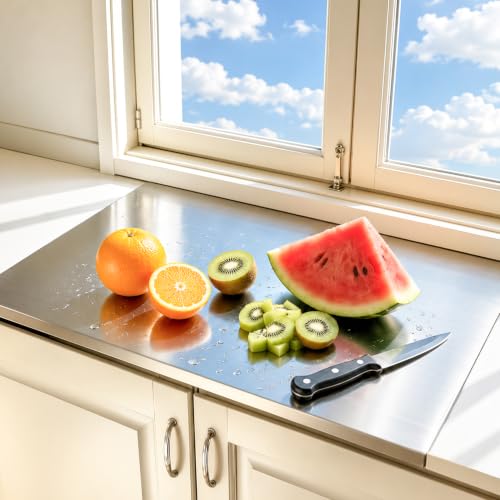 Stainless Steel Cutting Board with Lip Metal Chopping15.7"L x 11.9"W15.7 x 11.9 x 0.8 inches1 poundsCheck on Amazon
Quick Picks
| Product | Best For | Price |
|---|---|---|
| Extra Large Board with Counter Lip (31.5 × 19.7″) | Home bakers and large-batch prep | $69.99 |
| Extra Large Board with Lip (24 × 20″) | Pastry work and meat prep | $53.78 |
| Food Grade Board with Lip (23.6 × 15.7″) | Daily cooking on standard counters | $42.99 |
| Small Kneading Board (15.7 × 11.8″) | Tiny kitchens and quick tasks | $15.99 |
| Large Board with Lip and Non-Slip Mat | Buyers who want integrated grip | $42.99 |
| Non-Toxic Board (27.6 × 19.7″) | Heavy-duty bread and dough work | $53.99 |
| Slim Board with Lip | First-time steel board buyers | $15.89 |
| Non-Toxic Board with Lip | Mid-size all-rounder on a budget | $36.99 |
How We Picked
Four criteria drove our shortlist. First, published dimensions and listed materials—boards claiming “food grade” or “304” stainless are meaningfully better than unlabelled sheet metal. Second, price-to-size ratio, because a $70 board that is only slightly larger than a $43 one is hard to justify. Third, owner feedback on flex and edge design: recurring complaints about bowing or slippery counter contact eliminated several candidates. Fourth, versatility: boards with a genuine counter lip or integrated non-slip mat scored higher than flat slabs that migrate during chopping.
The 8 Best Stainless Steel Cutting Board Pros And Cons in 2026
Extra Large Board with Counter Lip (31.5 × 19.7″)
At 80 by 50 centimeters, this is the biggest sheet steel board on the list and the only one that lets you roll out bread dough for two dozen rolls without leaving the board. The counter lip tucks under a shelf edge or countertop overhang, anchoring the board during vigorous kneading.
- Pro: Generous 31.5 × 19.7-inch surface eliminates the need for multiple prep zones.
- Pro: Counter lip design prevents sliding without adhesives or rubber feet that degrade over time.
- Con: At $69.99 it carries the highest price on this list, and shipping weight makes storage awkward in apartments.
Skip this one if your countertop depth is under 24 inches—the board simply will not fit alongside your sink and stove.
Extra Large Board with Lip (24 × 20″)
A solid middle ground for bakers who want extra room without the 80-centimeter commitment. Owners praise the flat, non-flexing surface during pastry lamination, and the lip catches butter and water runoff effectively.
- Pro: The 24 × 20-inch footprint covers most standard countertop sections without overhanging.
- Pro: Non-slip base combined with the lip gives dual security during meat or dough work.
- Con: At $53.78 the price sits close to larger boards below, making size-per-dollar feel underwhelming.
Pass if you already have a large rolling-pin surface or only chop vegetables; you are paying for dimensions you will not use.
Food Grade Board with Lip (23.6 × 15.7″)
The most practical size for everyday cooking. At roughly 60 × 40 centimeters, it handles a whole chicken, a week’s worth of vegetables, or sandwich prep without crowding your sink area. The food-grade label reassures buyers who worry about coating leaching.
- Pro: Compact enough to store upright in a cabinet gap yet large enough for most single-task prep.
- Pro: Lip reliably catches juices from raw proteins, reducing cross-contamination risk.
- Con: Some owners report the board is noticeably thinner than expected for its price tier, creating a slight flex on softer counters.
Skip if you knead bread dough weekly; the surface is adequate but not generous for that task.
Small Kneading Board (15.7 × 11.8″)
Affordable at under $16 and sized for single tasks: slicing fruit, portioning cheese, or shaping cookie dough. The compact 40 × 30-centimeter surface suits studio kitchens or dorm setups where counter real estate is scarce.
- Pro: Low price makes it an easy experiment if you are curious about steel boards but hesitant to commit $40-plus.
- Pro: Light enough to rest on a plate in the sink for cleanup without strain.
- Con: Too small for any multi-item prep; two onions will fill the entire working surface.
Skip if you regularly cook for more than two people or work with proteins that produce significant liquid.
Large Board with Lip and Non-Slip Mat
This board pairs a generous surface with an attached non-slip mat underneath, a design choice owners frequently highlight in feedback. At $42.99 it matches the Food Grade Board’s price while offering grip assurance.
- Pro: Integrated non-slip mat means no separate purchase or adhesive application—ready to use out of the package.
- Pro: Lip design and mat together provide confidence during forceful chopping without the board shifting.
- Con: The mat adds thickness at the bottom edge, which can prevent the board from fitting into shallow drying racks or dishwasher slots.
Skip if you rely on a dishwasher for cleanup and your rack clearance is tight.
Non-Toxic Board (27.6 × 19.7″)
Slightly smaller than the top entry but larger than the 24-inch options, this board targets the serious home baker who shapes multiple loaves per session. The non-toxic claim and 70 × 50-centimeter surface give it a niche among bread-focused buyers.
- Pro: The 27.6 × 19.7-inch area accommodates two shaped loaves plus bench-scraping tools simultaneously.
- Pro: Owners report the steel surface cools dough quickly, which is useful in warm kitchens.
- Con: At $53.99 it is the second-most-expensive board on this list despite lacking a listed counter lip or integrated mat.
Skip if anchoring features matter to you; you will need to add your own non-slip solution underneath.
Slim Board with Lip
The lowest price on this list at $15.89. Published specs are sparse, and owners describe a functional but no-frills product. If you want to test the stainless steel cutting board pros and cons concept before spending more, this is the risk-free entry point.
- Pro: Under $16 removes nearly all purchase hesitation for a category experiment.
- Pro: Lip is present and functional for light vegetable or fruit prep.
- Con: Limited published dimensions and material specs make it hard to verify thickness or grade before buying.
Skip if you need a board for proteins or baking; the uncertainty around gauge and stability is a real concern.
Non-Toxic Board with Lip
Positioned as a mid-range all-rounder, this board at $36.99 offers a lip, a non-toxic claim, and a size that owners describe as suitable for most daily cooking without overwhelming the counter.
- Pro: Price sits meaningfully below the $42-plus competitors while retaining a useful lip and non-toxic label.
- Pro: Owners praise the balance between portability for storage and surface area for real cooking.
- Con: The lack of a non-slip base means you may need a damp towel or silicone mat underneath.
Skip if your countertops are slick granite or quartz and you already dislike chasing a sliding board during prep.
Buying Guide
Steel Gauge and Flex
Thickness is the single most consequential spec. A board under 1 millimeter will bow during kneading or heavy chopping, creating an uneven surface that defeats the purpose of metal. Published specs rarely list exact gauge, so rely on owner photos and comments about rigidity. If reviews mention the board “bending” or “crackling” under pressure, walk away regardless of price.
Lip Design and Counter Compatibility
A lip serves two roles: catching juices and anchoring the board. A counter lip that hooks under a shelf edge or overhang provides mechanical lock—no friction needed. A raised perimeter lip catches liquid but still allows the board to slide on its own base. Match the lip type to your countertop depth; a board wider than 20 inches needs at least a 25-inch counter section for a hook lip to engage properly.
Non-Slip Solutions and Longevity
Integrated rubber mats offer the best out-of-box grip but add height and can degrade with heat and detergent. Silicone feet are less obtrusive but collect grease and lose adhesion. A damp cloth or paper towel underneath works well with any board but requires a habit. If you cook daily, prefer an integrated solution; for occasional use, the towel trick suffices.
Our Verdict
The Food Grade Board with Lip (23.6 × 15.7″) is the top pick for most home cooks: right size, meaningful lip, food-grade claim, and a fair $42.99 price. The Small Kneading Board (15.7 × 11.8″) is the best budget pick at $15.99, ideal for solo cooks or as a dedicated fruit-and-cheese surface. However, if your primary task is bread baking, the Extra Large Board with Counter Lip (31.5 × 19.7″) justifies its $69.99 tag because no other board on this list anchors as securely under a counter overhang during vigorous kneading.
FAQ
Will a stainless steel cutting board ruin my knives?
Stainless steel is harder than knife edges, so prolonged chopping on metal will dull blades faster than wood or plastic. Owners who chop heavily on these boards report sharpening their knives more frequently—roughly every few weeks with daily use. Light slicing and pastry work cause noticeably less edge wear.
Are stainless steel boards dishwasher safe?
Most are, but boards with glued non-slip mats or silicone feet can suffer adhesive failure at high heat. Check whether the base attachment is glued or mechanical. Boards with a lip may not fit standard rack tines, so measure before assuming compatibility.
How do I prevent cross-contamination on a metal board?
Metal is non-porous, which means it does not absorb bacteria the way plastic or wood can. A wipe-down with hot soapy water between raw protein and produce use is sufficient. Many owners keep a dedicated steel board for raw meat specifically because it sanitizes so easily.
What are the main stainless steel cutting board pros and cons in a typical home kitchen?
The pros: durability, non-porous hygiene, easy sanitizing, and resistance to odors and stains. The cons: accelerated knife dulling, noise during chopping, limited availability of exact thickness specs, and higher upfront cost compared to a basic plastic board. The trade-off is worth it for bakers and raw-protein handlers; less so for people who primarily mince herbs.




0 Comments