RP Woodworks

  • Home
  • Reviews
  • Projects
  • Tools
  • Woodworking Techniques
  • About

Staining & Dyes

Choosing and applying wood stains, dyes, toners and color washes for even, predictable color.

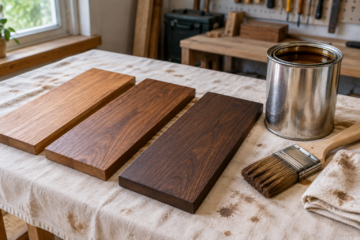
AI-generated editorial illustration of wood stain
Staining & Dyes

How to Apply Exterior Wood Stain in Cool, Damp Weather

Exterior wood stain can be applied in cool weather, but damp conditions narrow your margin for error. The finish may dry slowly, absorb unevenly, or remain soft long enough to collect dust and debris. The safest approach is to work with the weather, not against it: choose a penetrating stain, Read more

By , 2 weeksSeptember 25, 2026 ago
AI-generated editorial illustration of wood stain
Staining & Dyes

How to Blend a Stain Repair into an Existing Wood Finish

A stain repair is easiest to see when its color, sheen, or edge differs from the surrounding finish. The goal is not to cover the whole area with a darker stain. It is to identify which layer is damaged, match the existing color in small steps, and restore the protective Read more

By , 2 weeksSeptember 25, 2026 ago
AI-generated editorial illustration of wood stain
Staining & Dyes

How to Apply a Gel Stain Over an Existing Clear Finish

Gel stain can refresh a finished table, cabinet, or door without stripping it to bare wood—but it does not soak through a sound clear coat like ordinary penetrating stain. It colors the surface film, so adhesion and a thin, even application matter more than the wood species. The method works Read more

By , 2 weeksSeptember 25, 2026 ago
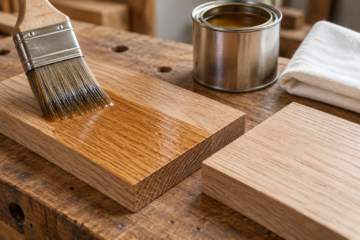
AI-generated editorial illustration: brush applying a clear wood finish to a board beside an unfinished offcut.
Staining & Dyes

How to Use Shellac as a Barrier Coat Before Staining

Shellac can separate a stain from wood or an existing finish, but it is not a universal stain-prep step. It is most useful for blocking resin or dye bleed, isolating an unknown surface, or sealing blotch-prone wood before applying a compatible stain. The catch: many stains need to soak into Read more

By , 2 weeksSeptember 25, 2026 ago
AI-generated editorial illustration of wood stain
Staining & Dyes

How to Create a Two-Tone Stain Finish on a Wood Panel

Plan the color break A two-tone stain finish uses two stain colors on one panel, usually separated by a straight line, a routed groove, or a change in grain direction. The cleanest results come from deciding the boundary before sanding or staining. Sketch the panel, mark the boundary, and test Read more

By , 2 weeksSeptember 25, 2026 ago
AI-generated editorial illustration of wood stain
Staining & Dyes

How to Apply Wood Dye Evenly Across a Large Panel

Large panels are harder to dye evenly than small parts because the wet edge has farther to travel, and a pause can leave a dark lap mark. The most reliable approach is to prepare the whole surface uniformly, work in manageable sections without stopping mid-panel, and judge color only after Read more

By , 2 weeksSeptember 25, 2026 ago
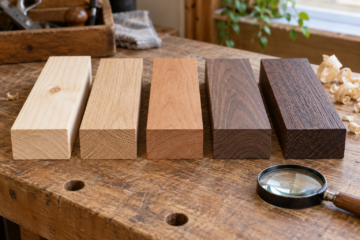
AI-generated editorial illustration: five wooden board samples showing different grain textures and colors.
Staining & Dyes

How to Pick a Wood Species for a Deep, Even Stain

Start with the finished look A deep stain is not the same as an even stain. Dark pigment can make pale sapwood, knots, and changing grain stand out more, not less. The easiest route to a consistent result is to choose wood with a fairly uniform color and pore structure, Read more

By , 2 weeksSeptember 25, 2026 ago
AI-generated editorial illustration of wood stain
Staining & Dyes

How to Compare Exterior Wood Stains for Sun Exposure

Sun exposure changes the right stain choice. A south- or west-facing deck can fade and dry out much faster than a shaded fence, and no stain stops weathering altogether. Compare products by the protection they offer, how they look on your wood, and how often you are willing to maintain Read more

By , 2 weeksSeptember 25, 2026 ago
AI-generated editorial illustration of wood stain
Staining & Dyes

How to Decide Whether to Use Wood Conditioner Before Staining

Wood conditioner is not an automatic step before staining. It is a tool for controlling uneven absorption, especially on blotch-prone softwoods. Used on the wrong project, it can make the stain lighter, reduce color depth, or add an unnecessary step. The right decision depends on the wood species, the stain Read more

By , 2 weeksSeptember 25, 2026 ago
AI-generated editorial illustration: five wooden board samples showing different grain textures and colors.
Staining & Dyes

How to Match Stain Color Across Different Wood Species

Matching stain across different wood species is possible, but the same stain rarely produces the same color on every board. Wood color, grain, density, and absorbency all affect the result. The reliable approach is to choose a target color, prepare each species consistently, and test the full finish schedule on Read more

By , 2 weeksSeptember 25, 2026 ago

Posts pagination

Previous 1 … 4 5 6 … 16 Next
Recent Posts
  • Best Woodworking Clamps: Which Types to Buy and How Many You Need
  • Best Pocket Hole Jigs in 2026: Kreg, Massca and Milescraft Compared
  • Best Dovetail Jigs: Fixed, Multi-Template and Variable-Spacing Options Explained
  • Best Compact Wood Routers: Corded vs Cordless Picks for Edge Work and Trimming
  • How to Repair a Wood Split Caused by a Screw (Even in Thin Teak)
Recent Comments
No comments to show.
Archives
  • October 2026
  • September 2026
Categories
  • Clear Coats & Topcoats
  • Finish Problems & Fixes
  • Gift Guides
  • Grain Filling & Sealing
  • Guides
  • Oils & Waxes
  • Painting & Priming
  • Sanding & Surface Prep
  • Shop Setup & Safety
  • Staining & Dyes
  • Tool Troubleshooting
  • Tools
  • Wood Finishing
  • Wood Species & Lumber
  • Woodworking Techniques
Hestia | Developed by ThemeIsle